What’s Actually Growing in Your Office Carpet — And How to Get Rid of It
A typical office carpet in Malaysia can harbour between 200,000 and 4 million bacteria per square inch — up to 4,000 times more germs than the average toilet seat. In our high-humidity tropical climate, that figure is not theoretical. It is a daily operational reality for every business in the Klang Valley, Penang, and beyond.
Book Office Carpet Cleaning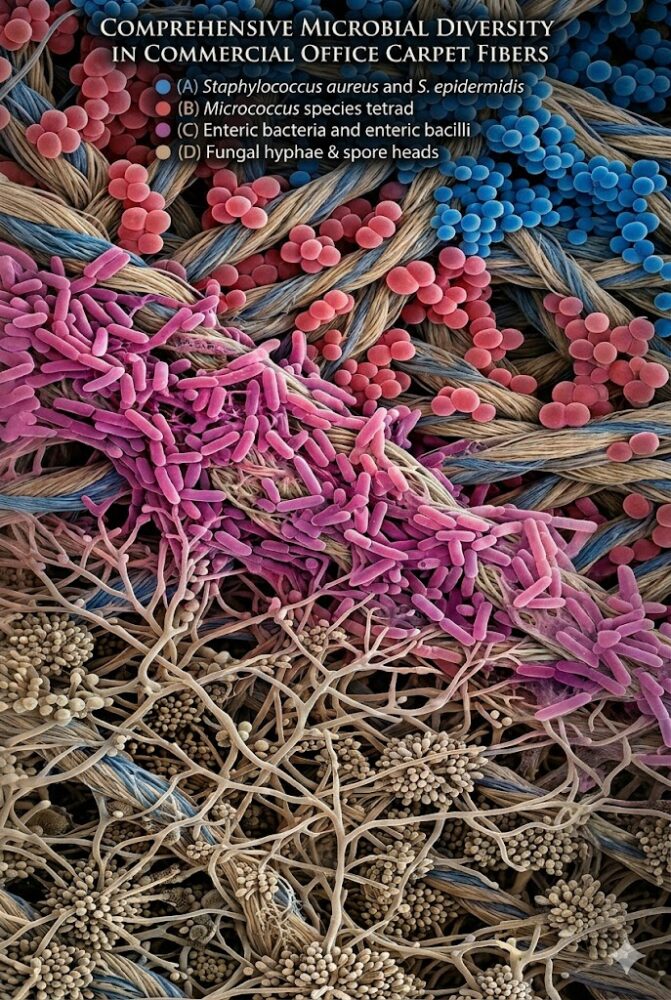
The short answer: A typical office carpet in Malaysia can harbour between 200,000 and 4 million bacteria per square inch — up to 4,000 times more germs than the average toilet seat. In our high-humidity tropical climate, where relative indoor humidity regularly exceeds 70–80%, the conditions inside a commercial carpet are functionally ideal for microbial proliferation.
What Is Actually Living Inside Your Office Carpet Right Now?
Office carpet is not a floor covering. It is a passive ecosystem. Every day, employees, clients, and delivery personnel track in biological and chemical material that accumulates in the carpet pile — layer by layer — with no visible sign of the contamination building beneath the surface.
Bacteria & Drug-Resistant Strains
Staphylococcus aureus, E. coli (survives up to 4 weeks in carpet), MRSA, and norovirus. In co-working spaces and clinics across KL, these are not theoretical — they are documented in peer-reviewed studies.
Dust Mites — Malaysia’s #1 Indoor Allergen
A single gram of carpet dust can contain 1,000 to 10,000 dust mites. Their faecal pellets — not the mites themselves — trigger asthma and rhinitis in the estimated 20–30% of Malaysians who suffer from allergic rhinitis.
Mould & Fungal Spores
Invisible to the naked eye until advanced. At 85% humidity — common in Malaysian buildings — mould spore germination drops to 24–48 hours. A single spill not professionally extracted will initiate a colony within two days.
Chemical Contaminants & VOCs
Pesticide residues, heavy metals from KL city pollution, and formaldehyde/benzene off-gassing from synthetic carpet tiles for up to 5 years after installation — all accelerated by Malaysia’s heat.
Bacteria (Including Drug-Resistant Strains)
- Staphylococcus aureus — a common skin bacterium that can cause infections if it enters a cut or reaches the eyes. Found on keyboards, door handles, and carpet fibres simultaneously.
- E. coli — tracked in from washrooms, food areas, and external footwear. Can survive in carpet fibres for up to four weeks.
- Methicillin-Resistant Staphylococcus aureus (MRSA) — detected in carpeted office environments in peer-reviewed studies. Particularly relevant in clinics, hospitals, and co-working spaces in KL.
- Norovirus and other pathogens — introduced during cold and gastro seasons; carpet acts as a reservoir for cross-contamination.
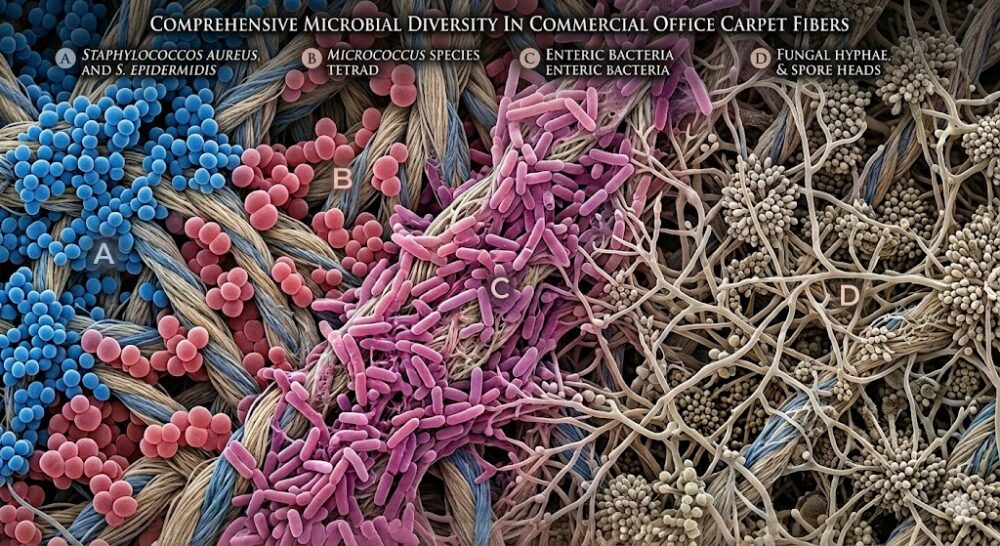 Bacteria colonies magnified — thriving in the warm, humid environment of a Malaysian office carpet pile.
Dust Mites: Malaysia’s Number One Indoor Allergen Threat
Malaysia’s year-round heat and humidity create optimal breeding conditions for the house dust mite (Dermatophagoides pteronyssinus). This species is the dominant allergen trigger for the estimated 20–30% of Malaysians who suffer from allergic rhinitis.
- A single gram of carpet dust can contain 1,000 to 10,000 dust mites.
- Dust mites feed on shed human skin cells (dander) — a resource continuously replenished in any occupied office.
- Their faecal pellets and body fragments — not the mites themselves — are the primary allergen trigger for asthma and rhinitis.
- Air-conditioning does not eliminate dust mites. Standard AC lowers temperature but does not reduce humidity sufficiently inside dense carpet pile to interrupt the mite life cycle.
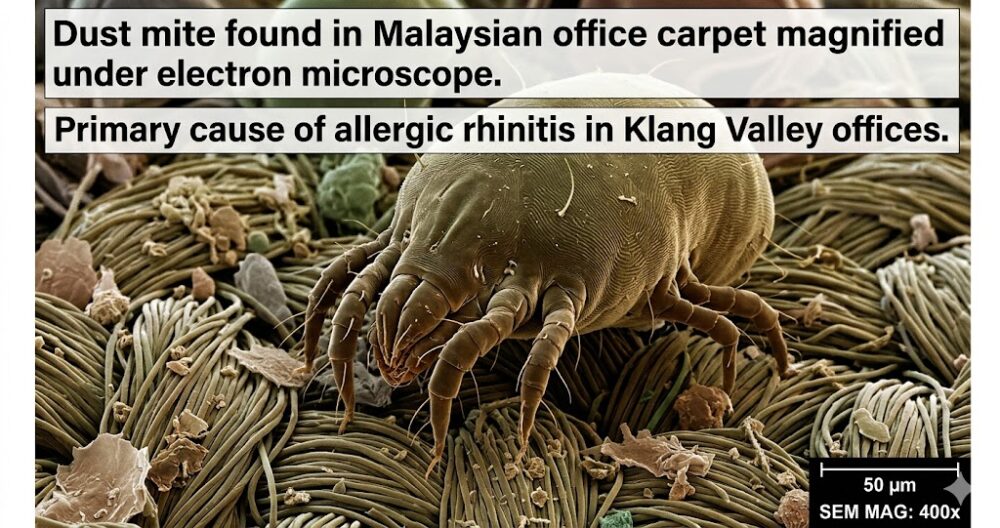 Dust mite magnified under electron microscope — the primary allergen trigger for rhinitis in Malaysian office environments.
Mould and Fungal Spores
This is the category most Malaysian facility managers underestimate. In a poorly ventilated office in Petaling Jaya, Subang Jaya, or Kuala Lumpur city centre, carpet near air-conditioning vents, pantry areas, or window edges is continuously subjected to condensation and moisture cycling. This creates conditions for mould colonies to establish within the carpet backing and underlay — completely invisible to the naked eye until the infestation is advanced.
| Mould Species | Health Risk | Primary Location in Office |
|---|---|---|
| Aspergillus niger | Respiratory irritation, hypersensitivity pneumonitis | Near AC vents, dark corners |
| Cladosporium spp. | Asthma trigger, skin irritation | Damp underlay, pantry areas |
| Stachybotrys chartarum | Severe respiratory toxicity (“toxic black mould”) | Persistently wet carpet areas |
| Penicillium spp. | Allergic reactions, sinusitis | Entire carpet surface |
⚠ Warning for Facility Managers: By the time you can smell a musty odour in your office, mould colonisation in the carpet is already extensive. Odour is a lagging indicator, not an early warning sign.
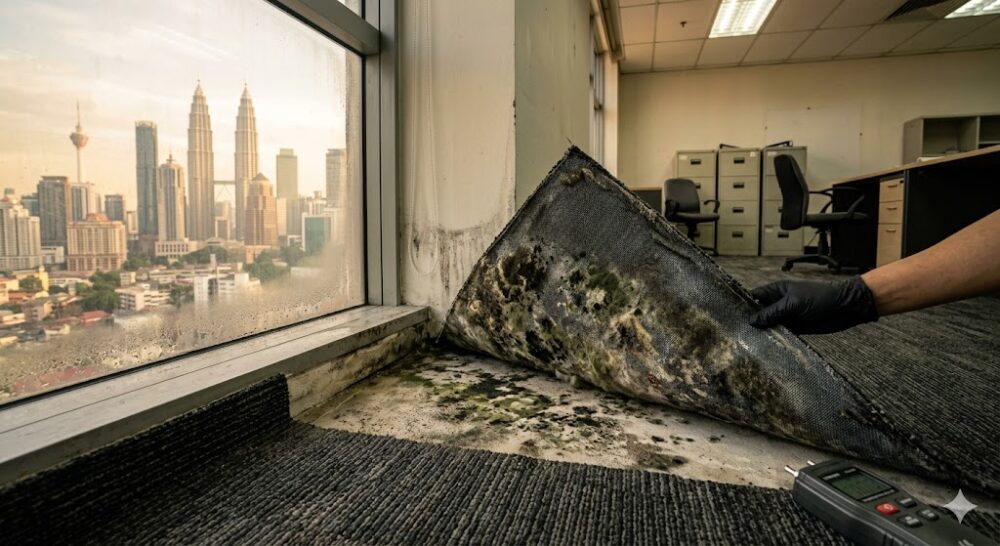 Mould colonisation visible on commercial carpet backing — a common but frequently overlooked hazard in KL office buildings.
Why Malaysian Office Carpets Are Uniquely High-Risk
Office carpets in Kuala Lumpur, Shah Alam, and the broader Klang Valley face a specific combination of stressors that does not apply in temperate climates:
Tropical Humidity Is a Biological Accelerant
At 85% relative humidity — a common figure in Malaysian buildings with underperforming AC systems — mould spore germination time drops from weeks to 24–48 hours. A single liquid spill not professionally extracted will initiate a mould colony within two days.
High-Density Occupancy in Commercial Towers
Modern open-plan offices in KLCC, Mont Kiara, Bangsar South, and Cyberjaya concentrate hundreds of workers per floor. Each person sheds approximately 1.5 million skin cells per hour. The bioload deposited per square metre is substantially higher than in lower-density environments.
The “Visual Clean” Illusion of Daily Vacuuming
Standard upright vacuums remove surface debris only. They do not extract sub-surface bacteria colonies, dust mite faecal pellets embedded in the carpet pile base, mould hyphae attached to carpet fibres, or oily chemical residues bonded to synthetic fibres. Daily vacuuming maintains the appearance of cleanliness — not the biological reality.
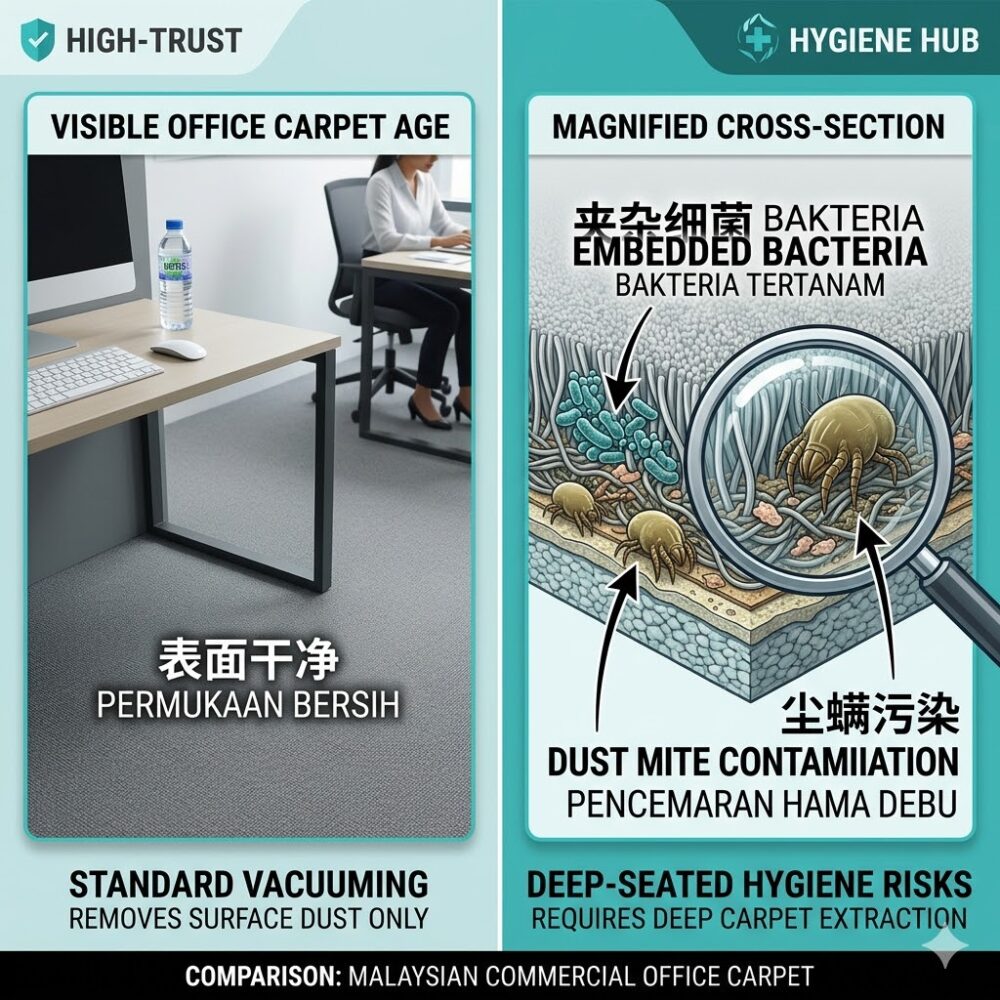 Surface appearance vs. biological reality: daily vacuuming does not address sub-surface contamination in Malaysian office carpets.
What the Research and Malaysian Health Authorities Actually Say
The Ministry of Health Malaysia (MOH) and the Department of Occupational Safety and Health (DOSH) have published Indoor Air Quality (IAQ) guidelines under the Industry Code of Practice on Indoor Air Quality 2010 (ICOP IAQ 2010).
ICOP IAQ 2010 establishes:
- A maximum acceptable concentration of 500 CFU/m³ for total fungi in commercial indoor air.
- Mandatory IAQ investigations where employees report recurring respiratory complaints.
- The responsibility of building owners and employers to maintain a safe indoor environment.
The implication is direct: If your office carpets have not been professionally deep-cleaned within the last 12 months, you are likely operating outside the spirit of ICOP IAQ 2010 — and your employees are breathing the evidence.
How to Actually Eliminate Carpet Contaminants (Not Just Mask Them)
This is where the distinction between cleaning and sanitising becomes critical.
Step 1: Hot Water Extraction (HWE) — The Clinical Standard
- Pre-treatment spray loosens bonded soiling and kills surface pathogens
- Hot water (typically 70–90°C) injected at high pressure into the carpet pile
- Simultaneous powerful suction extracts water along with dislodged contaminants, allergens, and moisture
- Drying time in a Malaysian office: typically 4–6 hours with adequate ventilation
- Categorically different from dry cleaning or bonnet cleaning — which only clean the top 20–30% of carpet fibre
Step 2: Targeted Mould Treatment (If Required)
- Where mould is suspected — particularly in offices near KL’s older commercial districts or buildings with known water ingress — HWE alone is insufficient
- A specialised antimicrobial treatment with an EPA-registered or MOH-approved fungicide must be applied to the carpet backing
- Product must be allowed to dwell before extraction
Step 3: Documented Cleaning Frequency Protocol
- Low traffic (<20 staff): Every 12 months
- Medium traffic (20–100 staff): Every 6 months
- High traffic (100+ staff, daily client footfall): Every 3–4 months
- Medical / Healthcare / Childcare premises: Every 1–2 months per MOH guidelines
 Professional HWE deep cleaning in a Kuala Lumpur office — the only method validated to remove sub-surface bacterial colonies, dust mite allergen, and mould spores.
What to Look for When Hiring a Commercial Carpet Cleaning Company in Malaysia
Not all carpet cleaning contractors operating in the Klang Valley deliver the same outcome. (For general office cleaning advice, refer to our office manager’s guide to hiring a cleaning company in PJ). When evaluating a carpet-specific vendor, demand the following:
✅ Must-Have Requirements
- Documented use of HWE equipment — ask for the machine make and model. Professional-grade truck-mounts or Prochem/Chemspec-equivalent portables only.
- Pre-treatment protocol — any contractor who vacuums and applies solution in one pass without a dwell period is not conducting a deep clean.
- DOSH-compliant or MOH-registered chemicals for healthcare and food-adjacent environments.
- Written service report documenting areas treated, chemicals used, and post-clean moisture readings.
- Liability insurance — essential for commercial environments.
- Verifiable reviews from Malaysian commercial clients — not generic Google reviews, but documented case studies.
Red Flags in the Malaysian Market
- Prices quoted below RM 0.30/sqft typically indicates diluted chemicals or skipped pre-treatment.
- No site inspection before quoting.
- Inability to name the active ingredients in their sanitising solution.
The Business Case: Carpet Hygiene as an Operational and Legal Obligation
Beyond employee health, there is a direct commercial and legal argument for proactive carpet maintenance in Malaysian offices:
Employee MC & Productivity
Multiple workplace health studies have correlated poor IAQ with increased sick leave. In Malaysia, the average MC costs a business not just the absent employee’s salary but productivity loss and team disruption.
Client Perception
In professional services, law firms, medical clinics, and financial advisory firms across KL, the physical environment communicates competence. Stained, odorous, or visibly dirty carpet is a client retention liability.
Landlord & Tenancy Obligations
Commercial tenancy agreements in Malaysian Grade A buildings frequently include carpet maintenance clauses. Failure to maintain carpets can result in dilapidation charges at lease expiry.
ESG & ISO 45001 Frameworks
Malaysian corporations pursuing ISO 45001 or GreenRE building certification must document IAQ management, of which carpet hygiene is a measurable component.
📅 Book Your Office Carpet Deep Clean in the Klang Valley
Whether you need a one-off deep clean or a scheduled maintenance programme, our vetted commercial carpet cleaning partners serve businesses across the Klang Valley with certified HWE equipment and written service reports from the very first session.
Tap your location to open WhatsApp — no forms, no waiting. Response within 2 business hours.
Hygiene Questions. 0
Questions from homeowners within and beyond Klang Valley, answered by our hygiene specialists.
─── MORE HYGIENE INSIGHTS
Keep Reading
Continue building your knowledge on maintaining a hygienically clean home in Malaysia’s tropical climate.