Why Your Klang Valley Condo Needs Weekly Cleaning Even When It ‘Looks Clean’
A visually clean Klang Valley condo is not a hygienically clean one. Malaysia’s tropical climate — averaging 80–90% relative humidity year-round — creates invisible threats including dust mite colonies, active mould spores, and off-gassing VOCs that no amount of surface wiping addresses.
Book a Cleaning Session Now
What Does “Clean” Actually Mean in a High-Humidity Malaysian Climate?
The short answer: A visually clean Klang Valley condo is not a hygienically clean one. Malaysia’s tropical climate — averaging 80–90% relative humidity year-round — creates invisible threats including dust mite colonies, active mould spores, and off-gassing VOCs that no amount of surface wiping addresses. Weekly professional-grade cleaning is not cosmetic maintenance. It is a clinical intervention.
“Looks clean” refers only to visible particulate matter — crumbs, dust, hair. In Malaysia’s climate, the real threats are biological and chemical, not visual.
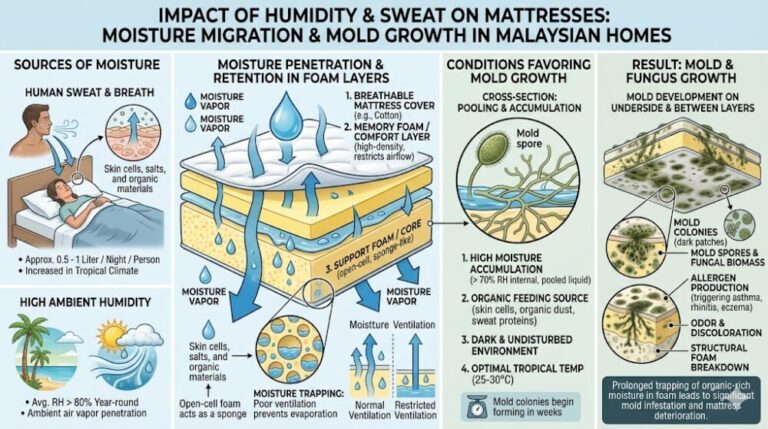
Klang Valley’s average relative humidity sits between 80% and 90% for most of the year. At humidity levels above 65%, three invisible contamination categories activate simultaneously inside your condo:
| Threat | Activation Humidity | Primary Location in Condo |
|---|---|---|
| Dust Mites | >65% RH | Mattresses, sofas, curtains |
| Mould & Mildew Spores | >70% RH | Grout, ceiling corners, A/C vents |
| VOCs (off-gassing) | Elevated by heat & humidity | Flat-pack furniture, carpets, paint |
💡 Key Insight: The World Health Organization (WHO) classifies indoor air quality as a significant public health concern. In hot-humid climates like Malaysia, indoor pollutant concentrations can be 2–5x higher than outdoor levels due to poor ventilation in sealed, air-conditioned condominiums.
 Microscopic view of a dust mite colony on fabric fibres — thriving in Malaysia’s high-humidity condo environments.
Why Dust Mites Are a Specific Klang Valley Problem
Dust mites thrive precisely in the conditions that define Malaysian urban living. A single gram of mattress dust can contain up to 19,000 dust mites and 250,000 allergenic faecal pellets.
The Condo-Specific Risk Factors
Landed properties have natural airflow advantages. Condominiums in PJ, Cheras, Mont Kiara, and KL City Centre do not.
- Sealed environments: Most condo units rely entirely on air-conditioning, which recirculates — rather than replaces — indoor air.
- High density of soft furnishings: Smaller condo square footage means sofas, mattresses, and curtains occupy a proportionally higher percentage of the living space.
- Limited sunlight penetration: High-rise units, particularly those facing north or in shaded towers, receive minimal direct UV light. Sunlight is a natural dust mite suppressant.
- Centralised HVAC systems: In older condos, shared A/C duct systems distribute particulate matter across units.
Dust Mite Allergy Symptoms Often Mistaken for “Sinus” in Malaysia
Malaysians disproportionately self-diagnose sinusitis when the true trigger is a dust mite infestation in their bedding. Symptoms include:
- Persistent morning sneezing upon waking
- Itchy, watery eyes with no outdoor trigger
- Nighttime nasal congestion that clears during the day (away from the mattress)
- Chronic dry cough in children (a key indicator flagged by the Malaysian Society of Allergy & Immunology)
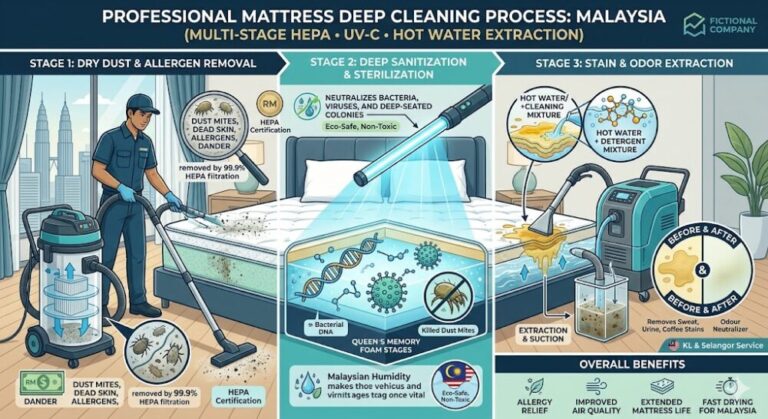
If these symptoms describe your household, the issue is not your sinuses — it is your mattress and sofa. The only corrective action is hot water extraction cleaning at temperatures above 60°C, which kills mites and denatures their allergens. You can schedule a professional deep cleaning service in Klang Valley that uses clinical-grade hot water extraction equipment.
 Dust mite lifecycle versus humidity levels — the higher the humidity, the faster the colony grows inside your mattress and sofa.
How Malaysian Weather Causes Mould Inside “Clean” Condos
Mould is not a sign of a dirty home. It is a sign of unmanaged moisture in a tropical climate.
In Klang Valley, mould growth is accelerated by:
- Monsoon seasons (October–March & May–August): Extended rainfall periods spike indoor humidity, particularly in units without dehumidifiers.
- Air-conditioning condensation: A/C units that are not serviced every 3 months accumulate moisture in their drip trays and coils — directly blowing mould spores into living spaces.
- Grout and silicone in bathrooms: These are the primary mould vectors. Once mould colonises bathroom grout, spores migrate through ventilation gaps into bedrooms.
- Condo construction materials: Many condominiums built in the 1990s–2010s used gypsum board (drywall) for internal partitions, which is highly mould-susceptible once moisture penetrates.
What “Weekly Cleaning” Actually Does for Mould Prevention
Surface wiping with standard household cleaners (including bleach) does not kill mould. It removes surface staining. The mycelium (root structure) remains active below the surface.
Effective mould management at the weekly level requires:
- Anti-fungal agents with a proven log-reduction efficacy (look for EPA or MOH-registered disinfectants)
- HEPA vacuuming of A/C filters and vents before spores disperse
- Hygrometer monitoring — maintain indoor humidity below 60% using an A/C or dehumidifier
 Mould growth on bathroom grout — once colonised, spores migrate through ventilation gaps into bedrooms and living areas.
What Are VOCs and Why Do They Build Up in Malaysian Condos?
Volatile Organic Compounds (VOCs) are gaseous chemicals emitted from building materials, furniture, cleaning products, and paints. They are odourless at low concentrations but accumulate to harmful levels in sealed, air-conditioned environments.
The Malaysian New-Condo VOC Problem
Malaysia’s booming property market means hundreds of thousands of households move into newly completed condominiums annually. New units are VOC hotspots because:
- Formaldehyde off-gasses from MDF furniture, laminate flooring, and plywood cabinetry — materials used extensively in developer-fitted Malaysian condos
- Benzene and toluene are emitted from new carpet adhesives and paint for 6–24 months post-completion. This is one of the surfaces most homeowners miss during post-renovation cleaning.
- Acetaldehyde is released from polyurethane-coated timber floors
The Department of Occupational Safety and Health Malaysia (DOSH) and the Ministry of Health (MOH) have identified IAQ (Indoor Air Quality) as a growing occupational and residential concern, with VOC accumulation specifically cited in sealed commercial and residential high-rises.
How Weekly Cleaning Reduces VOC Accumulation
- HEPA vacuuming removes VOC-laden dust particles that act as surface reservoirs
- Ventilating before and after cleaning — even opening windows for 15 minutes dilutes accumulated gases significantly
- Avoiding solvent-based cleaning products — many budget “multi-surface” cleaners sold in Malaysian hypermarkets (Giant, Aeon, Tesco) are themselves significant VOC sources
- Regular A/C coil cleaning — dust-coated A/C coils adsorb VOCs and release them back into the air when the unit is turned on
 New Malaysian condos are VOC hotspots — formaldehyde and benzene off-gas from MDF furniture and laminate flooring for up to 24 months.
Why a Maid Service Alone Is Not Enough: The Sofa and Mattress Gap
A standard maid or part-time cleaning service in Malaysia — typically priced between RM80–RM150 per session — is operationally designed for surface maintenance: mopping, wiping, bathroom scrubbing, and kitchen cleaning.
Maid services are structurally unable to address:
| What Maids Clean | What Requires Specialist Cleaning |
|---|---|
| Visible floor dust | Mattress interior (dust mites, dead skin, bodily fluids) |
| Surface sofa wipe-down | Deep sofa fabric (embedded allergens, pet dander, VOCs) |
| Bathroom surface mould | Grout-line mould (mycelium root penetration) |
| General floor mopping | Carpet fibre allergen extraction |
| Window ledges | A/C coil and drip tray mould |
This is not a criticism of maid services — it is a question of equipment and scope. A maid with a mop and a bottle of Dettol cannot replicate the function of an industrial hot water extraction machine operating at 90°C with 400 PSI pressure.
The Recommended Klang Valley Cleaning Cadence
For a typical 600–1,200 sqft condo in the Klang Valley:
- Weekly: General surface cleaning (maid/DIY)
- Every 3 months: Professional sofa deep cleaning to extract embedded allergens
- Every 6 months: Professional mattress deep cleaning using hot water extraction
- Every 3 months: Air-conditioning chemical wash (all indoor units)
- Annually: Full-unit disinfection and mould inspection
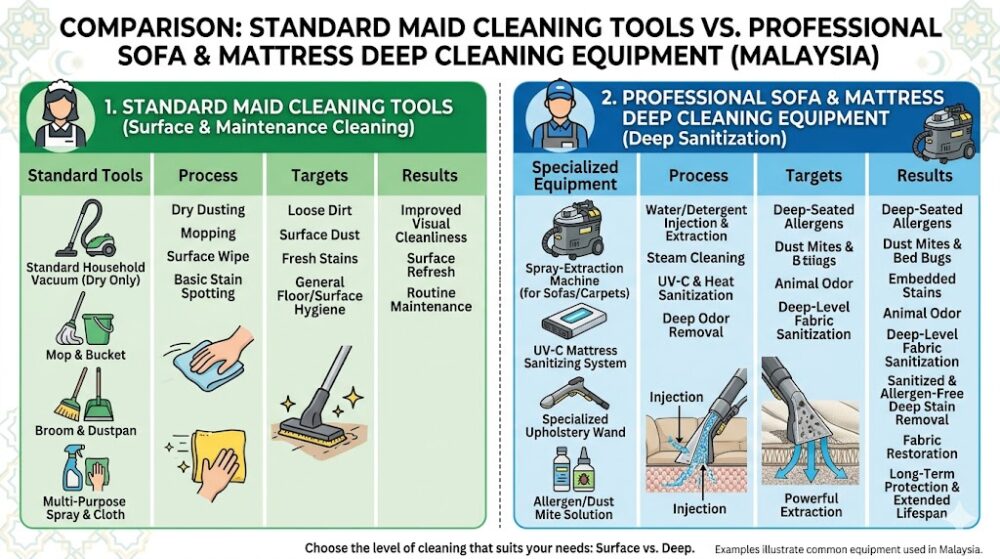 Standard mop and bucket vs. industrial hot water extraction machine — only specialist equipment can reach inside mattress fibres and sofa upholstery.
Frequently Asked Questions About Weekly Condo Cleaning in Malaysia
For standard Klang Valley condos, deep cleaning should occur at minimum every 3–6 months, with weekly surface maintenance in between. High-humidity units, homes with children under 12, elderly occupants, or allergy sufferers should schedule deep cleaning every 6–8 weeks.
Yes. Air-conditioning does not kill or deter dust mites. A/C units reduce ambient temperature but do not lower humidity at the micro-level inside mattress and sofa fibres — where mites live. The only effective eradication method is hot water extraction at temperatures above 60°C.
Professional sofa deep cleaning in Klang Valley typically ranges from RM80–RM250 depending on sofa size and fabric type (e.g., microfibre, leather, velvet). A standard 3-seater fabric sofa averages RM120–RM150. ServicePro.my partners are verified and priced transparently with no hidden charges.
Yes, particularly for children, the elderly, and those with asthma or suppressed immunity. The Ministry of Health Malaysia (MOH) classifies several mould species found in residential spaces — including Aspergillus and Stachybotrys (black mould) — as respiratory hazards. Professional remediation should be sought for any visible colony larger than 10cm².
The most effective approach is a combination of maintaining A/C at 24–26°C, using a portable dehumidifier in bedrooms and living areas, ensuring exhaust fans are functional in all bathrooms, and avoiding drying laundry indoors. Target an indoor relative humidity of 50–60% as measured by a hygrometer.
Yes. Short-term VOC exposure from new MDF furniture and flooring causes symptoms including headaches, eye irritation, and nausea — commonly reported by Malaysians moving into newly renovated or newly completed condos. Symptoms typically diminish after 6–12 months as off-gassing reduces. Accelerate this by maximising ventilation and using HEPA air purifiers.
No. Standard mopping with a wet mop addresses hard floor surfaces only and has zero impact on dust mites residing in soft furnishings. HEPA vacuuming of hard floors reduces airborne particulate, but mite eradication requires hot water extraction on the specific fabric item they inhabit.
Indicators of poor IAQ in a Malaysian condo include: persistent musty odour (mould), unexplained morning sneezing or congestion (dust mites), visible condensation on interior walls, A/C vents with black streaking (mould growth), and new-condo headaches (VOCs). A professional IAQ assessment can be conducted by DOSH-certified consultants.
📅 Book Your Part-Time Maid Service in Putra Heights & the Klang Valley
Whether you need weekly surface maintenance or a specialist deep clean, our vetted partners across Putra Heights and the Klang Valley deliver consistent, professional results from the very first session.
Tap your location to open WhatsApp — no forms, no waiting.
Hygiene Questions. 0
Questions from homeowners within and beyond Klang Valley, answered by our hygiene specialists.
─── MORE HYGIENE INSIGHTS
Keep Reading
Continue building your knowledge on maintaining a hygienically clean home in Malaysia’s tropical climate.