Why DIY Carpet Cleaning Usually Makes Odours Worse in Malaysia’s Climate
The science behind why your rented shampoo machine is creating a bigger problem than the stain you started with.
For homeowners and renters across the Klang Valley, Johor Bahru, and Penang, a spilled drink or a pet accident almost always triggers the same response: a rented shampoo machine, a can of foaming spray, and a confident scrubbing session. The outcome, however, is predictably the same — a sour, musty odour that is measurably worse than the original stain.
This is not a coincidence. It is a direct consequence of applying a cleaning method engineered for temperate climates to a textile sitting in one of the most humid environments on earth. Understanding the specific science behind this failure is the first step to protecting your carpet — and your indoor air quality — from permanent damage.
How Does Malaysia’s Year-Round Humidity Destroy a Wet Carpet From the Inside Out?
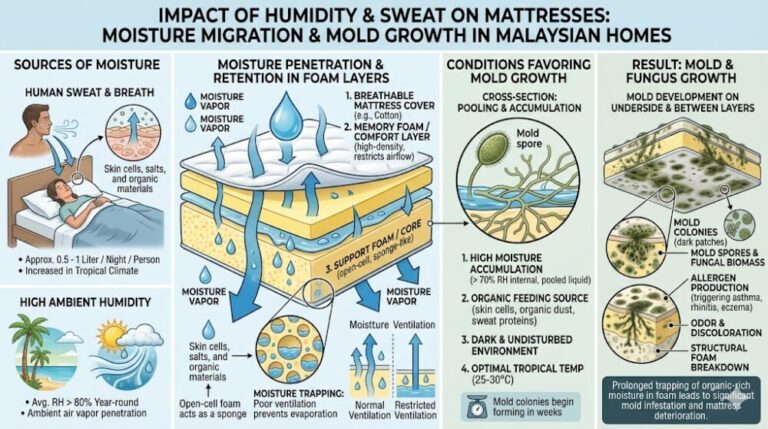
Malaysia’s average ambient relative humidity of 80% to 90% makes it nearly impossible for residual moisture in a carpet to evaporate naturally before biological degradation begins.
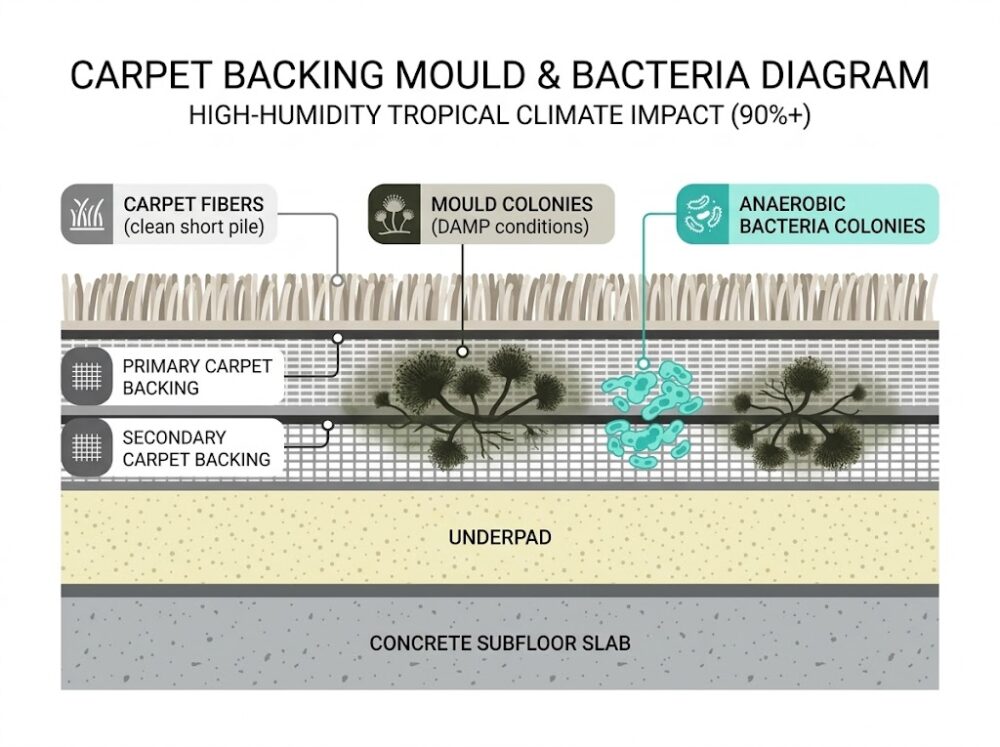
Unlike homes in temperate climates where a damp carpet might air-dry within 12 hours, a Malaysian home — whether a condominium in Mont Kiara or a terrace house in Shah Alam — provides bacteria with a perfect trifecta: sustained heat (28°C–32°C), near-saturated ambient air, and an organic nutrient source already embedded in the pile.
The biological timeline is unforgiving:
| Time After DIY Cleaning | What Is Happening Inside Your Carpet |
|---|---|
| 0 – 12 Hours | Water migrates past the face fibers and primary backing, soaking into the dense polyurethane or sponge-rubber underpad. Surface appears to dry. |
| 12 – 24 Hours | Ambient temperature activates dormant fungal spores and mesophilic bacteria in the damp pad. The underpad becomes oxygen-deprived. |
| 24 – 48 Hours | Anaerobic bacterial colonies establish themselves, metabolising trapped organic matter and releasing volatile organic compounds (VOCs) — the “sour” smell you detect. |
| 48 – 72 Hours | Mould mycelium begins to root into the backing fibers. At this stage, the contamination is structural, not superficial. |
| 72+ Hours | Secondary mould species take hold. Remediation may require partial or full carpet replacement in severe cases. |
The critical window to prevent permanent damage is fewer than eight hours — a timeline that DIY methods, by design, cannot meet.
What Are the Specific Reasons DIY Carpet Cleaning Fails in Tropical Conditions?
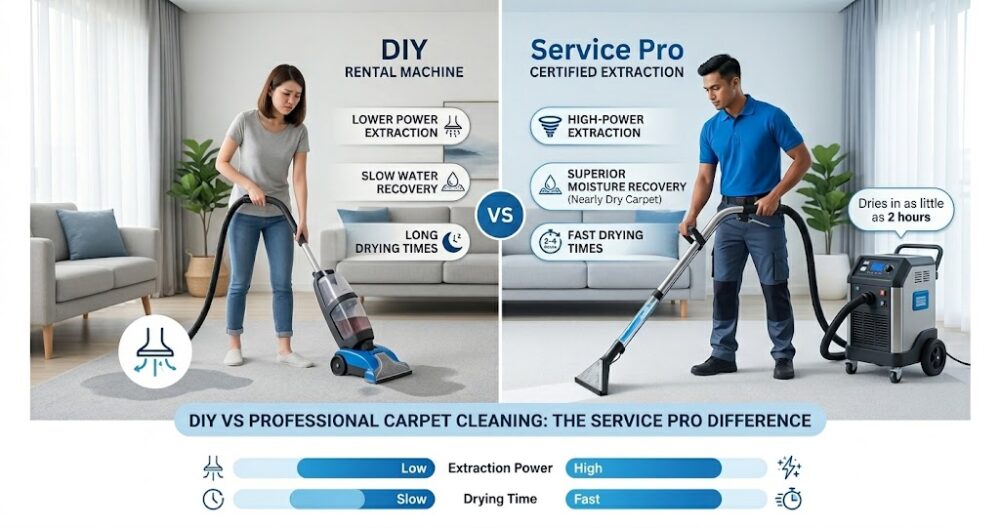
The primary failure point of all DIY carpet cleaning is the combination of over-saturation with dramatically insufficient extraction power, compounded by Malaysia’s inability to provide any natural drying assistance. (This is the exact same physical limitation that explains why steam cleaning often fails for mattresses in humid conditions). Consumer-grade rental machines and spray-foam products are manufactured to a price point, not a performance standard.
Over-Wetting the Substrate
Untrained users apply far more water than the machine’s weak suction can retrieve. In a Malaysian home with a thick underpad, this instantly soaks all three carpet layers and begins wicking into the concrete subfloor.
Alkaline Shampoo Residue
Standard retail carpet shampoos have a pH of 10–11. Without a professional acid-rinse neutralization step, this highly alkaline residue becomes a hygroscopic magnet — actively pulling moisture and particulates back in, day after day.
Inadequate Airflow
High-rise condominiums in KLCC, Bukit Jalil, or Cyberjaya typically have minimal natural cross-ventilation. Without commercial air movers, moisture simply redistributes into air that — at 85% humidity — has zero capacity to absorb it.
Masking vs. Removing Odours
Foaming sprays and deodorising powders temporarily suppress VOC perception only. They penetrate no deeper than the top 15–20% of the pile and leave no residual antimicrobial effect on bacteria colonising the backing.
Your Carpet Deserves a Deeper Clean
Stop masking the problem. ServicePro’s certified technicians use industrial-grade hot water extraction to physically remove odour sources — not just cover them up.
Book a Professional Carpet Deep Clean✓ Klang Valley · Johor Bahru · Penang | ✓ Vetted & Certified Technicians
Why Does the Sour “Wet Dog” Smell Return Days After a DIY Wash?
When water is introduced to a carpet that has not been deep-cleaned by professionals, you are not cleaning a surface — you are creating a nutrient broth for the bacteria already living below your feet.
The water dissolves and mobilises years of accumulated dead skin cells, dust mite fecal pellets containing the Der p 1 allergen, pet dander proteins, and food-based sugars — carrying all of this material down into the warm, dark, airless underpad. Anaerobic bacteria metabolise this rich substrate and excrete a cocktail of VOCs including putrescine, cadaverine, and various short-chain fatty acids: the exact compounds responsible for the smell.
Because the carpet surface may feel dry to the touch while the pad below remains fully saturated, homeowners are often genuinely baffled by an odour that seems to be coming from nowhere.
Does Malaysia’s Haze Season Make Carpet Odour Worse?
Yes. During Southwest Monsoon haze periods (typically June to September), the PM2.5 and PM10 particulate matter tracked by the Malaysian Meteorological Department (MetMalaysia) drawn indoors through ventilation systems deposits a thin, oily layer of carbonaceous particles into carpet fibers, dramatically accelerating bacterial adhesion and odour intensity.
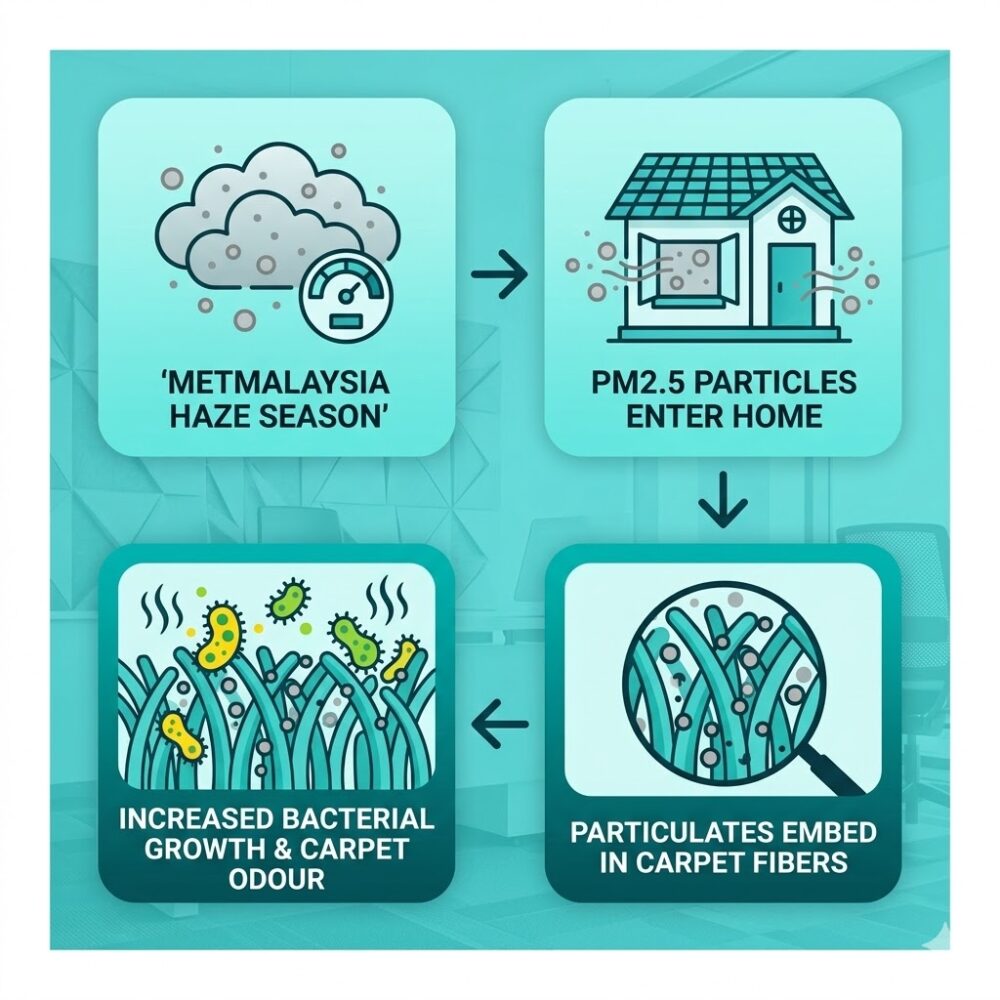
Haze particles are not simply dust — they are complex hydrocarbons, heavy metals, and biological fragments from peat fire combustion. When these settle into carpet pile, they provide an additional organic substrate for odour-causing bacteria. This is a uniquely Malaysian and Southeast Asian problem that generic online DIY cleaning advice completely fails to account for.
How Can You Permanently Remove Deep Mildew and Sour Odours from Carpet in Malaysia?
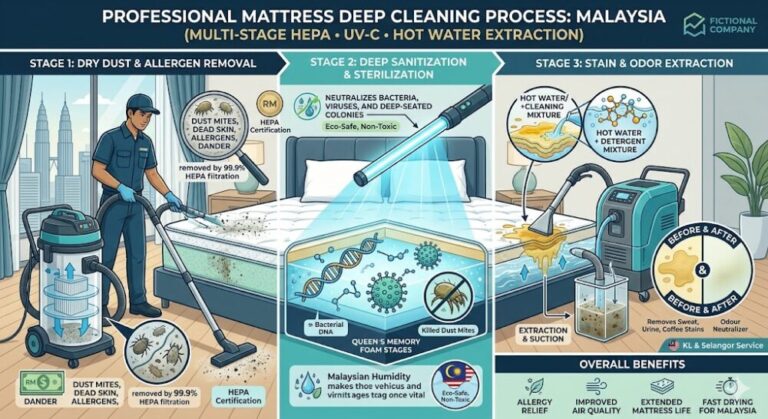
To permanently eliminate deep-set mildew odours from a Malaysian carpet, the contaminated moisture and the bacterial biofilm must be physically extracted using industrial-grade hot water extraction (HWE) — surface treatments will not suffice.
If a DIY cleaning attempt has already resulted in a persistent sour smell, the odour source is now biologically active in the backing or underpad, and no commercially available spray, powder, or consumer machine can reach it. The clinical remediation protocol involves a precise multi-stage process:
-
1
Pre-Inspection & Moisture Mapping
Technicians use calibrated moisture meters to determine the depth of saturation and identify hot spots before any water is introduced. No guesswork.
-
2
Enzymatic Pre-Treatment
Hospital-grade enzymatic solutions are applied with appropriate dwell time to biochemically break down bacterial biofilms and the organic substrate feeding them, converting them into water-soluble byproducts ready for extraction.
-
3
Hot Water Extraction (HWE)
Truck-mounted or high-CFM portable units inject water at 85°C–95°C into the pile while simultaneously extracting via negative pressure, recovering up to 95% of the injected moisture in a single pass. The heat denatures bacterial proteins and kills fungal spores.
-
4
Accelerated Drying with Air Movers
Commercial air movers are positioned to dry the carpet to a safe moisture level within hours — not days — eliminating the re-colonisation window that Malaysia’s humidity would otherwise guarantee.
Frequently Asked Questions
Ready to Permanently Eliminate Carpet Odours?
Don’t let Malaysia’s humidity turn a simple stain into a structural mould problem. Get a professional assessment and industrial HWE treatment from ServicePro’s vetted hygiene technicians.✓ No obligation · ✓ Free moisture assessment on-site · ✓ Serving KL, Selangor, JB & Penang
✓ No obligation · ✓ Free moisture assessment on-site · ✓ Serving KL, Selangor, JB & Penang
Hygiene Questions. 0
Questions from homeowners within and beyond Klang Valley, answered by our hygiene specialists.
─── MORE HYGIENE INSIGHTS
Keep Reading
Continue building your knowledge on maintaining a hygienically clean home in Malaysia’s tropical climate.