
160+
Countries Recognizing IGCSE
Age 16
Faster University Progression Runway
100%
English Assessment Medium
~RM900
Accessible Monthly Cambridge Tuition
1. The Core Dilemma: Why Malaysian Parents Are Re-Evaluating SPM vs IGCSE
Cambridge IGCSE and SPM differ fundamentally in five areas: assessment method (application-based vs rote), language of instruction (English vs Bahasa Malaysia), global recognition (160+ countries vs primarily Malaysia), graduation age (16 vs 17-18), and total cost. At value-tier schools like Axcel International School Puchong, Cambridge IGCSE tuition starts from ~RM900/month, often comparable to the hidden tuition costs of SPM schooling.
For decades, the standard educational roadmap for Malaysian children was clear: complete primary school, transition into a government secondary school (SMK), sit for the national Sijil Pelajaran Malaysia (SPM) at Form 5 (Age 17), and proceed to Matriculation, Form 6 (STPM), or private pre-university diplomas.
However, over the past decade—accelerated by the abolition of UPSR and PT3 assessments—thousands of urban Malaysian families in Selangor, Subang, and Puchong have re-examined this path. The central question is no longer just about passing exams, but about how children learn to think, communicate, and solve real-world problems in an AI-accelerated global economy.
This guide provides an objective, side-by-side analysis of the Cambridge Assessment International Education (CAIE) IGCSE qualification versus the Malaysian Ministry of Education (KPM) SPM certificate, helping you determine the ideal academic environment for your child’s personality and future goals.
2. Pedagogical Philosophy: Critical Thinking vs Rote Memorization
The fundamental divide between Cambridge IGCSE and SPM lies in their underlying pedagogical architecture:
- Cambridge IGCSE (Inquiry & Application): Syllabi are designed around conceptual mastery, experimental design, structured presentation, and cross-disciplinary critical thinking. Exam questions test unseen application problems where students must deduce answers from principles rather than regurgitating memorized textbook answers.
- SPM (Standardized National Rubric): Although the national KSSM curriculum has introduced KBAT (Higher Order Thinking Skills) questions, the examination ecosystem remains heavily formulaic. Success often hinges on matching specific keyword markers in strict marking schemes (skema jawapan), encouraging heavy after-school tuition and memorization.
In international schools like Axcel International School (Puchong Campus), this difference is amplified by smaller class sizes (15–25 students), enabling inquiry-based discussions, daily public pitching, and collaborative laboratory experiments that are impossible in crowded 40-student public school classrooms.
3. Side-by-Side Comparison: IGCSE vs SPM at a Glance
| Comparison Factor | Cambridge IGCSE | Malaysian SPM (KSSM) |
|---|---|---|
| Examination Body | Cambridge University Press & Assessment (UK) | Lembaga Peperiksaan Malaysia (MOE) |
| Primary Language | 100% English (First/Second Language available) | Bahasa Malaysia (compulsory passing subject) |
| Graduation Age | Age 16 (Year 11 completion in May/June or Oct/Nov) | Age 17–18 (Form 5 exams in Dec–March) |
| Global Recognition | 160+ countries (UK, US, Canada, Australia, Singapore) | Recognized in Commonwealth; often requires IELTS |
| Science Assessment | Theory, Multiple Choice & Practical Lab Paper | Written papers + school-based PEKA assessment |
| Tuition Cost Profile | Starting from ~RM900/month at Axcel Puchong | Free school fees; RM500–RM1,200/mo private tuition |
4. University Pathways & Global Mobility: 1-Year Fast Track
One of the most compelling advantages of the Cambridge IGCSE pathway is timeline efficiency. Because Cambridge IGCSE is completed at the end of Year 11 (age 16), students can begin pre-university studies (Cambridge A-Levels, Australian Matriculation, IB Diploma, or direct 1-year university foundation) a full year earlier than many SPM peers.
For students aspiring to enter top global institutions—such as Oxford, Cambridge, Imperial, National University of Singapore (NUS), Melbourne, or UCL—having official Cambridge IGCSE transcript grades (A* to C) provides an internationally standardized academic track record that admissions tutors readily benchmark.
5. Real Cost Analysis: Is International School Really Unaffordable?
A widespread misconception among Malaysian parents is that international school education is exclusively for the top 1% earning six-figure corporate salaries. While mega-campus international schools charging RM40,000 to RM80,000 per year do exist, boutique community-focused schools have revolutionized affordability.
Consider the hidden costs of national SPM schooling: many parents find themselves spending RM600 to RM1,500 per month on 5 to 7 external tuition subjects to compensate for large classes and inconsistent teaching standards, plus hours wasted in daily traffic shuttling between centers.
At Axcel International School Puchong, full-time Cambridge schooling starts from approximately ~RM900/month for primary and RM1,500 to RM1,700/month for secondary. Because tuition, science labs, co-curricular clubs, and life-skills training are integrated during the school day, the net cost difference is remarkably narrow—while delivering dramatically superior pastoral care and English fluency.
6. Why Puchong Families Choose Axcel’s Cambridge + Singapore Math Hybrid
Axcel International School does not simply replicate textbook Cambridge education. Under the visionary leadership of Principal Susan Koh, Axcel combines the best elements of Asian mathematical rigor with Western inquiry-based creativity:
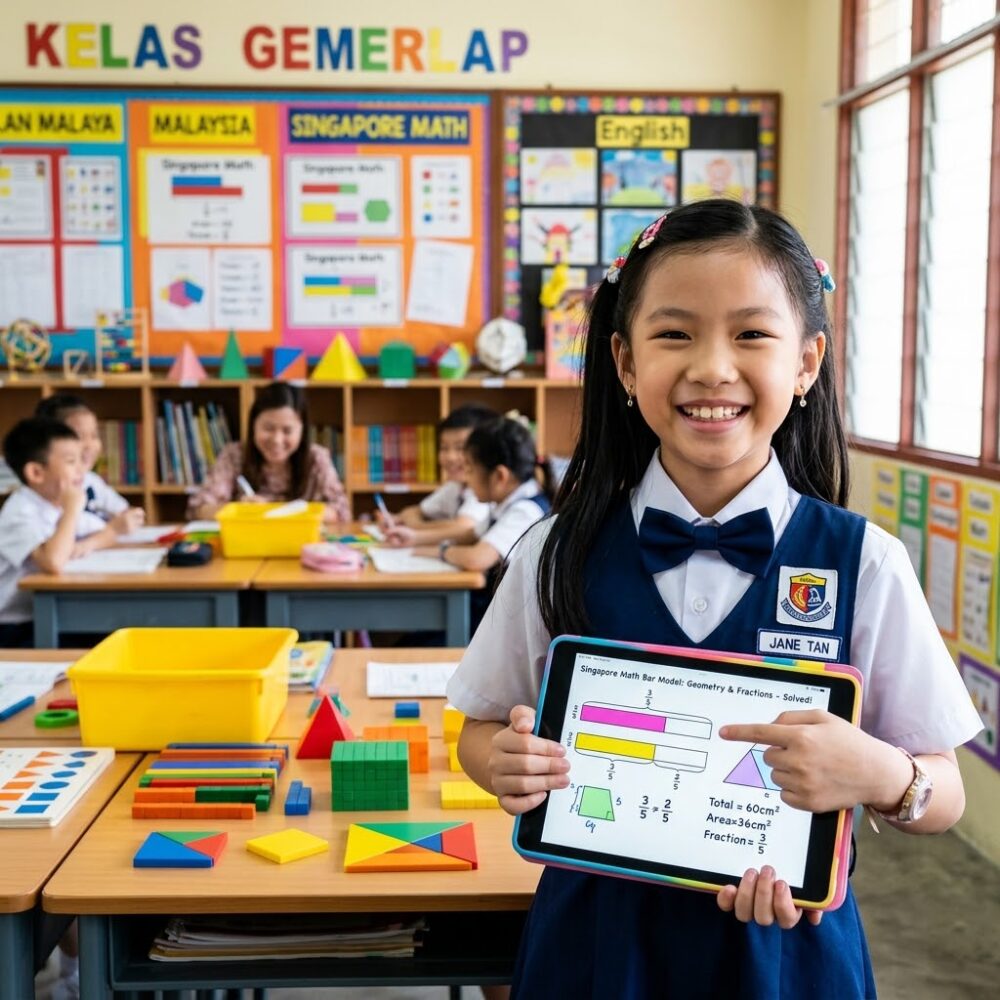
📐 Singapore Math CPA Model
Building concrete-to-abstract problem solving so students excel in international Math Olympiads (SASMO, Kangaroo Math).
💡 The Axcel Programme
Proprietary life-skills: Financial IQ, AI Prompting, Public Pitching, and TRIZ Innovation integrated into the weekly timetable.
👔 Industry Mentorship
Bi-weekly masterclasses with real corporate CEOs, tech founders, and doctors sharing career roadmaps with secondary students.
7. The Strategic Decision Checklist for Parents
Use this simple checklist to determine whether Cambridge IGCSE or SPM is the right fit for your family:
Choose Cambridge IGCSE if:
- You prioritize trilingual fluency with world-class English spoken and written mastery.
- Your child plans to study abroad or attend private/foreign branch universities in Malaysia.
- Your child thrives in interactive, small-group environments and dislikes rote memorization.
- You value practical future skills—like financial literacy and AI prompting—alongside textbook exams.
To explore our curriculum in detail, review our comprehensive the Cambridge and IGCSE curriculum in Puchong or schedule a private campus tour with our academic counselors.
Frequently Asked Questions: IGCSE vs SPM
Clear answers to common questions asked by Malaysian parents making secondary school decisions.
Cambridge IGCSE emphasizes conceptual understanding, application-based problem solving, and analytical essay writing in English, whereas SPM (Sijil Pelajaran Malaysia) follows the national KSSM curriculum with a heavier reliance on rote memorization, standardized marking rubrics, and Malay language assessment.
Direct entry into Malaysian public universities via UPU primarily requires SPM with credit in Bahasa Malaysia and History. However, IGCSE graduates can enter private universities locally (IPTS), branch campuses (e.g., Monash, Nottingham), or proceed to A-Levels/STPM/Foundation to enter public institutions later.
Cambridge IGCSE is globally recognized in over 160 countries. Because examinations are set and marked directly by Cambridge Assessment International Education in the UK, international universities and pre-university colleges offer seamless direct admission without requiring separate English language proficiency tests (like IELTS) if English First Language is achieved.
While government SPM education is virtually free, value-tier international schools like Axcel International School in Puchong have made Cambridge education accessible starting from ~RM900/month, eliminating the massive tuition expenses often incurred by SPM students outside regular school hours.
Yes. Many international school students sit for SPM Bahasa Malaysia (Julai paper) as private candidates if they wish to fulfill local civil service or professional board licensing requirements.
IGCSE students typically complete Year 11 at age 16 (in November or June exam series), allowing them to start university foundation or A-Levels several months earlier than SPM candidates whose national exams frequently stretch toward March of the following calendar year.
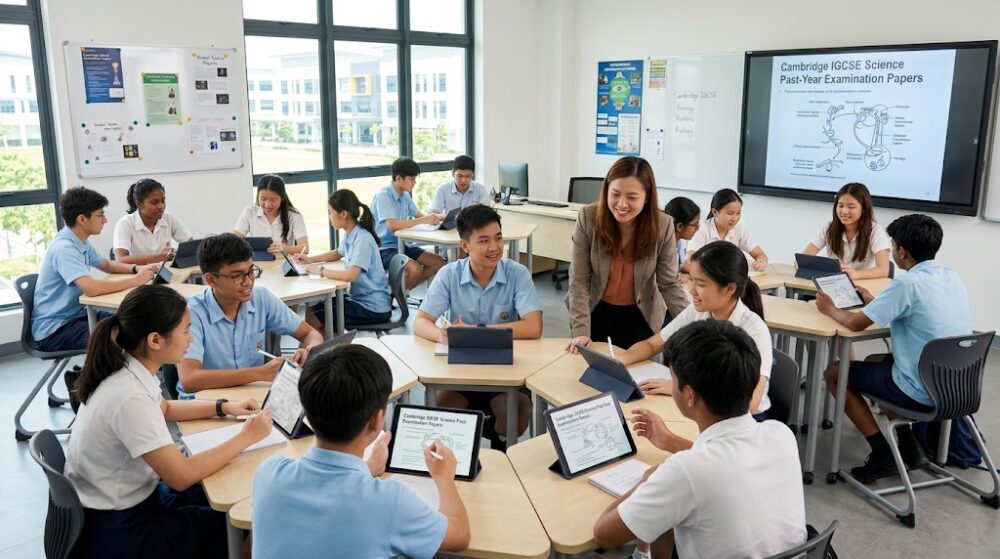
Cambridge IGCSE sciences (Biology, Chemistry, Physics) require hands-on laboratory practical examinations (Paper 5 or Paper 6 Alternative to Practical) testing experimental design, error analysis, and quantitative accuracy rather than theoretical recall.
Axcel blends rigorous Cambridge syllabi with Singapore Mathematics heuristics, the proprietary Axcel Programme (Financial IQ, AI Prompting, Pitching), small classes of 15–25 students, and affordable tuition starting from ~RM900/month.
Related Education & Curriculum Guides
Explore more research articles to help you make informed schooling decisions.


Looking for Cambridge Excellence in Puchong?
Explore Axcel International School‘s accredited Cambridge Primary & IGCSE Secondary curriculum, featuring Singapore Math heuristics, life-skills leadership, and starting tuition of ~RM900/month.
© 2026 Service Pro Education Insights Malaysia.
Disclaimer: Fees and curriculum details reflect 2026/2027 school schedules and may change. Images are representational; actual facilities may differ and no identifiable students are shown. Contact Axcel International School Puchong to verify current details.