How to Choose the Right Mobility Aid for Elderly Patients in Malaysia
The wrong mobility aid — used without proper physiotherapy guidance — does not reduce fall risk. It often increases it. This clinical guide helps Malaysian families make the right choice, with the right professional support.
Book Clinical Assessment Now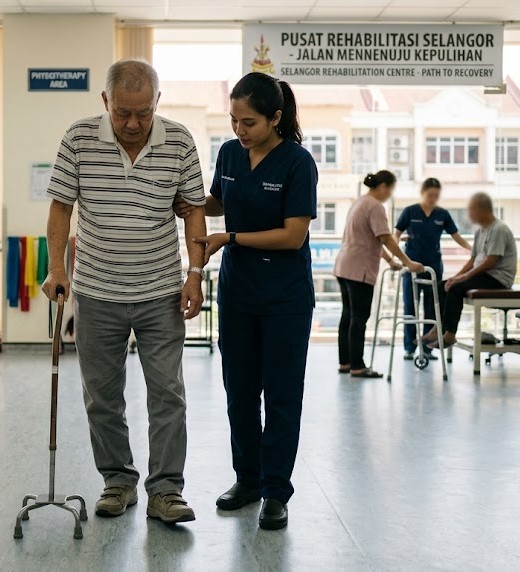
Watching a parent or grandparent lose their mobility is one of the most emotionally demanding transitions a Malaysian family will face. Whether it follows a stroke, a hip fracture, advancing osteoarthritis, or simply the cumulative decline of age, the question families ask is almost always the same: “What do we do next — and how do we choose the right aid?”
What Is a Mobility Aid and When Does an Elderly Person Actually Need One?
A mobility aid is any device that compensates for a loss of functional movement, balance, or weight-bearing capacity in the lower limbs — enabling safe, independent ambulation and reducing the risk of falls. In Malaysia, mobility aid need is most commonly triggered by one of four clinical events: ischaemic or haemorrhagic stroke, hip or knee replacement surgery, advanced osteoarthritis, or progressive neurological conditions such as Parkinson’s disease. For families observing broader functional changes beyond just gait, understanding how to recognise early signs of neurological decline in ageing parents across the Klang Valley is a critical step in preventing falls before they occur.
The decision to introduce a mobility aid should not be made by family members alone based on observation. A formal functional mobility assessment — conducted by a licensed physiotherapist or rehabilitation physician — is the medically appropriate starting point. Self-prescribing the wrong aid is a documented cause of secondary falls in elderly patients.
Key indicators that a formal mobility assessment is urgently needed:
- Recurrent near-falls or actual falls in the past three months
- Visible antalgic gait (limping caused by pain avoidance)
- Inability to stand from a seated position without arm support
- Fear of walking unassisted (a strong, independent predictor of future falls)
- Post-surgical discharge from a Malaysian public or private hospital with a physiotherapy referral letter
- Diagnosed neurological condition affecting balance or coordination
What Are the Main Types of Mobility Aids for Elderly Patients?
The main types of mobility aids for elderly patients are canes, crutches, walkers (Zimmer frames), rollators, and wheelchairs — each indicated for a specific level of functional impairment. There is no universal “best” device; the correct choice depends on the patient’s weight-bearing status, balance, upper limb strength, cognitive state, and the physical environment of the home.
Walking Canes
Clinical indication: Mild balance impairment, unilateral weakness, or early-stage joint pain with preserved weight-bearing capacity.
| Type | Best For | Key Feature |
|---|---|---|
| Single-point cane | Mild balance issues, fatigue during walking | Lightest; user must have good wrist stability |
| Quad cane (4-point) | Post-stroke hemiplegia, moderate balance deficits | Four contact points increase stability; does not move as fluidly |
| Offset cane | Users with wrist arthritis or reduced grip strength | Handle positioned over the shaft for better weight distribution |
Malaysian context: The quad cane is widely prescribed by government hospital physiotherapy departments (KKM) following stroke rehabilitation. It is available through Jabatan Kesihatan Daerah equipment loan schemes in some states, though wait times can be long.
Correct usage rule: A cane is always held on the opposite side to the affected or weaker limb. Many family members instinctively hand it to the “bad side” — this is clinically incorrect and increases mediolateral sway.
Forearm Crutches (Elbow Crutches)
Clinical indication: Partial weight-bearing post-fracture or post-surgery; conditions requiring more offloading than a cane provides but where full non-weight-bearing is not required.
Forearm crutches require significant upper limb strength and bilateral coordination. They are generally unsuitable for elderly patients over 70 unless the patient has high baseline fitness or has received extensive gait training from a physiotherapist.
Standard Walkers (Zimmer Frames)
Clinical indication: Moderate-to-severe bilateral lower limb weakness, significant balance impairment, or early post-surgical ambulation where maximum stability is required.
- Non-wheeled walker: Maximum stability; requires the user to lift the frame fully before advancing. Suitable for patients in early rehabilitation phases.
- Two-wheeled walker (front wheels only): Permits a more natural gait cadence; reduces upper body fatigue from lifting.
🏠 Malaysian home environment consideration: Standard walkers are problematic in older Malaysian terrace houses and apartments with narrow bathroom doorways (standard Malaysian door opening: 700–750 mm). A physiotherapist conducting a home environment assessment can flag these obstacles before discharge.
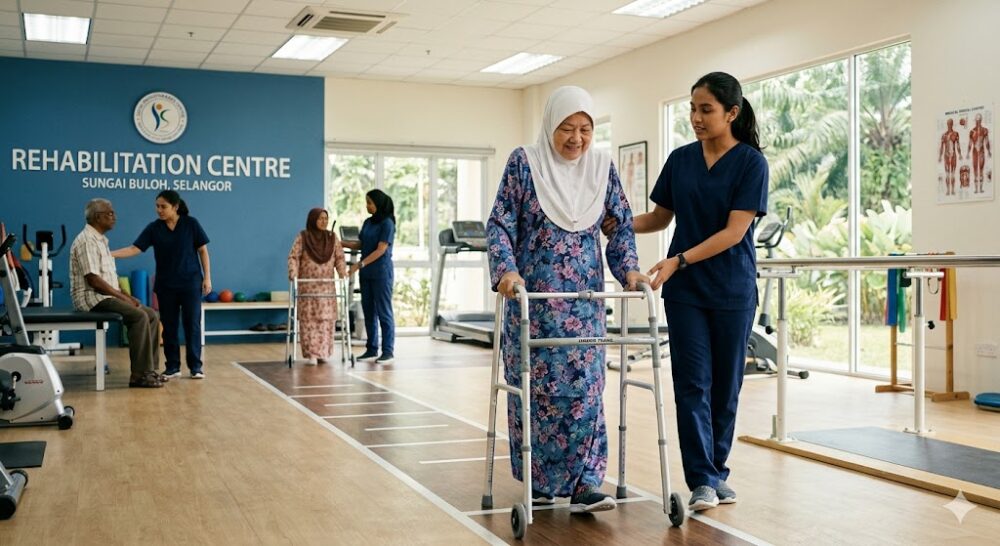 A licensed physiotherapist ensures correct height fitting and gait technique before the patient uses a walker at rehab centre.
Rollators (Four-Wheeled Walkers with Brakes)
Clinical indication: Patients with Parkinson’s disease, moderate balance deficits with good cognitive function, and those who fatigue easily but retain reasonable gait pattern. The built-in seat is a significant benefit for patients who need to rest frequently.
Critical caveat: Rollators are contraindicated in patients with significant cognitive impairment or dementia. Because the device rolls freely, a patient who leans forward suddenly — a common pattern in cognitive decline — can fall forward over the frame. This is a documented fall mechanism. A physiotherapist must screen for cognitive status before prescribing a rollator.
Wheelchairs
Clinical indication: Non-ambulatory patients, patients awaiting surgery, or those whose endurance is insufficient for any ambulation over functional distances.
| Feature | Manual Wheelchair | Electric Powered Wheelchair (EPW) |
|---|---|---|
| User requirement | Caregiver or strong upper limb function | Cognitive ability to operate joystick safely |
| Cost range (Malaysia) | RM 250 – RM 1,500 | RM 4,000 – RM 25,000+ |
| Maintenance | Low | Moderate to high (battery, electronics) |
| Best for | Transitional use, indoor + outdoor | Long-term primary mobility |
Government subsidy note: The Jabatan Kebajikan Masyarakat (JKM) offers assistive device subsidy programmes for eligible low-income Malaysians. A registered occupational therapist or social worker at a government hospital can facilitate the application.
Why Is Physiotherapy Assessment the Most Important First Step Before Buying a Mobility Aid?
Physiotherapy assessment is the most important first step because the wrong mobility aid — used without proper gait training — does not reduce fall risk; it often increases it. A licensed physiotherapist evaluates the patient’s gait pattern, strength, balance, range of motion, and home environment before prescribing a device, and then trains the patient to use it correctly.
Many Malaysian families purchase a mobility aid from a pharmacy or online marketplace based on a general description of the patient’s condition. This approach has three documented clinical risks:
Risk 1: Incorrect Device Selection
A patient with Parkinson’s festination gait may be given a standard walker when a rollator with a laser line attachment (to cue step initiation) is clinically superior.
Risk 2: No Fitting Calibration
A cane or walker that is the wrong height increases lumbar flexion, alters gait mechanics, and accelerates joint degeneration.
Risk 3: No Gait Training
Knowing how to use an aid correctly requires instruction. A patient who uses a quad cane in the wrong hand is more unstable than a patient who uses no aid at all.
What a physiotherapy rehabilitation assessment includes:
Berg Balance Scale (BBS)
Standardised fall risk quantification using a validated clinical scoring system.
Timed Up and Go (TUG) Test
Functional mobility screening measuring the time to rise, walk 3 metres, turn, and return to seated.
Manual Muscle Testing (MMT)
Identifies specific muscle group deficits affecting gait, balance, and weight-bearing capacity.
Gait Analysis
Assessment of stride length, cadence, step symmetry and abnormal compensatory movement patterns.
Home Environment Risk Audit
Floor surfaces, bathroom configuration, stair access — all systematically assessed before discharge home.
Caregiver Education
Teaches family members correct transfer and guarding techniques to prevent secondary falls.
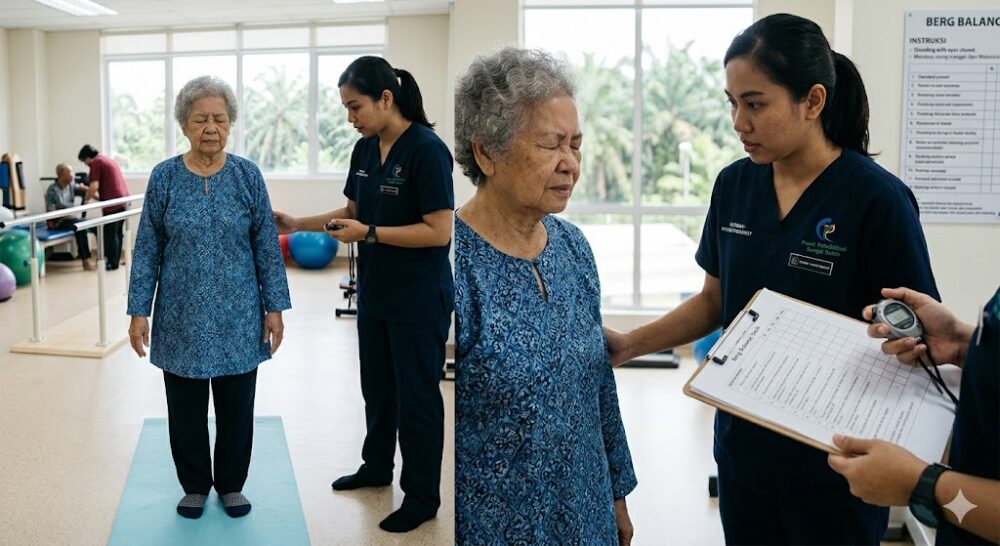 The Berg Balance Scale is a validated 14-item clinical tool used to quantify fall risk in elderly patients before prescribing a mobility aid.
How Are Malaysian Families Managing Elderly Mobility Care — and What Are They Getting Wrong?
Malaysian families managing elderly mobility care most commonly struggle with three patterns: over-reliance on informal caregiving without professional guidance, delayed rehabilitation following acute medical events, and underestimating the home environment’s role in fall risk.
The Cultural Context
In Malaysian Chinese, Malay, and Indian families alike, the default instinct is to manage an elderly parent’s mobility needs within the family unit — a deeply rooted expression of filial piety. Hiring an external caregiver or engaging a professional rehabilitation service can feel like an admission of inadequacy, or worse, abandonment.
This cultural dynamic, while understandable, creates measurable clinical harm. Malaysian Ministry of Health (MOH) data consistently shows that falls among the elderly are the leading cause of injury-related hospitalisation in patients over 60 — and a significant proportion of those falls occur in the home, often while using improperly selected or fitted mobility aids, or while being transferred by an untrained family caregiver.
The “Wait and See” Problem
Many families observe declining mobility in an elderly parent but attribute it to normal ageing and delay seeking a formal assessment. In post-stroke or post-fracture patients, the 90-day window following the acute event is the period of maximum neuroplasticity and rehabilitation potential. Every week of delayed physiotherapy is a measurable reduction in functional recovery ceiling.
What Families Should Actually Do
- Request a physiotherapy referral at hospital discharge — insist on a written plan, not just verbal advice.
- Engage a community or outpatient physiotherapist within two weeks of returning home.
- Do not rearrange furniture without professional guidance — well-intentioned home modifications can introduce new hazards.
- Attend the physiotherapy sessions as a family member, not just the patient. Caregiver competency is part of the rehabilitation programme.
- Set functional goals, not just safety goals — the objective is not to prevent the patient from walking; it is to restore as much independent function as possible.
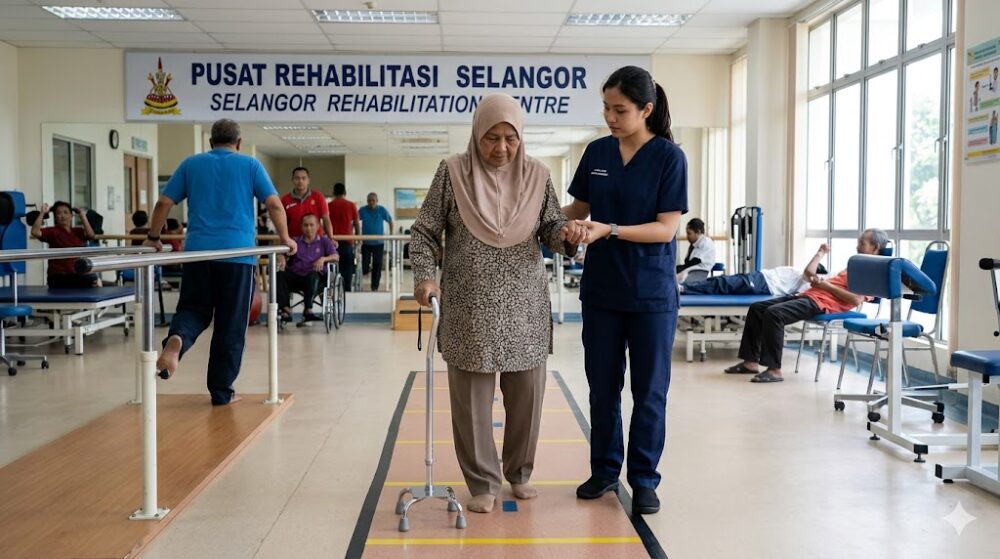
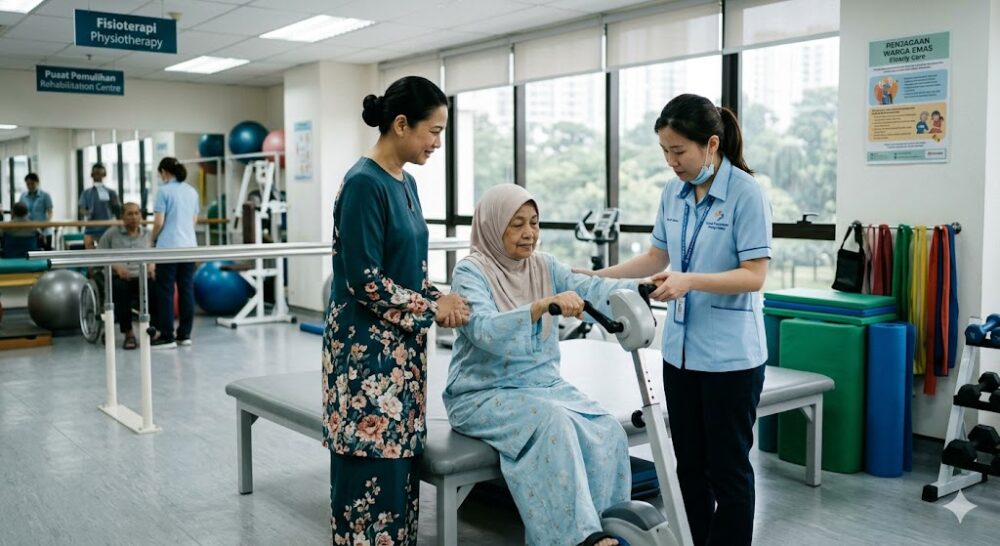 Family involvement in physiotherapy sessions is a documented factor in better rehabilitation outcomes for elderly patients in Malaysia.
What Is the Correct Way to Size and Fit a Mobility Aid for an Elderly Person?
The correct fitting method depends on the device type, but the universal principle is that a mobility aid should allow the user to maintain an upright posture with a slight elbow bend (approximately 15–20 degrees) and relaxed shoulders — not a hunched, weight-bearing posture.
Cane and Walker Height Fitting Protocol
- Patient stands in bare feet (or with the footwear they will habitually wear).
- Arms hang relaxed at sides.
- The top of the cane or walker handle should align with the wrist crease (ulnar styloid process).
- When gripping the handle, the elbow should flex at approximately 15–20 degrees.
- Shoulders should remain level — if one shoulder is elevated, the aid is too short on that side.
Critical error to avoid: A walker that is too low forces the patient into a stooped posture, dramatically increasing lumbar load and making forward falls more likely. A walker that is too high forces the user onto their toes.
Wheelchair Fitting Principles
- Seat depth: 2–3 cm clearance between the front edge of the seat and the back of the knee.
- Seat width: 2–3 cm clearance on each side of the hips.
- Footrest height: Thighs should be parallel to the floor; no pressure under the thighs from a raised footrest.
- Back height: Supports the lumbar spine without interfering with shoulder movement for self-propulsion.
All of these measurements should be taken and verified by an occupational therapist or physiotherapist, not estimated from a size chart.
Mobility Aid Comparison Table: Matching the Device to the Patient’s Condition
Use this clinical reference table to understand which aid is most appropriate for each common elderly patient profile seen in Malaysian rehabilitation settings.
| Patient Condition | Recommended Aid | Contraindicated Aid | Physiotherapy Priority |
|---|---|---|---|
| Post-stroke (mild hemiplegia) | Quad cane | Standard walker (initial phase) | Gait re-education, spasticity management |
| Post-hip replacement | Walking frame → cane (progressive) | Rollator (early phase) | Weight-bearing progression |
| Parkinson’s disease (moderate) | Rollator with forearm support | Non-wheeled walker | Freezing of gait strategies, cueing |
| Advanced osteoarthritis (bilateral) | Two-wheeled walker | Single-point cane | Pain management, strengthening |
| Post-knee replacement | Crutches → cane (progressive) | Wheelchair (unless non-WB) | ROM restoration, quadriceps activation |
| Severe cardiac/pulmonary limitation | Rollator (seated rest function) | Manual wheelchair (insufficient exertion) | Pacing and energy conservation |
| Cognitive decline (moderate) | Standard walker (caregiver-assisted) | Rollator | Caregiver training, environmental simplification |
Frequently Asked Questions About Choosing Mobility Aids for Elderly Patients in Malaysia
Mobility aid costs in Malaysia range from approximately RM 40 for a basic single-point cane to RM 25,000 or more for a powered electric wheelchair. Standard aluminium walkers (Zimmer frames) typically cost between RM 80 and RM 250 at pharmacies like Caring Pharmacy or Guardian. Rollators range from RM 200 to RM 600 depending on build quality. For low-income families, the Jabatan Kebajikan Masyarakat (JKM) offers assistive device subsidies for eligible recipients — your hospital social worker can assist with the application.
Technically yes, but it is clinically inadvisable. Purchasing a mobility aid without a physiotherapy assessment means you may select the wrong device type, fit it to the wrong height, and the patient receives no gait training on how to use it correctly. All three errors are documented independent contributors to falls in elderly patients. At minimum, request a single physiotherapy consultation before or immediately after purchase.
Free or subsidised mobility aids are available through several channels in Malaysia. The JKM assistive device programme provides equipment to registered OKU (Orang Kurang Upaya) recipients. Government hospital physiotherapy departments may provide equipment on temporary loan following inpatient rehabilitation. The MySalam and PeduLi Sihat schemes cover certain rehabilitation services for eligible Malaysians. Eligibility criteria and availability vary by state — check with your nearest Pejabat Kebajikan Masyarakat Daerah.
A walker (Zimmer frame) has no wheels and requires the user to lift and advance the frame with each step, providing maximum stability. A rollator has four wheels and brakes and rolls freely, enabling a more natural walking pattern and offering a built-in seat for rest. Walkers are generally preferred for early rehabilitation phases and patients with severe balance impairment; rollators suit patients with better balance who have chronic endurance limitations. Rollators are contraindicated in patients with moderate-to-severe cognitive decline due to forward fall risk.
The correct device depends on your parent’s weight-bearing status, balance, upper limb strength, and the specific medical diagnosis — not on their age alone. A physiotherapist uses validated clinical tools including the Berg Balance Scale and Timed Up and Go test to quantify fall risk and functional mobility, then recommends the appropriate device. General rule: canes suit mild impairment; walkers suit moderate impairment; wheelchairs are for non-ambulatory or very low endurance patients.
Many Malaysian private health insurance policies cover physiotherapy sessions when linked to a hospitalisation claim or a specialist referral. Panel coverage and session limits vary significantly between providers (e.g., Prudential, AIA, Great Eastern, Allianz). Standalone outpatient physiotherapy without a referral may not be covered. Check your policy schedule for “rehabilitation benefit” or “physiotherapy benefit” clauses. Some employers’ group health plans extend coverage to dependants including elderly parents.
The highest-risk fall hazards in Malaysian homes include: wet bathroom tiles without non-slip treatment or grab bars (the single most common fall location), polished marble or ceramic floors in the living area, raised door thresholds common in older terrace houses, low-level platforms and steps at the entrance (particularly in older Malay and Chinese terraced units), inadequate lighting in corridors, and unsecured floor mats or prayer rugs. A physiotherapist or occupational therapist conducting a home assessment can systematically identify and prioritise these hazards.
There is no fixed age threshold — the trigger is functional decline, not chronological age. However, Malaysian geriatric medicine guidelines recommend proactive physiotherapy engagement from age 65 onwards for anyone with two or more risk factors: recurrent falls history, osteoporosis diagnosis, cardiovascular condition, neurological diagnosis, or chronic pain affecting gait. Early physiotherapy intervention preserves muscle mass, improves balance, and significantly delays the point at which a mobility aid becomes necessary.
📅 Book Your Mobility Assessment in the Klang Valley
Whether you are navigating post-stroke recovery, post-surgical rehabilitation, or age-related mobility decline, our vetted physiotherapy partners in Sungai Buloh and the Klang Valley provide clinical assessment, mobility aid prescription, and caregiver education from the very first session.
Tap your location to open WhatsApp — no forms, no waiting.
The information in this article is intended for general educational purposes and does not constitute medical advice. Always consult a clinician registered with the Malaysian Medical Council (MMC) or a physiotherapist registered with the Malaysian Physiotherapy Association (MPA) for a diagnosis and personalised treatment plan. ServicePro.my connects Malaysians with vetted, verified healthcare and home service professionals across the Klang Valley and beyond.
Healthcare Questions. 0
Questions from our followers and readers within and beyond Klang Valley, answered by our healthcare specialists.
─── MORE HEALTHCARE INSIGHTS
Keep Reading
Continue building your knowledge on maintaining a healthy community in Malaysia.