
💰 Financial IQ • Street-Smart Leadership

Financial Literacy for Kids: Why Money Habits Must Start in Primary School

How interactive budgeting, investing simulations, and commerce projects build smart financial mindsets from only ~RM900/month in Puchong.

Financial Literacy for Kids: Why Money Habits Must Start in Primary School

Year 3

Early Financial Education Start

100%

Practical Budgeting Projects

Compound IQ

Interest & Investment Logic

~RM900

Starting Monthly Tuition
Financial Literacy for Kids: Why Money Habits Must Start in Primary School

1. The Great Blindspot in Modern Education: Money Management

Financial literacy is taught as a formal timetabled subject at Axcel International School Puchong through the proprietary Axcel Programme, covering saving, investing, hire-purchase mathematics, and entrepreneurial thinking from primary through secondary levels. Unlike enrichment add-ons, this Financial Intelligence curriculum runs weekly alongside Cambridge core subjects.

Traditional schooling teaches advanced calculus, chemical equations, and medieval history, yet rarely equips young adults with fundamental financial survival skills: how compound interest works, how credit card debt accumulates, how inflation erodes savings, and how to create a profitable business budget. As cashless transactions and e-wallets make spending invisible, teaching financial literacy from primary school has become essential. For authoritative benchmarks, consult the official OECD Financial Education in Schools Guidelines.


2. The Psychology of Money: Habits Form Before Age 7

Cambridge University research shows that money habits—delayed gratification, value perception, and saving routines—are formed by age 7. Children who learn the difference between ‘needs’ and ‘wants’ early grow into financially prudent adults who avoid impulse consumption and lifestyle inflation.


3. Primary Level Financial IQ: Earn, Save, Spend, Donate

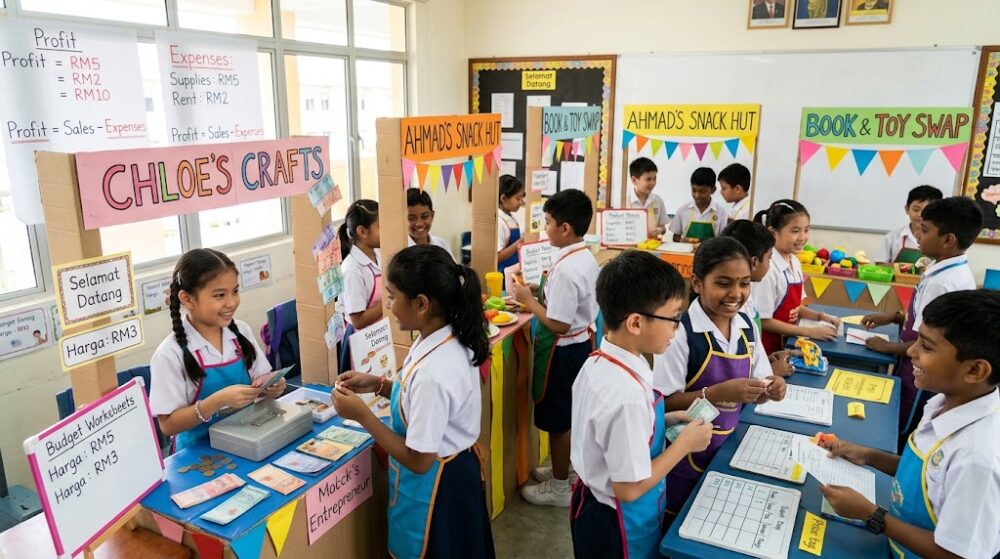
At Axcel International School Puchong, Financial IQ is integrated directly into the weekly timetable starting in primary years. Students participate in classroom token economies, earning credits through effort, budgeting for school privileges, and managing simulated savings accounts with interest incentives.


4. Secondary Level Mastery: Investing, Compound Interest & Entrepreneurship

Secondary students advance into real-world commercial simulations: calculating annual percentage yields (APY), analyzing business cash flow statements, understanding stock market diversification, and evaluating startup unit economics. Students pitch viable micro-business ideas in annual entrepreneurship showcases.


5. Avoiding the Debt Trap: Credit Literacy in a Digital World

With the rise of Buy-Now-Pay-Later (BNPL) schemes and aggressive digital marketing, teenagers face unprecedented financial temptations. Our curriculum deconstructs the mechanics of consumer credit, teaching students how interest compounding can work for them through investing or against them through revolving debt.


6. How The Axcel Programme Pioneers Practical Life Skills

Financial IQ is one of four core pillars in The Axcel Programme (alongside Pitching, AI Prompting, and TRIZ Innovation). By combining academic excellence with street-smart financial acumen, Axcel graduates possess the practical judgment needed to build, preserve, and grow wealth in their adult careers.


7. Actionable Ways Parents Can Reinforce Financial IQ at Home

Parents can build healthy financial habits at home by: (1) Giving an allowance tied to budgeting responsibilities rather than chore-bribery; (2) Involving children in utility bill and grocery planning; (3) Opening a custodial investment account to demonstrate compound dividend growth.

Jan-2027 Academic Checkpoints Open

Give Your Child the Academic Advantage at Axcel Puchong

Assess your child’s academic readiness and lock in the 50% Application Fee Waiver for early Jan-2027 admissions. Small classes guarantee personalized teacher attention.

Curriculum FAQs

Frequently Asked Questions

Clear answers to common questions asked by Malaysian parents.

Why should children learn financial literacy at primary school age?

Habits of delayed gratification and value perception are established before age 7. Early education prevents reckless consumer spending and debt traps in adulthood.

How does Axcel teach financial literacy without making it boring?

We use interactive gamified commerce simulations, classroom token economies, mock stock portfolios, and real student entrepreneurship markets.

Is Financial IQ a compulsory part of the curriculum at Axcel Puchong?

Yes. Financial IQ is a timetable-integrated pillar of The Axcel Programme taken by all primary and secondary students.

Do students learn about digital currencies and e-wallets?

Yes. Secondary students study the mechanics of digital payment systems, cybersecurity in banking, inflation, and the economics of global currencies.

How does financial education complement Cambridge IGCSE subjects?

Financial IQ provides real-world context that accelerates understanding in Cambridge IGCSE Economics, Business Studies, and Accounting.

What is the classroom token economy at Axcel?

Students earn school credits for punctuality, teamwork, and innovation, which they budget for rewards, invest in class ventures, or save for term dividends.

Do students receive a certification upon completing Financial IQ modules?

Yes. Students earn verified Axcel Financial IQ milestone certificates that enhance their extracurricular portfolios for university applications.

What is the tuition fee to enroll in Axcel’s Cambridge + Financial IQ program?

Tuition starts from ~RM900/month for Primary and RM1,500 to RM1,700/month for Secondary at our Puchong campus.

Related Insights

Related Education & Curriculum Guides

Explore more research articles to help you make informed schooling decisions.
Looking for Educational Excellence in Puchong?

Explore Axcel International School‘s accredited Cambridge curriculum, featuring Singapore Math heuristics, life-skills leadership, and starting tuition of ~RM900/month.

© 2026 Service Pro Education Insights Malaysia.

Disclaimer: Fees and curriculum details reflect 2026/2027 school schedules and may change. Images are representational; actual facilities may differ and no identifiable students are shown. Contact Axcel International School Puchong to verify current details.

Common Questions About Financial Literacy for Kids

M
Mrs. SamiBandar Bukit Puchong2026-10-04
Hello, how does Financial Intelligence connect with the Character First subject?
Service Pro TeamVerified Expert2026-10-04
Dear Mrs. Sami, Financial Intelligence and Character First sit alongside each other within the Axcel Programme, and there is a natural link between the two — sound money habits are as much about discipline, patience and honesty as they are about arithmetic. Lessons in Character First reinforce the kind of judgement students need when applying what they learn about budgeting and saving in Financial Intelligence, so the two subjects tend to reinforce similar values from slightly different angles across the school week. This is one of the areas parents ask about most once they understand it sits alongside, rather than instead of, our core academic subjects. For more on how our life-skills subjects work together, message our admissions team at 601151207390.
M
Mr. Ganesan16 Sierra2026-09-29
Hi there, is there a final project or capstone task for older students in Financial Intelligence?
Service Pro TeamVerified Expert2026-09-29
Dear Mr. Ganesan, Older students in the secondary years generally work through more applied, project-style tasks as part of Financial Intelligence, building on the foundational concepts introduced earlier in primary school. The exact format of any culminating project can shift as our teachers refine the curriculum, so I would rather our academic team confirm the current structure for your child's specific year level than describe something that might not match this term's plan. This is something worth experiencing firsthand rather than just reading about, and our team is glad to arrange that. Ask about the current project format for your child's year by contacting admissions at 601151207390.
M
Mr. NathanPutra Heights2026-09-22
Good morning, does this subject help prepare teenagers for real savings habits later in life?
Service Pro TeamVerified Expert2026-09-22
Dear Mr. Nathan, That is very much the intention behind Financial Intelligence — building habits and vocabulary early enough that they feel natural by the time students are managing their own money as young adults. Rather than a one-off lesson on saving, the subject revisits these ideas repeatedly across the years, layering budgeting, spending discipline and eventually investment basics on top of each other. Parents often tell us they notice their child starting to ask more thoughtful questions about money at home as a result. We keep refining the exact activities used each term as our teachers learn what resonates most with different year groups. Ask our admissions team for parent feedback on this subject by messaging 601151207390.
P
Puan ZainabTaman Tasik Prima2026-09-15
Hello, who designed the Financial Intelligence curriculum at Axcel?
Service Pro TeamVerified Expert2026-09-15
Dear Puan Zainab, Financial Intelligence sits within the wider Axcel Programme, which was shaped under the direction of our school leadership including Principal Susan Koh, who brings over 30 years of experience in education, alongside co-founders Wynce Low Cha Shyang and Ally Tan Ai Khuan. The subject reflects their broader view that academic strength under the Cambridge curriculum should be paired with practical life skills. Day-to-day delivery is handled by our subject teachers, who adapt the material to suit each year group. It genuinely is one of the more distinctive parts of what we offer compared with a standard national or international syllabus. For more background on how the programme was developed, contact our admissions team at 601151207390.
M
Mrs. YapTaman Wawasan2026-09-10
Hi, how is Financial Intelligence different from what most Malaysian schools teach about money?
Service Pro TeamVerified Expert2026-09-10
Dear Mrs. Yap, Most mainstream syllabuses touch on money only briefly within mathematics, usually limited to calculations rather than genuine financial thinking. At Axcel, Financial Intelligence is a standalone compulsory subject within the Axcel Programme, taught consistently from primary through secondary rather than as an occasional topic. This gives students repeated, structured exposure to budgeting, saving and eventually investment concepts across their schooling years, alongside our other life-skills subjects like Pitching and Presentation, Next Futurist, TRIZ and Character First. Many parents tell us this is the subject their child mentions most often at the dinner table, which says something about how relatable the lessons are. To see how this compares with a typical local syllabus, speak with our admissions team at 601151207390.
E
En. HafizBandar Puteri Puchong2026-09-04
Hello, are there practical activities like budgeting simulations in this subject?
Service Pro TeamVerified Expert2026-09-04
Dear En. Hafiz, Financial Intelligence lessons lean toward practical, hands-on formats rather than purely theoretical teaching, since money concepts tend to stick better when students actually work through a scenario rather than just hear about it. This might involve planning a mock budget, working through simple saving-versus-spending decisions, or other applied exercises appropriate to the year level. The exact activities used in a given term can vary as our teachers refine the programme, so current examples are best confirmed directly with our academic team. We are happy to have our academic team walk you through exactly how this is paced across the primary and secondary years. Ask for current examples of classroom activities by messaging admissions on WhatsApp at 601151207390.
M
Mr. TanBandar Saujana Putra2026-08-28
Hello, does the Financial Intelligence curriculum cover investment basics for secondary students?
Service Pro TeamVerified Expert2026-08-28
Dear Mr. Tan, Yes, as students move into the secondary years, Financial Intelligence lessons build toward introducing investment basics alongside the budgeting and saving concepts covered earlier on. This is meant to give teenagers an early, age-appropriate understanding of how money can grow over time, rather than turning them into active investors while still at school. The intention is to demystify concepts many adults only encounter later in life, so students leave secondary school with a working vocabulary for financial decisions ahead of them. This approach reflects our broader belief that academic strength under the Cambridge curriculum should sit alongside genuinely useful life skills. For specifics on the secondary-level investment topics covered, message our admissions team at 601151207390.
E
En. ZakiPusat Bandar Puchong2026-08-23
Hi there, how does Financial Intelligence connect with Axcel's Singapore Mathematics approach?
Service Pro TeamVerified Expert2026-08-23
Dear En. Zaki, There is a natural overlap between the two, since our Singapore Mathematics teaching uses the Concrete-Pictorial-Abstract framework to build strong number sense, and that same numerical confidence supports the budgeting and calculation work students do in Financial Intelligence lessons. A child who is comfortable moving between concrete examples and abstract reasoning in maths tends to pick up percentage-based concepts like interest or savings growth more comfortably too. The two subjects are not formally merged, but they clearly reinforce each other across the week. Teachers revisit the same core ideas at increasing levels of complexity each year, which tends to make the concepts feel familiar rather than intimidating by the time students reach secondary school. Happy to explain how these subjects complement each other — reach out to admissions at 601151207390.
J
JohnnyBandar Kinrara2026-08-18
Good morning, is Financial Intelligence formally assessed or just an enrichment activity?
Service Pro TeamVerified Expert2026-08-18
Dear Johnny, Financial Intelligence is a compulsory subject within the Axcel Programme rather than an optional enrichment add-on, which means it sits alongside your child's regular academic subjects on the timetable. How exactly progress is tracked and reported can vary by year level, and I would rather have our academic team explain the specifics of assessment for your child's stage than give a generalised answer that might not match. What I can confirm is that it is treated with the same seriousness as other core subjects. It is worth noting this subject is taught consistently rather than as an occasional workshop, which is part of what makes the habit-building effect work over time. Ask our admissions team for the assessment details relevant to your child's year at 601151207390.
M
Mr. RajanTaman Puchong Utama2026-08-04
Hi, what exactly does the Financial Intelligence subject teach at Axcel?
Service Pro TeamVerified Expert2026-08-04
Dear Mr. Rajan, Financial Intelligence is one of the compulsory subjects under the Axcel Programme, and it walks students through practical money concepts such as budgeting, the difference between needs and wants, saving habits, and the basics of how investing works, pitched at a level appropriate for each year group. Rather than treat money as an abstract topic, lessons tend to use real scenarios your child can relate to, building gradually from simple allowance management in the earlier years toward more structured planning concepts as they move through primary and into secondary school. To see a sample of the topics covered at your child's year level, message our admissions team at 601151207390.
Scroll to Top