
Urinary Catheter and NG Feeding Tube Care at Home in Taiping
Two tubes send more Taiping families into a panic than any other part of home care. Both are routine to manage — once you know what normal looks like, and what does not.

Clinical Standard: Catheter-associated urinary tract infection is among the most common healthcare-associated infections worldwide, and almost all of it is preventable with correct insertion technique, a closed drainage system, and removal as soon as the catheter is no longer needed.
Authority Reference: Aligned with Ministry of Health Malaysia infection prevention and control guidance
A parent comes home from Taiping Hospital with a tube that was not there a week ago. Nobody explained what it does, how long it stays, or what to do when the bag stops filling at two in the morning. The discharge summary says continue care at home and the family is left to work out what that means.
Urinary catheters and nasogastric feeding tubes are the two devices that most often follow a senior home after a stroke, a prostate problem, or a long admission. Both are managed routinely by home care in Taiping and across the wider Larut, Matang and Selama district. Both also fail quietly, in ways that are obvious once you know the signs and invisible until then.
Why the Tube Comes Home at All
Hospitals discharge patients with tubes because the alternative — staying admitted purely for a procedure that takes fifteen minutes every few weeks — helps nobody. The bed is needed, and a familiar bedroom is measurably better for an elderly person’s orientation and sleep than a ward.
What the hospital cannot send home is the nursing judgement that goes with the device. That is the gap a scheduled home visit fills: someone who has changed several hundred of these looks at the tube, the skin around it, the fluid coming out, and the patient’s temperature, and decides whether this is normal or the start of something.
Urinary Catheters: What Families Need to Watch
A Foley catheter drains the bladder continuously into a bag. It is placed when someone cannot pass urine on their own — kencing tak lepas from an enlarged prostate, or a stroke patient who no longer registers the urge. Silicone catheters are usually changed every four to six weeks; latex ones sooner.
The blockage that arrives at night
The single most common emergency call is a bag that has stopped filling. Sediment, a kink under the bedsheet, or the tube pinned beneath the patient’s own leg will all do it. Before assuming the worst, check the line from the body to the bag for a bend, and confirm the bag is below bladder level — urine does not flow uphill.
If the line is clear and the bag is still dry while the patient is uncomfortable, that is a genuine call-out. A distended bladder is painful and, left long enough, damages the kidneys.
Infection signs that are not obvious in the elderly
- Cloudy, thick or strong-smelling urine — often the first change a family notices.
- Fever, or a temperature that swings — but many frail seniors mount no fever at all.
- New confusion or agitation. In an elderly patient, sudden confusion is a urinary infection until proven otherwise. Families routinely mistake it for the dementia worsening.
- Blood in the drainage bag — a trace after a change can be normal, a steady red is not.
- Pain or burning around the insertion site, or leakage around the tube rather than through it.
That third point causes the most delay. A parent who becomes suddenly muddled is assumed to be declining, the family grieves quietly, and nobody tests the urine for a week. Treated early, the confusion reverses.
 Gastric pH is checked before every feed. A tube that has migrated looks identical from the outside — the pH strip is what tells you.
NG Feeding Tubes: The Rule That Cannot Be Skipped
A nasogastric — Ryle’s — tube runs through the nose into the stomach and carries feed, water and medication for someone who can no longer swallow safely. It follows severe stroke (angin ahmar with tersedak bila makan), advanced dementia, and some head and neck cancers.
There is one non-negotiable rule: position is verified before every single feed. A tube can migrate upward into the oesophagus, or in the worst case into the airway, without moving visibly at the nostril. The external marking looks unchanged. Feeding into a displaced tube causes aspiration pneumonia, which in a frail senior is frequently fatal.
Verification means aspirating a small amount of stomach content and testing it on pH paper. A reading in the acidic range confirms the tip is in the stomach. If nothing can be aspirated, or the reading is wrong, the feed does not start — the tube is repositioned or replaced first. No exceptions, including at 3am, including when the family is tired.
Day-to-day tube care
- Flush before and after every feed and every medication with the volume of water you were shown. Blocked tubes are almost always under-flushed tubes.
- Crush medication properly, or ask for a liquid form. Slow-release tablets must never be crushed — they dump a full day’s dose at once.
- Rotate the tape. Fixing the tube to the same patch of nostril for weeks causes a pressure ulcer inside the nose.
- Sit the patient up to at least 30 degrees during a feed and for half an hour after. Feeding a flat patient invites reflux into the lungs.
- Keep mouth care going. A person who is not eating still needs their mouth cleaned — it is not optional comfort, it reduces the bacterial load that reaches the chest.
Managing a Tube at Home in Taiping?
Our nurses handle scheduled catheter and NG tube changes across Taiping and the surrounding district, with the position check done properly every time.
What a Scheduled Visit Actually Covers
A tube-care visit is a defined piece of work, not an open-ended stay. The nurse performs the change under aseptic technique, inspects the site, checks vital signs, reviews what has drained or been fed since the last visit, leaves a written record, and escalates to the doctor if something has changed. A registered nurse visit is RM 120 to RM 180; consumables are billed at cost on top.
Where a tube problem needs a doctor rather than a nurse — a catheter that will not pass, a suspected infection needing prescription — the daytime home care visit band is RM 150 to RM 220, and outside standard hours RM 250 to RM 350.
When to Stop Managing It at Home
Home tube care works well until the pattern of trouble changes. Repeated blockages, repeated infections, or a family that is no longer sleeping are all signals worth taking seriously rather than absorbing.
- Three or more urinary infections in six months — the catheter plan itself needs review, not just another course of antibiotics.
- The tube is being dislodged repeatedly by a confused or agitated patient, meaning every feed carries risk.
- Nobody in the household sleeps through the night because feeds and drainage checks fall to one exhausted person.
- The senior is losing weight despite full feeds, which points at absorption or dosing rather than technique.
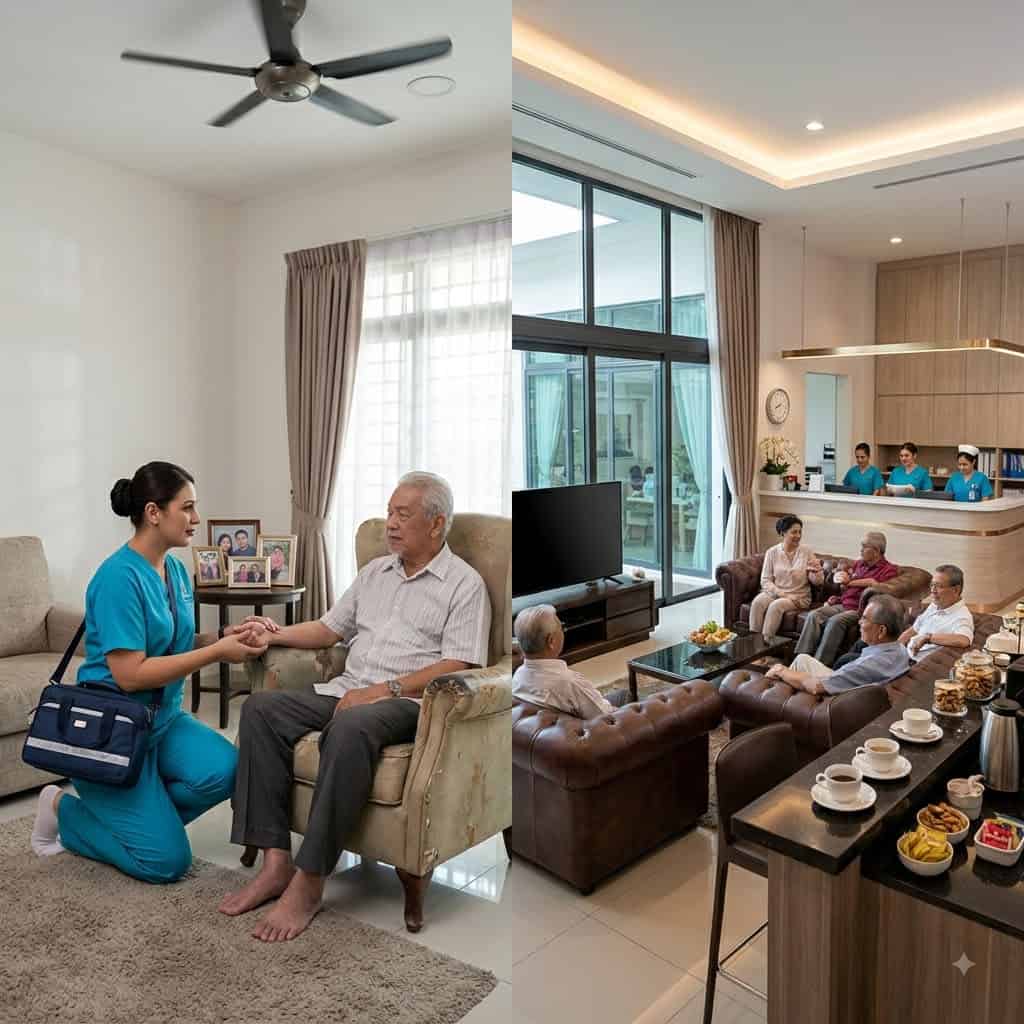
At that point the honest comparison is not home care versus giving up — it is a visit schedule against nursing home with overnight cover, which a visiting nurse cannot provide. Our guide comparing home care and care centre arrangements works through the decision in detail, and if a hospital transfer is needed, private medical transport in Perak covers the options.
Frequently Asked Questions
Helpful answers to common questions about Catheter & Feeding Tube Care.
Silicone catheters are typically changed every four to six weeks and latex ones more frequently, but the schedule is adjusted to the individual — someone who blocks repeatedly may need a shorter interval. The change itself takes around fifteen minutes at the bedside.
First check the whole line for a kink, including under the bedsheet and beneath the patient’s leg, and confirm the bag sits below bladder level. If the line is clear, the bag stays dry and the patient is uncomfortable or the lower abdomen feels firm, call for a nurse or doctor — a blocked catheter with a full bladder needs attention the same day.
Look for cloudy or strong-smelling urine, fever, pain around the insertion site, or blood in the bag. In elderly patients the most common sign is new confusion or agitation with no other explanation — that should be treated as a suspected infection and tested, not dismissed as dementia progressing.
A feeding tube can migrate out of the stomach without any visible change at the nostril. Feeding into a displaced tube can send liquid into the lungs and cause aspiration pneumonia, which is often fatal in a frail senior. Aspirating stomach content and testing it on pH paper is the only reliable bedside check, and it is done before every feed without exception.
Yes for routine tasks — flushing, positioning, feed administration and the pH check are all taught to families and done safely at home every day. Insertion and replacement of both catheters and NG tubes should be left to a nurse or doctor, because a failed attempt can cause injury or place the tube in the airway.
Blockages are almost always caused by insufficient flushing or by crushed medication that was not suitable for the tube. Flushing with warm water often clears an early blockage. Never force it with a syringe under pressure, and never use fizzy drinks or fruit juice — call for a tube change instead.
No, and staying in bed causes its own harm through pressure sores and muscle loss. Catheter bags have leg-worn versions for mobility, and feeding is scheduled around activity rather than the other way round. The patient should sit up during feeds and for around thirty minutes afterwards.
A registered nurse visit covering the change, site inspection, vital signs and a written record is RM 120 to RM 180, with consumables billed at cost. If a doctor is required — for a difficult catheter or a suspected infection needing prescription — a daytime house call is RM 150 to RM 220, and RM 250 to RM 350 outside standard hours.
Popular Related Insights
Explore key guides and healthcare insights for elderly care in Taiping.



Ready to Explore Elderly Care Options in Taiping?
Book a free virtual tour, schedule a doctor consultation, or speak directly to our medical team today.
💬 WhatsApp Us NowPart of the ServicePro.my Healthcare Hub Network. All rights reserved.
Disclaimer: Some images used on this page are representational illustrations of clinical procedures and senior accommodations. Actual layout and equipment may vary.
Common Questions About Catheter & Feeding Tube Care
Helpful answers from our healthcare team on this subject.