
Recognising Early Signs of Neurological Decline in Ageing Parents — A Malaysian Family’s Guide
Early neurological decline in elderly parents appears as subtle changes long before a formal diagnosis. For Malaysian families, knowing what to look for can mean early intervention — or a late-stage crisis.
ServicePro.my Healthcare Insights • Neurological Rehab • 8 Min Read
Book Your Sungai Buloh Clinical Assessment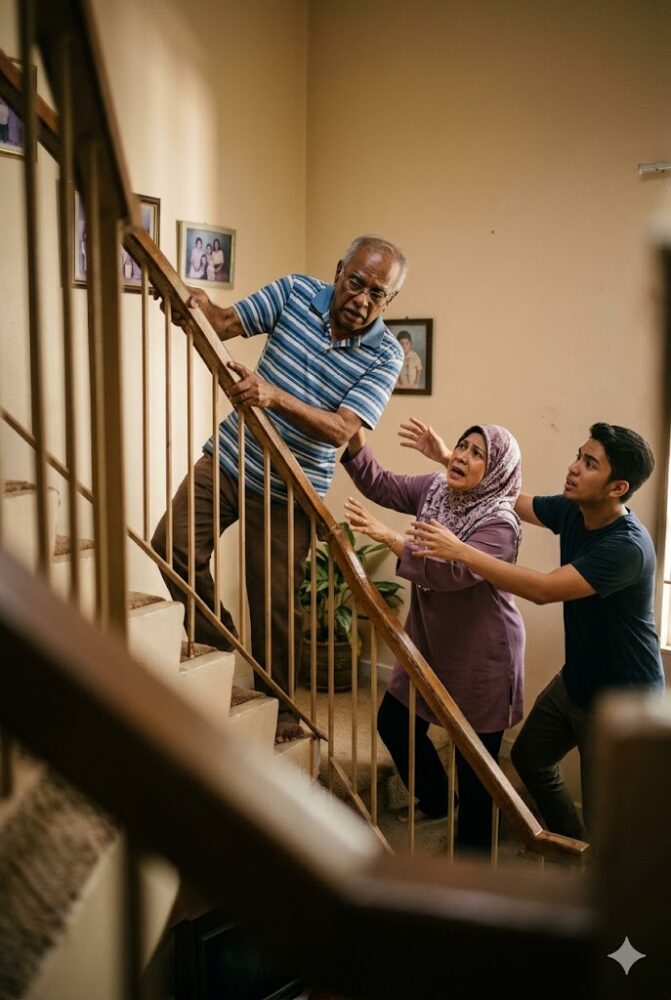
What Are the Early Warning Signs of Neurological Decline in Ageing Parents?
Early neurological decline in elderly parents typically appears as subtle behavioural and physical changes long before a formal diagnosis is made. As a child or caregiver, knowing what to look for can mean the difference between early intervention — which is highly treatable — and a late-stage crisis.
Malaysian families face a particularly compressed window to act. Many ageing parents in Malaysia come from a generation that views medical complaints as a sign of weakness, making self-reporting rare. The responsibility to notice falls entirely on the children.
Watch for these early warning signs:
- Frequent stumbling or balance problems — trips over kerbs, hesitates at stairs, holds walls when walking
- Subtle changes in handwriting or grip strength — cannot open jar lids, handwriting becomes small and cramped (a clinical hallmark of early Parkinson’s disease called micrographia). You can read more about how neurological physiotherapy manages Parkinson’s symptoms in the Klang Valley if you observe these specific signs.
- Repeating the same question within minutes — not occasional forgetfulness, but a loop with no awareness it is repeating
- Loss of sense of smell — an underreported early marker of both Parkinson’s disease and Alzheimer’s
- Reduced facial expression — the face appears “flat” or emotionally blank, even in joyful situations
- Shuffling gait — feet barely lift off the ground; short, dragging steps replace a normal stride
- Sudden personality shift — previously calm parent becomes unusually irritable, suspicious, or apathetic
- Difficulty finding words mid-sentence — pauses frequently, substitutes wrong words, or abandons sentences entirely
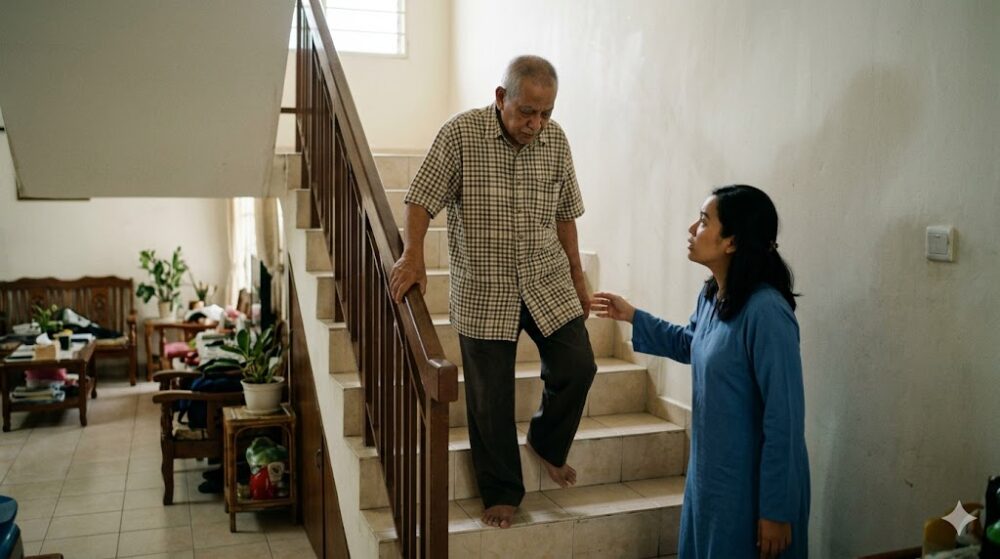 An elderly Malaysian man being guided down stairs by his adult child at home — balance problems are among the earliest physical signs of neurological decline.
Why Are Malaysian Adult Children Often the First to Detect the Problem?
In the Malaysian context, adult children — particularly those in multi-generational households common in Selangor, KL, Penang, and Johor Bahru — are often the first line of neurological surveillance, not doctors.
Several structural factors create this reality:
- GP visits are reactive, not preventive. Most elderly Malaysians only see a doctor when pain is severe. Subtle gait changes or word-finding difficulty are never volunteered.
- The “jangan buat malu” (don’t cause embarrassment) culture. Admitting cognitive changes in front of a doctor is deeply uncomfortable for older Malaysians across Malay, Chinese, and Indian communities.
- Distance from specialist centres. Neurologists and geriatric specialists are concentrated in KL, Petaling Jaya, and Penang. Families in smaller towns like Kuantan, Seremban, or Ipoh face 1–2 hour travel times just for a consult.
- Shared household observation. A child living with or visiting parents regularly notices the gradual shift that a 15-minute clinic appointment never will.
How Malaysian Kids Are Managing Ageing Parent Care in 2024–2025
A growing pattern among Malaysian families, particularly among urban millennials managing parents in their 60s and 70s, reflects a more proactive posture:
WhatsApp family group coordinationSiblings divide responsibility for weekly check-ins, medication monitoring, and appointment transport.
Home fall preventionInstalling grab bars and removing floor rugs as the first home intervention before any formal diagnosis.
Seeking physiotherapy earlyArranging home or clinic-based physiotherapy before a neurologist officially recommends it, based on visible physical decline.
Using telehealth for preliminary assessmentPlatforms available in Malaysia allow preliminary cognitive screening without requiring the elderly parent to leave the house.
Caregiver burnout awarenessAdult children are increasingly recognising the secondary impact on their own mental health, leading to greater uptake of respite care and professional support services.
 A Malaysian daughter reviewing medication schedule with her elderly mother at a dining table.
What Is the Connection Between Neurological Decline and Physical Deterioration?
Neurological decline and physical deterioration are not separate problems — they are two expressions of the same underlying process. This is a critical concept that many Malaysian families miss because they treat the body and brain as separate systems.
Here is how neurology drives physical decline in the elderly:
| Neurological Issue | Physical Manifestation |
|---|---|
| Basal ganglia degeneration (Parkinson’s-type) | Rigid muscles, shuffling walk, resting tremor |
| Cerebellar atrophy | Loss of coordination, inability to walk in a straight line |
| Frontal lobe thinning (early dementia) | Poor judgement, impulsive movement, wandering |
| Peripheral neuropathy (often diabetic in Malaysia) | Numbness in feet, loss of proprioception, fall risk |
| Post-stroke neural pathway disruption | One-sided weakness, foot drop, slurred speech |
| White matter lesions (small vessel disease) | Slow processing speed, frequent falls, urinary urgency |
📍 Malaysia has a compounding risk factor: The country has one of the highest rates of Type 2 diabetes in Southeast Asia, and diabetic peripheral neuropathy is a direct cause of neurological-physical deterioration in the lower limbs — often years before a parent has a formal stroke or dementia diagnosis. The early physical signs of this neuropathy — tingling feet, clumsiness at night, inability to feel the floor surface — are frequently dismissed as “normal ageing” by both the parent and the GP.
Why Is Physiotherapy Highly Recommended for Neurological Decline?
Physiotherapy is the single most evidence-backed intervention for slowing the functional impact of neurological decline in the elderly. It does not reverse the underlying neurological disease, but it substantially delays the timeline to dependence — often by years.
What Neurological Physiotherapy Actually Does
Unlike standard post-injury physiotherapy, neurological physiotherapy (also called neuro-rehab) is a specialist discipline targeting the brain-body communication pathway. It works on the principle of neuroplasticity — the brain’s ability to form new neural pathways to compensate for damaged ones.
Key physiotherapy interventions for neurological decline:
- Gait retraining — Correcting the shuffling walk pattern through deliberate step-width and heel-strike exercises
- Balance therapy — Proprioceptive training using wobble boards, foam surfaces, and eyes-closed exercises to retrain the brain’s spatial awareness
- Strength and resistance training — Targeting the hip extensors, core, and ankle dorsiflexors that directly prevent falls
- Cognitive-motor dual-task training — Simultaneously performing a cognitive task (counting backwards) while walking, which trains the brain’s multitasking capacity — degraded early in neurological decline
- Hydrotherapy (where available) — Warm-water physiotherapy reduces joint load while maintaining movement quality; available at select rehab centres in Selangor
- Hand and fine motor therapy — For parents showing grip weakness, tremor, or micrographia — critical for maintaining independence in daily tasks like eating and dressing
The Evidence for Early Physiotherapy Intervention
The clinical consensus from bodies including the World Physiotherapy Federation and Malaysia’s own Malaysian Physiotherapy Association (MPA) — in alignment with Ministry of Health Malaysia (MyHealth) clinical guidelines on elderly fall prevention — is clear: the earlier physiotherapy begins in neurological decline, the greater the functional preservation achieved.
Fall risk reduction with structured balance and gait training in elderly patients with early neurological decline
Months longer that elderly patients receiving regular physiotherapy maintain independence compared to those without
Improved quality of life scores in both Parkinson’s and post-stroke patients receiving neurological physiotherapy versus medication alone
For Malaysian families managing an ageing parent showing early signs, arranging a professional physiotherapy and rehabilitation assessment is one of the highest-impact decisions available — ideally before a fall, a stroke, or a crisis triggers an emergency referral.
 A physiotherapist assisting an elderly Malaysian patient with balance exercises at a rehabilitation centre.
How to Talk to Your Malaysian Parents About Seeing a Physiotherapist
Convincing an elderly Malaysian parent to accept physiotherapy is often harder than arranging the appointment itself. Resistance is cultural, generational, and deeply embedded in how this generation perceives vulnerability.
Common Objections and How to Respond
Reframe it as a fitness class, not a medical procedure. “Abah, ini macam senaman dengan instructor. Bukan ubat. Bukan hospital.” (Dad, this is like exercise with an instructor. Not medicine. Not the hospital.)
Accompany them to the first session. Remove the unknown. Many Malaysian elders accept care once they see a calm, professional environment and are treated with dignity.
Address cost transparently. Physiotherapy sessions in Malaysia typically range from RM80–RM200 per session depending on the facility and intervention type. Frame it against the cost of a fall: hospitalisation, surgery, and long-term nursing care dwarf the cost of preventive physio by a significant multiple.
The neurological window for maximum physiotherapy benefit is early. Every month of delayed intervention is a month of muscle atrophy, neural pathway degradation, and lost neuroplasticity. “Later” is medically expensive.
 An adult child and elderly parent having a conversation over tea in a Malaysian home.
What to Expect at a Neurological Physiotherapy Assessment in Malaysia
For families who have never arranged a physiotherapy assessment, the process is straightforward and non-intimidating.
A standard first assessment at a certified Malaysian physiotherapy centre includes:
- Functional movement assessment — The physiotherapist observes your parent walking, standing from a chair, and reaching. No machines. No pain.
- Balance and fall-risk scoring — Using validated tools such as the Berg Balance Scale or Timed Up and Go (TUG) test, the physiotherapist assigns a quantified fall-risk level.
- Strength and flexibility testing — Manual muscle testing of key lower limb and core groups.
- Neurological screening — Coordination tests, reflex checks, and sensory assessment of the feet and hands.
- Goal-setting and treatment plan — The physiotherapist proposes a session frequency, duration, and measurable outcomes tailored to your parent’s specific presentation.
For families in Selangor and Greater KL, a physiotherapy and rehabilitation centre in Sungai Buloh provides accessible, specialist neurological rehab services with verified practitioners — an important consideration given that Malaysia’s Allied Health Act requires all practising physiotherapists to be registered with the Allied Health Professions Council Malaysia.
Frequently Asked Questions About Neurological Decline and Physiotherapy for Elderly Parents in Malaysia
The earliest physical signs are balance instability, a shuffling or slowed walking pattern, reduced grip strength, and intermittent falls — often appearing years before a formal neurological diagnosis. Many Malaysian families initially attribute these to “being tired” or general ageing rather than recognising them as clinical indicators.
Proactive monitoring should begin when parents enter their early 60s, particularly if there is a family history of Parkinson’s disease, stroke, diabetes (high in Malaysian demographics), or dementia. Observable changes warrant a medical review at any age — early detection significantly improves intervention outcomes.
Coverage varies significantly by policy. Many Malaysian medical cards (including Great Eastern, AIA, and Prudential plans) cover physiotherapy under hospitalisation riders or specialist outpatient benefits, but session caps often apply. It is advisable to check your parent’s policy specifically for “physiotherapy” or “allied health” benefits. Government hospital physiotherapy is available but waiting times can extend to weeks or months.
Physiotherapy sessions in Malaysia typically cost between RM80 and RM200 per session at private clinics and rehabilitation centres, depending on session type and duration. Neurological rehabilitation sessions involving specialist equipment or hydrotherapy may fall at the higher end. Some rehabilitation centres offer package rates for long-term programmes that reduce per-session costs.
Physiotherapy cannot reverse the underlying neurological degeneration, but it can meaningfully slow functional decline by promoting neuroplasticity — the brain’s ability to form compensatory pathways. Consistent physiotherapy has been shown to reduce fall frequency, preserve independence, and improve quality of life scores in patients with Parkinson’s disease, post-stroke sequelae, and general age-related neurological decline.
A physiotherapist (fisioterapi) is an Allied Health professional registered with the Allied Health Professions Council Malaysia who delivers movement-based therapeutic interventions. A rehabilitation doctor (physiatrist) is a fully qualified medical doctor (registered with the Malaysian Medical Council / MMC) specialising in physical medicine and rehabilitation. For most early neurological decline cases, a physiotherapist is the first appropriate contact; a physiatrist is typically involved in complex post-stroke or post-surgical rehabilitation.
Most physiotherapy protocols for early neurological decline recommend 2–3 sessions per week during an initial 6–8 week intensive phase, transitioning to weekly maintenance sessions thereafter. Your parent’s physiotherapist will calibrate this based on severity, fatigue tolerance, and observed progress.
Yes. Home physiotherapy services are available across the Klang Valley, Penang, and Johor Bahru through registered providers. Home visits are particularly appropriate for elderly patients with severe mobility limitations, post-hospitalisation recovery phases, or significant anxiety around clinical environments. Verify that the practitioner is registered with the Allied Health Professions Council Malaysia before engaging any home service.
📅 Book Your Neurological Physiotherapy Assessment in the Klang Valley
If your parent is showing any of the early signs described in this article — balance problems, a shuffling walk, grip weakness, or unexplained falls — the time to act is now, not after a crisis. Our vetted physiotherapy partners across Sungai Buloh and the Klang Valley provide accurate clinical assessment and condition-specific rehabilitation from the very first session.
Tap your location to open WhatsApp — no forms, no waiting. All practitioners verified with Allied Health Professions Council Malaysia.
The information in this article is intended for general educational purposes and does not constitute medical advice. Always consult a clinician registered with the Malaysian Medical Council (MMC) or a physiotherapist registered with the Malaysian Physiotherapy Association (MPA) for a diagnosis and personalised treatment plan. ServicePro.my connects Malaysians with vetted, verified healthcare and home service professionals across the Klang Valley and beyond.
Healthcare Questions. 0
Questions from our followers and readers within and beyond Klang Valley, answered by our healthcare specialists.
─── MORE HEALTHCARE INSIGHTS
Keep Reading
Continue building your knowledge on maintaining a healthy community in Malaysia.