Knee Replacement Recovery in Malaysia: The Complete TKR Rehab Roadmap
For patients recovering from Total Knee Replacement surgery near Sungai Buloh, Selangor — your phase-by-phase guide to regaining full function through evidence-based orthopaedic physiotherapy.
Consult a Verified Sungai Buloh Physiotherapist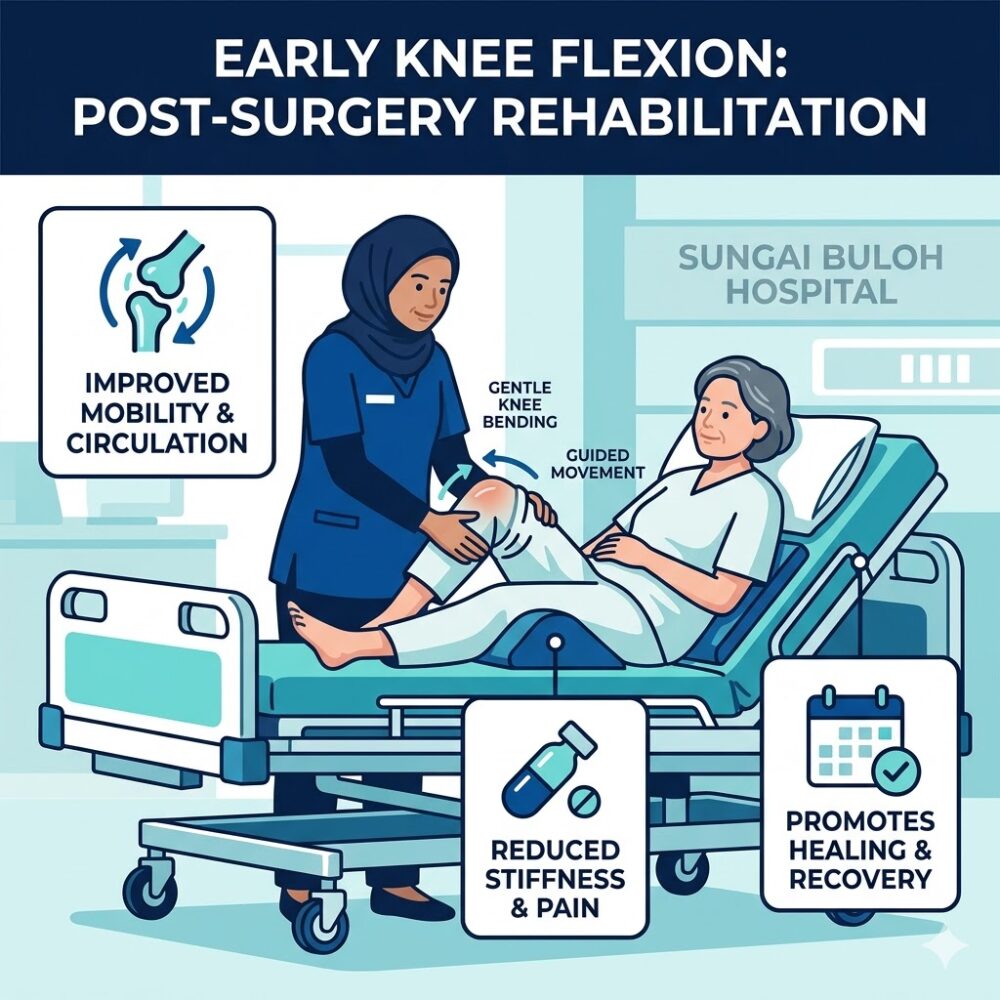
📍 Local Note: This article is written specifically for patients recovering from Total Knee Replacement (TKR) surgery at hospitals in and around Sungai Buloh, Selangor — including Hospital Sungai Buloh (HSB), Columbia Asia Hospital Petaling Jaya, and private specialist centres in the Klang Valley corridor.
What Is the Standard Recovery Timeline After a Knee Replacement in Malaysia?
The standard TKR recovery timeline in Malaysia spans 6 to 12 months, with the most critical physiotherapy window occurring within the first 6 weeks post-surgery. Recovery is divided into four clinically-defined phases, each with specific mobility milestones your physiotherapist will track.
Malaysian patients — particularly those recovering in landed terrace houses or multi-storey condos in areas like Sungai Buloh, Kepong, or Shah Alam — face unique environmental challenges: humid tropical heat (averaging 27–32°C year-round), which can increase post-operative swelling, and home layouts with staircases that demand faster mobility milestones than flat-layout homes.
Understanding your TKR rehab roadmap phase by phase is the single most important factor in achieving a full, pain-free recovery. If you have not yet undergone surgery and are exploring conservative options, you may first want to read our clinical guide on managing knee osteoarthritis without surgery for seniors in the Klang Valley.
Hospital & Early Discharge
Medically supervised mobilisation starting within 24 hours of surgery. Focus on DVT prevention, knee flexion goals, and discharge readiness.
Home Recovery & Outpatient Physio
3 sessions per week determining long-term range of motion. Heel slides, SLR, step training, and swelling management.
Active Strengthening
Transition from joint protection to joint loading. Hydrotherapy, resistance training, and balance retraining introduced.
Full Rehab & Long-Term Health
Gait retraining, return-to-activity assessment, plateau-breaking techniques, and implant longevity education.
Phase 1: The Hospital & Early Discharge Stage (Day 0 – Week 2)
Day 0 to Week 2 is the most medically supervised phase of your TKR recovery — and the most critical for preventing complications.
In Malaysian public hospitals like Hospital Sungai Buloh, physiotherapy typically begins within 24 hours of surgery, before you are even discharged. Private hospitals in the Klang Valley often begin mobilisation on the same day as surgery under Enhanced Recovery After Surgery (ERAS) protocols supported by the Malaysian Orthopaedic Association (MOA).
What Physiotherapy For Knee Replacement Recovery Looks Like in Week 1–2
- Ankle pumps and quadriceps setting — performed every waking hour to prevent deep vein thrombosis (DVT), a serious post-surgical risk
- Assisted standing and walking with a walking frame (kerusi roda or walker)
- Knee flexion (bending) goals: Reaching 90 degrees of bend by Day 5–7 is a key early milestone
- Ice therapy (cryotherapy): Applied for 15–20 minutes every 2–3 hours to manage post-op swelling, which is amplified by Malaysia’s humid climate
- Wound care monitoring: Sutures or staples are typically removed at Day 10–14
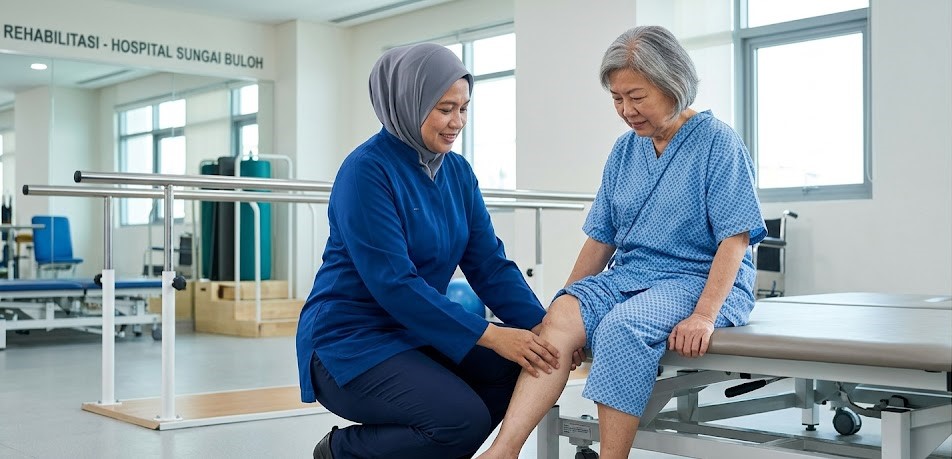 Early mobilisation within 24 hours of TKR surgery reduces complication risk and accelerates recovery.
Discharge Readiness Checklist (Malaysia Context)
Before you are cleared for discharge from a Malaysian hospital post-TKR, your clinical team will confirm:
- You can walk 30–50 metres independently with a walking aid
- Knee bend (flexion) has reached at least 90°
- Pain is controlled on oral medication (Panadol, NSAIDs, or tramadol-based)
- You can safely manage 3–5 steps of a staircase
- No signs of DVT, infection (jangkitan), or wound dehiscence
Phase 3: Active Strengthening & Return to Function (Week 6 – Month 3)
By Week 6, if rehab has been consistent, most TKR patients in Malaysia will have achieved 110–120° of knee flexion and can begin progressive strengthening.
This phase transitions from “protecting the joint” to “loading the joint” — a critical psychological and physiological shift.
What Changes at Week 6
- Walking stick use: Many patients can transition to no walking aid for flat surfaces
- Exercise pool therapy (hydrotherapy): Particularly effective in this phase; the buoyancy of water reduces joint load while enabling full-range movement. Several physiotherapy centres near Sungai Buloh offer pool-based TKR rehab.
- Light resistance training: Leg press machines (low weight), mini squats, and wall slides are introduced
- Balance and proprioception training: Standing on one leg, wobble board exercises — restores the neural signalling the surgical disruption impaired
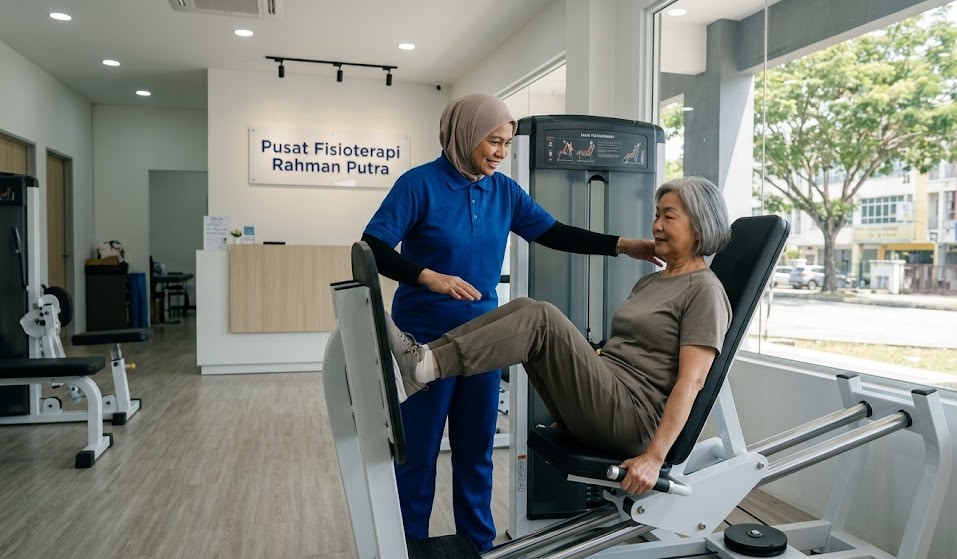 Progressive resistance training in Phase 3 is essential for restoring functional independence after total knee replacement.
Red Flags to Report to Your Physiotherapist Immediately
Do not dismiss these symptoms as “normal” soreness:
- Sudden increase in knee swelling after a previously stable plateau
- Redness, warmth, or discharge at the incision site (signs of periprosthetic joint infection — PJI)
- Calf pain or swelling (possible DVT — seek emergency care immediately)
- A “clunking” or “grinding” sensation in the knee (report to your orthopaedic surgeon, not just physio)
- Fever above 38°C — go to A&E at the nearest hospital
Phase 2: Home Recovery & Outpatient Physiotherapy (Week 2 – Week 6)
Weeks 2 through 6 are when consistent outpatient physiotherapy — ideally 3 sessions per week — determines the long-term range of motion you will regain.
This is where many Malaysian patients underperform. Common barriers include long commutes from Sungai Buloh or Rawang to physiotherapy centres, the misconception that rest equals recovery (“rehat lebih baik”), and cost concerns around frequent private physio sessions.
Key Rehabilitation Goals for Weeks 2–6
| Week | Flexion Target | Mobility Milestone |
|---|---|---|
| Week 2 | 90–100° | Walk indoors with walking stick |
| Week 3 | 100–105° | Stairs with one hand on railing |
| Week 4 | 105–110° | Short outdoor walks (10–15 min) |
| Week 6 | 110–120° | Drive (left knee only; check with surgeon) |
Exercises Prescribed in This Phase
- Straight Leg Raises (SLR): Builds quadriceps strength without stressing the new joint
- Heel Slides: Core TKR flexion exercise — slide the heel toward the buttocks while lying flat
- Terminal Knee Extension (TKE): Using a resistance band to fully extend the knee
- Step-up and step-down training: Critical for Malaysian homes with split-level floors and staircases
- Stationary cycling (no resistance): Typically introduced at Week 4 to improve range and reduce stiffness
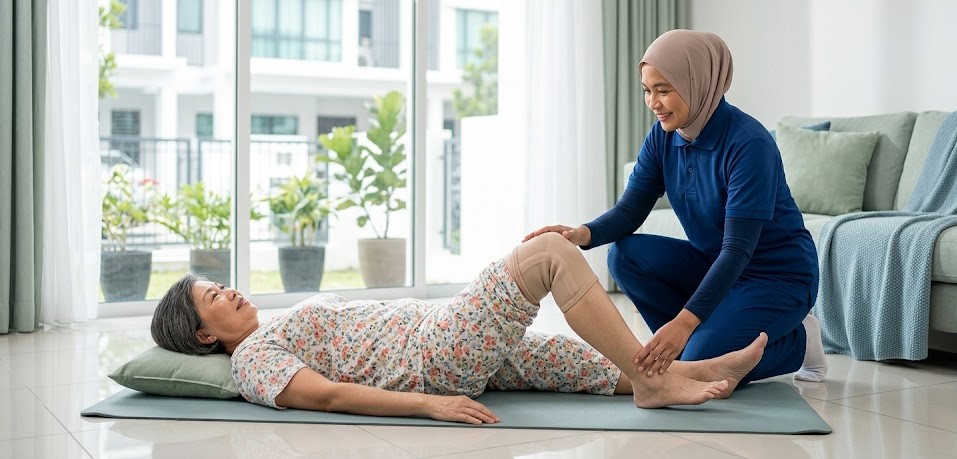 Heel slides are the gold-standard home exercise for TKR patients in Weeks 2–6.
Managing Swelling in Malaysia’s Climate
Malaysia’s high ambient humidity (70–90% RH) and heat directly worsen post-TKR swelling. Clinical recommendations for local patients:
- Keep the home air-conditioned at 22–24°C during recovery hours
- Elevate the operated leg above heart level for 30-minute intervals throughout the day
- Avoid prolonged sitting on the floor (duduk bersila) — this stresses the implant joint capsule
- Stay well-hydrated; dehydration thickens the blood and increases DVT risk
Ready to Start Your TKR Recovery?
Our vetted physiotherapists are available across Sungai Buloh and the Klang Valley for immediate clinical assessments and post-surgical rehabilitation.
Phase 4: Full Rehabilitation & Long-Term Joint Health (Month 3 – Month 12)
Full functional recovery from TKR – where the knee feels “normal” in daily life – typically takes 9 to 12 months for Malaysian patients.
By Month 3, most patients can walk continuously for 30+ minutes, climb and descend stairs reciprocally (one foot per step), return to desk-based sedentary work (MC is typically issued for 6–8 weeks for most clerical and office roles in Malaysia), and perform light household tasks (kerja rumah).
What Ongoing Physiotherapy Addresses in Months 3 – 12
- Gait retraining: Correcting limping patterns (ketimpangan) that developed as compensation during acute pain
- Return-to-sport assessment: For more active patients – low-impact activities like swimming, cycling, and golf are typically cleared by Month 4–6
- Knee bending (flexion) plateau-breaking: Some patients stall at 110°–115°. Specific joint mobilisation techniques and scar tissue management (myofascial release) are used to push past these limits
- Patient education on implant longevity: Malaysian patients are counselled to avoid high-impact loading sports (running, badminton, futsal), prolonged squatting, and sitting cross-legged on the floor
Returning to Work: Malaysian MC & SOCSO Context
| Job Type | Typical Return-to-Work Timeline |
|---|---|
| Sedentary / Office (Kerja Pejabat) | 6–8 weeks with MC |
| Light Standing Work | 8–12 weeks |
| Manual Labour (Kerja Berat) | 3–6 months (SOCSO claim may apply) |
| Driving (Manual Car) | Right knee: minimum 6 weeks; confirm with surgeon |
📍 SOCSO Note: Malaysian workers covered under PERKESO (SOCSO) may be eligible for the Return to Work (RTW) Programme, which subsidises physiotherapy costs for work-related injuries. Confirm eligibility with your HR department or SOCSO branch office.
How to Choose the Right Physiotherapy Centre in Sungai Buloh After TKR
The best TKR physiotherapy centre near Sungai Buloh combines post-surgical orthopaedic specialisation, modern equipment, and flexible appointment scheduling to fit your recovery phase.
Not all physiotherapy clinics are equipped for post-TKR rehabilitation. When evaluating a centre in the Sungai Buloh, Kepong, or Petaling Jaya corridor, confirm:
Registered with the Malaysian Physiotherapy Association (MPA) – verify credentials at mpa.org.my
Physiotherapists with orthopaedic or musculoskeletal specialisation
Access to dry needling, ultrasound therapy, and TENS for pain management alongside exercise
Ability to coordinate with your orthopaedic surgeon – good centres will request your discharge summary and operative notes
Home visit physiotherapy option – valuable for patients with limited mobility in the first 2 weeks
Transparent, itemised pricing in RM – typical per-session costs in the Klang Valley range from RM 80–RM 180 for private physiotherapy
To connect with a vetted post-surgical physiotherapy and rehabilitation centre near Sungai Buloh, book a session at our verified post-surgical physiotherapy and rehabilitation centre in Sungai Buloh, where all partner clinics are verified and accept walk-in and scheduled bookings.
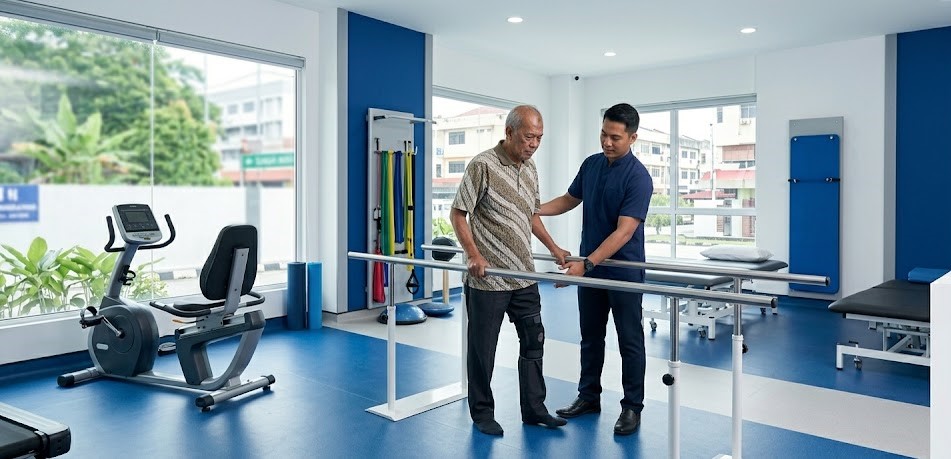 Choosing a physiotherapy centre with orthopaedic specialisation is the most important decision a TKR patient makes after discharge.
Frequently Asked Questions About Knee Replacement Recovery in Malaysia
Full TKR recovery in Malaysia typically takes 9 to 12 months, though most patients return to normal daily activities by Month 3. The first 6 weeks of consistent physiotherapy are the most critical phase — patients who attend structured physio sessions 3x per week in this window consistently achieve better long-term outcomes.
Private physiotherapy in the Klang Valley and Sungai Buloh area typically costs RM 80 to RM 180 per session. A full Phase 1–3 rehab programme (approximately 20–30 sessions) may cost RM 2,000–RM 5,000 in total. Patients with panel insurance (e.g., AIA, Prudential, Great Eastern) should check if post-surgical physiotherapy is claimable under their policy’s “surgical benefit” rider.
Mild to moderate achiness at 3 months is normal; sharp, escalating, or localised pain is not. Some post-TKR patients experience “start-up pain” — stiffness in the first 10–15 steps — for up to 6 months. However, persistent swelling, warmth, or pain that worsens over time must be evaluated by your orthopaedic surgeon to rule out periprosthetic joint infection (PJI) or implant loosening.
No — sitting cross-legged (duduk bersila) is generally not recommended after TKR. The internal rotation and forced flexion required to sit bersila stresses the tibial insert of the knee implant. Most Malaysian orthopaedic surgeons advise avoiding this position indefinitely to protect implant longevity. Use a chair or supportive cushion for floor-level activities.
For the left knee (in a right-hand-drive car), most surgeons clear driving at 4–6 weeks if you are no longer on opioid-based painkillers and can perform an emergency stop manoeuvre. For the right knee, the timeline extends to 6–10 weeks minimum, as the right leg operates the throttle and brake. Always obtain explicit written clearance from your operating orthopaedic surgeon before driving.
Yes — significantly. Malaysia’s average humidity of 70–90% RH and ambient temperatures above 30°C can accelerate post-operative swelling, increase discomfort, and raise infection risk at incision sites. TKR patients in Malaysia are advised to keep their recovery environment air-conditioned, elevate the limb frequently, and stay well-hydrated to compensate for fluid loss through perspiration.
Swimming and stationary cycling are the two most recommended low-impact exercises for TKR patients in Malaysia after the first 4–6 weeks. Both provide cardiovascular conditioning and joint mobilisation without high-impact loading. Public swimming pools (kolam renang awam) in Selangor, such as those managed by local councils (MBPJ, MPAJ, MBSA), are accessible options once your surgeon clears aquatic activity.
Verify that your physiotherapist is registered with the Malaysian Allied Health Professions Act (AHPA) 2016 and holds a valid Annual Practising Certificate (APC). You can request to see their registration number, which should be verifiable via the Malaysian Allied Health Professions Council (MAHPC). Additionally, ask specifically whether the physiotherapist has post-graduate training or supervised clinical experience in orthopaedic and post-surgical rehabilitation.
📅 Book Your TKR Physiotherapy Session in Sungai Buloh
Recovering from a Total Knee Replacement requires structured, expert-guided physiotherapy — not guesswork. Whether you’ve just been discharged from Hospital Sungai Buloh or you’re 3 months post-op and hitting a plateau, the right rehabilitation partner makes the difference between a 70% recovery and a 100% return to function.
Or WhatsApp Your Nearest Location
📍 Local Note:
This article is produced by the ServicePro.my Healthcare Editorial Team for informational purposes only. It does not constitute medical advice. Always consult a licensed healthcare professional — including a registered physiotherapist, orthopaedic surgeon, or GP — for diagnosis and individualised treatment planning.
Healthcare Questions. 0
Questions from our followers and readers within and beyond Klang Valley, answered by our healthcare specialists.
─── MORE HEALTHCARE INSIGHTS
Keep Reading
Continue building your knowledge on maintaining a healthy community in Malaysia.