Top 5 Badminton Injuries in Malaysia: How to Return to the Court Faster in Selangor
Badminton is Malaysia’s most beloved recreational sport — and its most injury-prone. When injury strikes, the difference between a 3-week recovery and a 3-month setback often comes down to one thing: how fast and how correctly you treat it.
ServicePro.my Healthcare Insights • Sports Physiotherapy • 12 Min Read
Book Your Sungai Buloh Clinical Recovery Assessment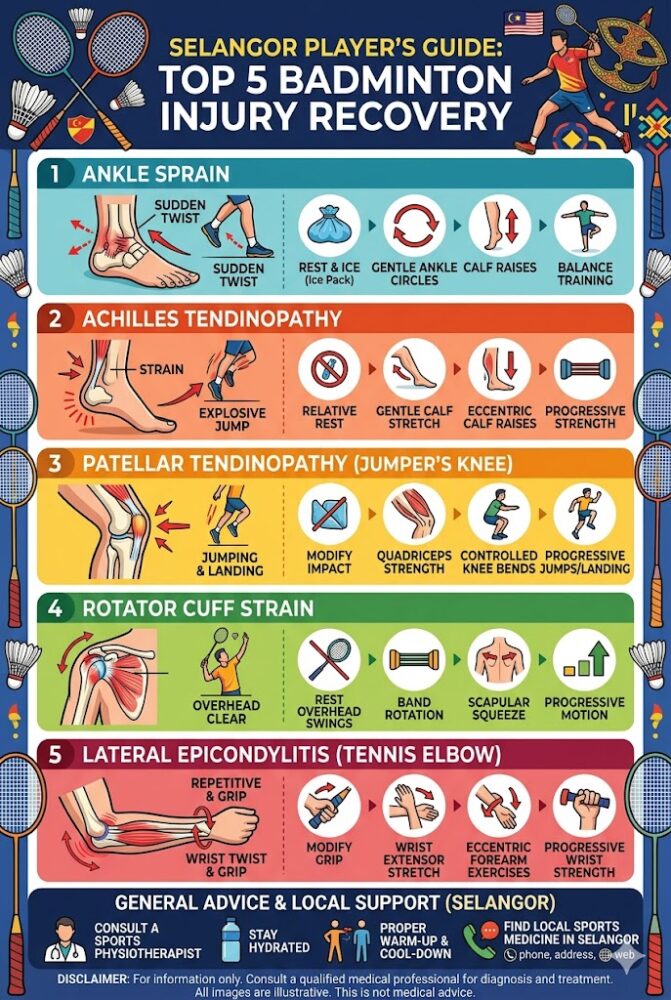
Whether you’re a weekend warrior at the Bukit Jalil Sports Complex, a competitive club player drilling at your Subang Jaya community hall, or a retiree squeezing in games at the Petaling Jaya Recreation Club, the repetitive explosive mechanics of the game place enormous biomechanical stress on your joints, tendons, and soft tissue.
This guide identifies the five most common badminton injuries seen in Malaysian recreational and competitive players, details their clinical presentation, and explains how structured rehabilitation — including Kinesio Taping and Certified Sports Massage — can accelerate your return-to-court timeline safely.
What Are the Most Common Badminton Injuries in Malaysia?
The most common badminton injuries in Malaysia are ankle sprains, Achilles tendinopathy, patellar tendinopathy (“jumper’s knee”), rotator cuff strains, and lateral epicondylitis (“tennis elbow”). These five injuries collectively account for the majority of court-time lost among recreational players in the Klang Valley and reflect the explosive lateral movement, overhead loading, and rapid deceleration patterns unique to the sport, as documented in official Ministry of Health Malaysia (MyHealth) sports injury guidelines.
1 Injury One
Ankle Sprain — The Most Common Badminton Injury in Malaysia
Ankle sprains are the single most reported badminton injury among Malaysian players, caused by the sport’s rapid lateral lunges, unexpected direction changes, and net-play drops that force the ankle into inversion beyond its structural tolerance.
Clinical Presentation
- Grade I: Mild ligament stretching. Localised swelling over the lateral malleolus, weight-bearing possible with discomfort.
- Grade II: Partial ligament tear. Moderate swelling and bruising, pain on weight-bearing, joint instability.
- Grade III: Complete ligament rupture. Significant swelling, loss of function, joint laxity.
The anterior talofibular ligament (ATFL) is the most frequently compromised structure, followed by the calcaneofibular ligament (CFL).
Recovery Protocol & Kinesio Taping Application
For Grades I and II, structured physiotherapy with Kinesio Taping (KT) is the evidence-supported first-line intervention. KT applied in a mechanical correction fan technique across the peroneal musculature:
- Reduces oedema by lifting the epidermis and increasing interstitial space for lymphatic drainage
- Provides proprioceptive re-education — critically important in preventing the chronic re-sprain cycle common among recreational badminton players
- Allows early mobilisation without complete joint immobilisation, preserving range of motion during the subacute phase
Certified Sports Massage targeting the tibialis anterior, peroneals, and gastrocnemius reduces compensatory muscular guarding that develops above the injured site, which, if untreated, commonly loads the knee and hip in dysfunctional patterns.
Estimated Return-to-Court Timeline (Klang Valley Players, Grade I–II)
| Phase | Duration | Key Milestone |
|---|---|---|
| PRICE + Taping (Acute) | Days 1–3 | Oedema control, pain < 4/10 VAS |
| Mobility & Strengthening | Days 4–14 | Single-leg balance 10 seconds |
| Sport-Specific Drills | Weeks 3–4 | Court lunges pain-free |
| Full Return to Play | Week 4–6 | Reactive agility drills cleared |
⚠️ Malaysian Court Warning: Many community halls in Shah Alam and Cheras use older hardwood courts with inconsistent grip quality. Players recovering from ankle sprains should confirm court surface condition before returning to play.
2 Injury Two
Achilles Tendinopathy — The Selangor Weekend Warrior’s Nemesis
Achilles tendinopathy is the most undertreated badminton injury in the Malaysian recreational population, frequently misdiagnosed as a simple calf strain and managed with rest alone — an approach that entrenches the degenerative tendon changes and prolongs recovery by weeks.
Why Malaysian Players Are Disproportionately Affected
Several factors specific to the Malaysian context elevate Achilles tendinopathy risk:
- Training load spikes: Weekend warriors in PJ, Ampang, and Cheras typically play zero days Monday–Friday, then play 3–4 consecutive hours on Saturday mornings — a classic tendon overload pattern
- Footwear: Playing in non-badminton-specific court shoes (running shoes, cross-trainers) is extremely common in Malaysia and dramatically alters heel strike mechanics
- Tropical climate: Inadequate warm-up in air-conditioned sports halls (temperature differential vs. outdoor carpark can be 10–15°C) leaves Achilles tissue less extensible at game start
Clinical Presentation
Mid-portion tendinopathy (2–7 cm above calcaneal insertion) presents as:
- Morning stiffness that “warms up” within 10–15 minutes
- Pain that worsens at the start of activity, briefly improves, then worsens again at end
- Palpable nodular thickening at mid-tendon
- Absence of swelling (distinguishing it from rupture)
Insertional tendinopathy (at the calcaneal enthesis) presents differently and requires modified management — specifically, avoiding aggressive eccentric loading protocols used for mid-portion.
Sports Massage & Taping for Achilles Recovery
A Certified Sports Massage Practitioner plays a specific role in Achilles rehabilitation that passive stretching cannot replicate:
- Transverse frictions to the paratenon break down adhesions between the tendon sheath and tendon body, restoring glide mechanics
- Gastrocnemius-soleus neuromuscular release reduces the proximal load contribution that initiates at the musculotendinous junction
- Kinesio Taping — Achilles offloading technique: A “Y” strip applied from calcaneal base to gastrocnemius belly, with a corrective strip over the mid-tendon, reduces tensile stress during push-off and facilitates a 15–20% reduction in tendon loading per stride (based on taping biomechanics literature)
Critical Malaysian context: Players should NOT return to play on a “feels better” basis alone. Achilles tendons that feel pain-free at rest can still demonstrate pathological ultrasound changes. If you are in the Klang Valley, a practitioner with sports tendinopathy training can provide clinical load-testing to confirm readiness.
3 Injury Three
Patellar Tendinopathy (Jumper’s Knee) — Driven by Malaysia’s Jump-Smash Culture
Patellar tendinopathy (“jumper’s knee”) is the defining overuse injury of Malaysian competitive badminton, directly driven by the sport’s relentless demand for high-power jumping, explosive smash loading, and rapid deceleration landings — mechanics that subject the patellar tendon to forces 7–10× bodyweight on each jump cycle.
Who Gets It
- Players training or competing more than 3× per week
- Players aged 18–35 in the Klang Valley’s active club league circuit (Shah Alam, Subang, Puchong, Kepong)
- Players who have recently increased training intensity — a common pattern ahead of corporate tournaments in KL
Clinical Presentation
- Anterior knee pain localised to the inferior pole of the patella
- Pain is provoked specifically by activities that load the quadriceps: jumping, squatting, descending stairs
- The Victorian Institute of Sport Assessment-Patella (VISA-P) scale is the validated outcome measure — practitioners in Malaysia should use this to score severity and track progress
Rehabilitation Approach
Isometric loading (e.g., wall sits, Spanish squats) is now the evidence-supported first-line intervention for in-season pain management. Sports Massage targets:
- Quadriceps neuromuscular inhibition (common in tendinopathy — the quad “shuts down” to protect the tendon)
- IT band and lateral retinaculum tightness, which increases lateral patella tracking stress
- Hip flexor shortening, which is endemic in Malaysia’s predominantly desk-based workforce and directly modifies knee loading mechanics
Kinesio Taping: A patellar unloading tape applied in a “donut” configuration around the inferior pole reduces mechanoreceptor-mediated pain during loading tasks and allows continuation of graded rehabilitation without pain sensitisation.
4 Injury Four
Rotator Cuff Strain — The Hidden Cost of Malaysia’s Smash-Heavy Game Style
Rotator cuff strains — particularly of the supraspinatus and infraspinatus — are the most common upper extremity injury in Malaysian badminton players, produced by the extreme internal rotation velocity of the overhead smash and the repetitive eccentric deceleration demand placed on the posterior cuff musculature.
The Malaysian Smash Problem
Malaysian badminton culture, influenced by decades of national team dominance, produces recreational players who replicate the aggressive overhead smash far beyond their shoulder’s structural preparation. In a typical recreational session in Damansara or Kepong, a player may execute 200–400 overhead shots — a volume that would challenge conditioned athletes.
Clinical Presentation
- Supraspinatus: Painful arc 60°–120° abduction, positive empty-can test, difficulty reaching overhead
- Infraspinatus/Teres Minor: Posterior shoulder pain with external rotation resistance, weakness holding the shuttle at full follow-through
- Biceps Long Head Tendinopathy: Anterior shoulder pain, frequently co-occurring with rotator cuff involvement
Sports Massage & Taping Protocol
Certified Sports Massage for the shoulder in overhead sport players addresses:
- Posterior capsule tightness — the “GIRD” (Glenohumeral Internal Rotation Deficit) pattern endemic in overhead athletes and a primary modifiable risk factor for rotator cuff injury recurrence
- Pectoralis minor/subscapularis hypertonicity from the serve and net-play forehand mechanics
- Cervical and upper trapezius referral patterns that masquerade as rotator cuff pain
Kinesio Taping — Rotator Cuff Support:
- Supraspinatus facilitation strip from the greater tubercle along the superior shoulder to mid-trapezius
- Deltoid inhibition strip to reduce compensatory deltoid substitution pattern
- Scapular positioning tape to correct the protracted, anteriorly tipped scapular resting position common in desk workers who play badminton
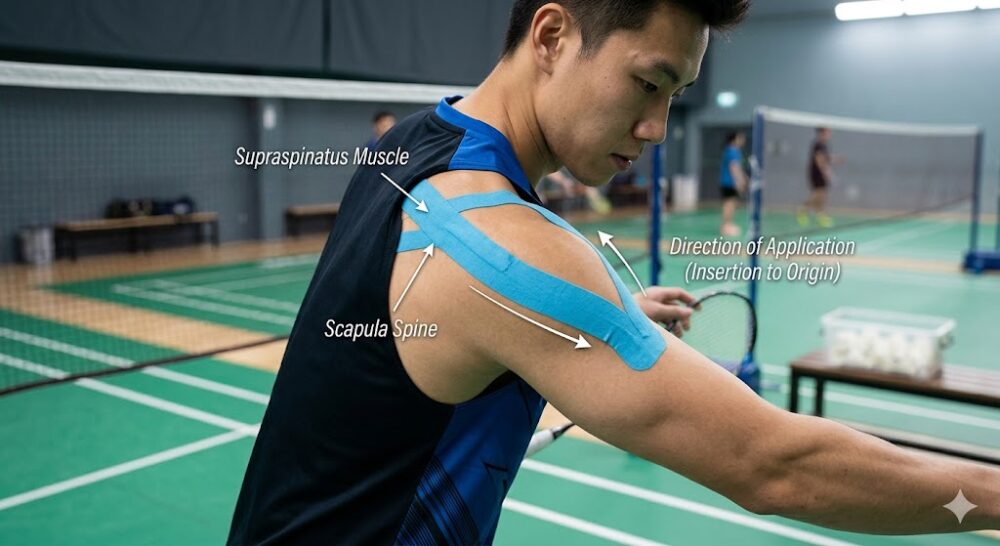 Kinesio Taping for rotator cuff support — supraspinatus facilitation strip technique used in Klang Valley sports rehabilitation.
5 Injury Five
Lateral Epicondylitis (Tennis Elbow) — The Badminton Backhand’s Signature Injury
Lateral epicondylitis — the extensor tendinopathy of the lateral elbow — is the most common overuse injury of the badminton wrist and forearm complex in Malaysian recreational players, caused specifically by the high-velocity backhand flick, the defensive backhand drive, and the net spin shot — all requiring rapid wrist extension and supination against eccentric load.
Why It’s Misnamed and Mismanaged
Despite its common name “tennis elbow,” this condition is ubiquitous in Malaysian badminton. The injury is a tendinopathy of the extensor carpi radialis brevis (ECRB) at its origin on the lateral humeral epicondyle — not a muscle tear. This distinction matters clinically: cortisone injection, the most commonly sought treatment at Malaysian klinik kesihatan, produces short-term pain relief but has demonstrated inferior long-term outcomes compared to structured loading rehabilitation.
Clinical Presentation
- Lateral elbow pain provoked by: gripping the racquet, towel-wringing motion, pouring action
- Positive Cozen’s test and Mill’s test
- Pain referral into the forearm extensor mass
Recovery Protocol
Sports Massage:
- Transverse frictions at the ECRB enthesis following the Cyriax protocol (controversial but widely practised in Malaysian sports physiotherapy)
- Wrist extensor neuromuscular release and forearm fascial decompression
- Thoracic spine mobility work — thoracic restriction elevates radial nerve mechanosensitivity and prolongs lateral elbow pain
Kinesio Taping — Lateral Elbow:
- Space correction technique applied over the ECRB belly from the lateral epicondyle to the mid-forearm
- Reduces compressive forces at the enthesis during gripping tasks
- Allows players to continue moderate-intensity play during the subacute phase without provoking tendon sensitisation
If your symptoms extend into the wrist or cause tingling, you should also explore non-surgical wrist pain and hand numbness relief options in the Klang Valley to rule out median nerve compression.
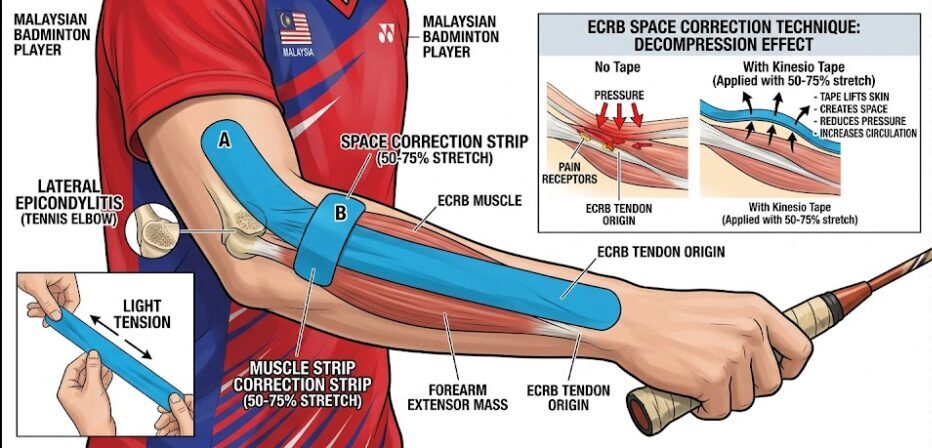 Kinesio Taping space correction technique applied to the ECRB belly for lateral epicondylitis management in Malaysian badminton players.
Why Certification Matters: What a Certified Sports Massage Practitioner Does Differently
A Certified Sports Massage Practitioner (CSMP) applies evidence-informed clinical reasoning to soft tissue treatment — not a generic relaxation massage rebranded for athletes. This distinction is critical for Malaysian players seeking genuine functional recovery rather than temporary symptomatic relief.
Mr. Raja, a Certified Sports Massage Practitioner serving clients across the Klang Valley (including Subang Jaya, Shah Alam, and Petaling Jaya), integrates:
Functional Movement Screening
Identifies the movement impairments upstream of the injury site — because the ankle sprain is often driven by a hip abductor weakness pattern, not just the ankle itself.
Kinesio Taping (KT)
A clinically structured neurosensory and biomechanical taping system, distinct from rigid sports strapping — applied in specific patterns matched to the phase of tissue healing.
Graduated Loading Prescription
Coordinated with the rehabilitation phase, preventing the premature return to full sport that produces the re-injury cycle devastating to the Klang Valley weekend warrior population.
Session Documentation
Tracks VISA scores, VAS pain ratings, and range-of-motion benchmarks across visits for objective, measurable recovery progress.
If you are managing a badminton-related soft tissue injury in Selangor, booking a session with a vetted Certified Sports Massage Practitioner is the clinically appropriate first step before returning to play. Explore ServicePro’s verified sports wellness practitioners and schedule your assessment today.
 A Certified Sports Massage Practitioner conducting a clinical soft tissue assessment for a badminton player in Subang Jaya, Selangor.
How Kinesio Taping Accelerates Badminton Injury Recovery
Kinesio Taping (KT) accelerates badminton injury recovery by modulating pain signalling, reducing oedema, facilitating inhibited musculature, and providing proprioceptive cueing without restricting the joint range of motion required to continue graded rehabilitation. Unlike rigid athletic strapping, which immobilises structures and can accelerate deconditioning, KT’s elastic properties (130–140% stretch capacity) mimic skin tension mechanics and work synergistically with movement.
Mechanisms Relevant to Badminton Injuries
| Mechanism | Clinical Effect | Relevant Injury |
|---|---|---|
| Epidermis lift (convolutions) | Increases interstitial space → lymphatic drainage | Ankle sprain (Grade I–II) |
| Mechanoreceptor stimulation | Proprioceptive re-education, reflex muscle activation | Ankle chronic instability |
| Fascial directional tension | Corrects scapular position, reduces impingement | Rotator cuff strain |
| Space correction | Reduces compressive load at enthesis | Lateral epicondylitis |
| Neurosensory inhibition | Reduces pain during loading tasks | Patellar tendinopathy |
KT application in badminton injury management is not a standalone treatment — it functions as an adjunct to sports massage, exercise rehabilitation, and load management within a structured recovery plan.
Return-to-Court Timeline: Realistic Expectations for Malaysian Badminton Players
Return-to-court timelines for common Malaysian badminton injuries range from 2 weeks (Grade I ankle sprain) to 12+ weeks (Grade III ankle sprain or severe rotator cuff tear), with most soft tissue injuries resolving to sports readiness within 4–8 weeks when managed with structured physiotherapy and sports massage. The single greatest predictor of prolonged recovery in the Malaysian recreational population is premature return to unsupervised play.
| Injury | Typical RT Play (Recreational) | Key Readiness Test |
|---|---|---|
| Ankle Sprain Grade I | 2–3 weeks | Single-leg hop, pain-free |
| Ankle Sprain Grade II | 4–6 weeks | SEBT anterior reach symmetry > 90% |
| Achilles Tendinopathy | 6–12 weeks | Single-leg calf raise × 25, pain < 2/10 |
| Patellar Tendinopathy | 6–10 weeks | VISA-P score > 80 |
| Rotator Cuff Strain (mild–moderate) | 4–8 weeks | Empty-can test pain-free, full ROM |
| Lateral Epicondylitis | 4–8 weeks | Pain-free grip strength ≥ 90% contralateral |
Note for Malaysian players: Court bookings at Klang Valley sports complexes — particularly during the period of September to March when humidity peaks and concurrent haze events raise airway irritant load — should account for an additional recovery buffer. Exercising in sub-optimal air quality during tissue healing increases systemic inflammation and can extend recovery timelines.
Frequently Asked Questions About Badminton Injuries and Recovery in Malaysia
You should not rest completely — controlled early mobilisation, not full rest, is the evidence-supported approach for ankle sprain recovery. A Grade I sprain requires 2–3 days of relative rest followed by guided mobilisation; a Grade II sprain typically requires 4–6 weeks of progressive rehabilitation. Complete rest beyond 72 hours has been shown to delay return-to-function by increasing joint stiffness and muscular inhibition. Seek assessment from a Certified Sports Massage Practitioner or physiotherapist in the Klang Valley within 48–72 hours of injury.
Yes — Kinesio Taping is widely used in Malaysian sports rehabilitation settings and is particularly effective for badminton-related soft tissue injuries. Its elastic properties allow continued mobility during recovery, making it suitable for the early-to-mid rehabilitation phases of ankle sprains, patellar tendinopathy, rotator cuff strains, and lateral epicondylitis. It should be applied by a certified practitioner who can match the taping technique to the specific phase of tissue healing.
Continued play with untreated lateral epicondylitis is possible with appropriate load management and Kinesio Taping, but playing through pain without clinical guidance significantly increases the risk of transitioning to a chronic, treatment-resistant tendinopathy. If your lateral elbow pain has persisted beyond 3 weeks, consult a Certified Sports Massage Practitioner for a loading programme that allows graduated continuation of play during recovery.
Sports massage sessions in the Klang Valley typically range from RM 80 to RM 200 per session (45–90 minutes), depending on the practitioner’s certification level, session duration, and the clinical complexity of the injury. Certified Sports Massage Practitioners with functional rehabilitation integration and Kinesio Taping services generally charge in the RM 120–180 range per session. ServicePro.my connects you with vetted practitioners with transparent published rates.
Yes — Malaysia’s chronic high ambient humidity (70–85% RH) meaningfully affects soft tissue injury recovery in several ways. Sweat retention in bandages and braces increases maceration risk and reduces Kinesio Tape adhesion duration (typically 3–5 days in tropical conditions vs. 5–7 days in temperate climates). Oedema management is also more challenging in humid environments. Practitioners in Klang Valley should use pre-tape spray and manage taping frequency accordingly.
Both roles are clinically relevant — a Certified Sports Massage Practitioner focuses on soft tissue dysfunction, neuromuscular recovery, and Kinesio Taping, while a physiotherapist provides broader diagnostic scope including exercise prescription and joint mobilisation. For soft tissue injuries without suspected fracture or nerve involvement, a Certified Sports Massage Practitioner is an appropriate and cost-effective first contact. Complex injuries, or those not responding within 2–3 weeks, warrant physiotherapy referral. Many practitioners in Selangor integrate both disciplines.
Yes — Petaling Jaya and Subang Jaya have a growing number of certified sports wellness practitioners who regularly treat badminton-related injuries in the Klang Valley recreational and competitive community. ServicePro.my’s vetted network includes practitioners in these areas offering sports massage, Kinesio Taping, and functional rehabilitation specifically relevant to court sport injuries.
Return to badminton after a rotator cuff strain is safe when you can demonstrate full, pain-free range of motion, external rotation strength within 90% of the unaffected side, and complete an overhead smash simulation without pain reproduction. This typically takes 4–8 weeks for mild-to-moderate strains managed with structured sports massage and rehabilitation. Return guided purely by pain resolution (rather than functional testing) is the most common cause of reinjury in Malaysian badminton players.
📅 Book Your Sports Massage & Kinesio Taping Assessment in the Klang Valley
Whether you’re dealing with an ankle sprain, Achilles pain, jumper’s knee, or a sore shoulder from smashing — our vetted Certified Sports Massage Practitioners across Selangor provide accurate clinical assessment and condition-specific recovery from the very first session.
Tap your location to open WhatsApp — no forms, no waiting.
The information in this article is intended for general educational purposes and does not constitute medical advice. Always consult a clinician registered with the Malaysian Medical Council (MMC) or a physiotherapist registered with the Malaysian Physiotherapy Association (MPA) for a diagnosis and personalised treatment plan. ServicePro.my connects Malaysians with vetted, verified healthcare and home service professionals across the Klang Valley and beyond.
Healthcare Questions. 0
Questions from our followers and readers within and beyond Klang Valley, answered by our healthcare specialists.
─── MORE HEALTHCARE INSIGHTS
Keep Reading
Continue building your knowledge on maintaining a healthy community in Malaysia.