
Home Palliative Care in Taiping: Controlling Cancer Pain Without a Hospital Admission
Palliative care is not the point at which treatment stops. It is the point at which comfort becomes the treatment — and it works better started early than late.

Clinical Standard: The World Health Organization identifies pain relief and palliative care as an essential component of cancer care, yet fear of opioid medication among patients and families remains one of the largest barriers to adequate pain control worldwide.
Authority Reference: Aligned with World Health Organization guidance on palliative care and cancer pain management
When a Taiping family is told there is nothing more to be done, what they usually hear is that nothing more will be offered. That is not what it means, and the gap between those two readings costs people months of unnecessary suffering.
Palliative care treats the symptoms rather than the disease: pain, breathlessness, nausea, agitation, and the exhaustion of the people doing the caring. It runs alongside active treatment when there is active treatment, and continues when there is not. Most of it happens at home, which is where the majority of people say they would prefer to be.
What Home Palliative Care Covers
A palliative home visit assesses symptoms systematically rather than waiting for the family to raise them, because patients routinely under-report pain to avoid worrying their children.
- Pain assessment and titration — finding the dose that controls pain without unacceptable side effects, then reviewing it as the illness changes.
- Breathlessness management — sesak nafas responds to positioning, a fan, low-dose opioids and anxiety management, often better than to oxygen alone.
- Nausea and constipation control — constipation from opioids is universal and is prevented rather than treated.
- Subcutaneous medication via syringe driver when swallowing becomes unreliable.
- Pressure area care for a patient spending most of the day in bed, which overlaps with bedsore prevention.
- Support for the family — practical teaching, and an honest account of what to expect.
The Morphine Conversation
Almost every family raises the same three fears, and all three deserve a direct answer.
“Will they become addicted?”
Addiction is a psychological dependence that develops in a pattern of use unrelated to pain. A patient taking opioids for cancer pain, at a dose titrated to that pain, does not follow that pattern. Physical tolerance and dependence are different phenomena — expected, managed, and not the same thing as addiction.
“If we start morphine now, will it still work later?”
There is no ceiling that gets used up. Opioid doses are increased as the disease progresses, and there is no fixed maximum in palliative practice. Withholding pain relief early to preserve its effect later has no pharmacological basis and simply produces months of avoidable pain.
“Does starting morphine mean the end is close?”
No. Morphine is a pain treatment, not a stage of illness. Patients start it and continue for a long time, sometimes years. The association exists because it is so often started far too late — which is a criticism of the timing, not the drug.
 A syringe driver gives a steady dose under the skin over 24 hours — used when swallowing has become difficult, not as a sign the end is near.
What a Syringe Driver Is, and Is Not
A syringe driver is a small battery-powered pump that delivers medication continuously under the skin over 24 hours through a fine cannula. It is used when a patient can no longer reliably swallow, or when vomiting prevents oral medication from being absorbed.
Families frequently interpret it as a signal that death is imminent, and sometimes resist it for that reason. It is a delivery route. A patient on a driver can be sitting up and talking, and some are switched back to oral medication when their swallowing improves. What it does provide is steady control instead of the peaks and troughs of intermittent doses — which for a patient who was waking in pain every few hours is a substantial change.
Managing Cancer Pain at Home in Taiping?
Our doctor and nursing team provide home palliative visits across Taiping — pain titration, breathlessness management and support for the family doing the caring.
Caring for the Carer
The person most likely to break down in a home palliative situation is not the patient. It is the daughter or son who has taken leave, is sleeping in two-hour fragments, and feels unable to admit that they are struggling because the patient is the one who is ill.
This is worth naming early. Practical support — a night nurse for two nights a week, or a short respite stay — is not a failure of devotion. Carers who collapse mid-course force exactly the emergency admission the family was trying to avoid.
When Home Is No Longer the Right Place
Most people can be cared for at home to the end if that is the wish and the support exists. Some cannot, and recognising the point honestly is part of good care rather than a defeat.
- Symptoms that cannot be controlled in the home setting despite adjustment.
- A carer who is no longer safe to continue through exhaustion or their own illness.
- A patient who is frightened at home and would feel safer with staff present around the clock.
- Nursing needs beyond what visits can cover — repositioning every two hours through the night is not achievable by one exhausted relative.
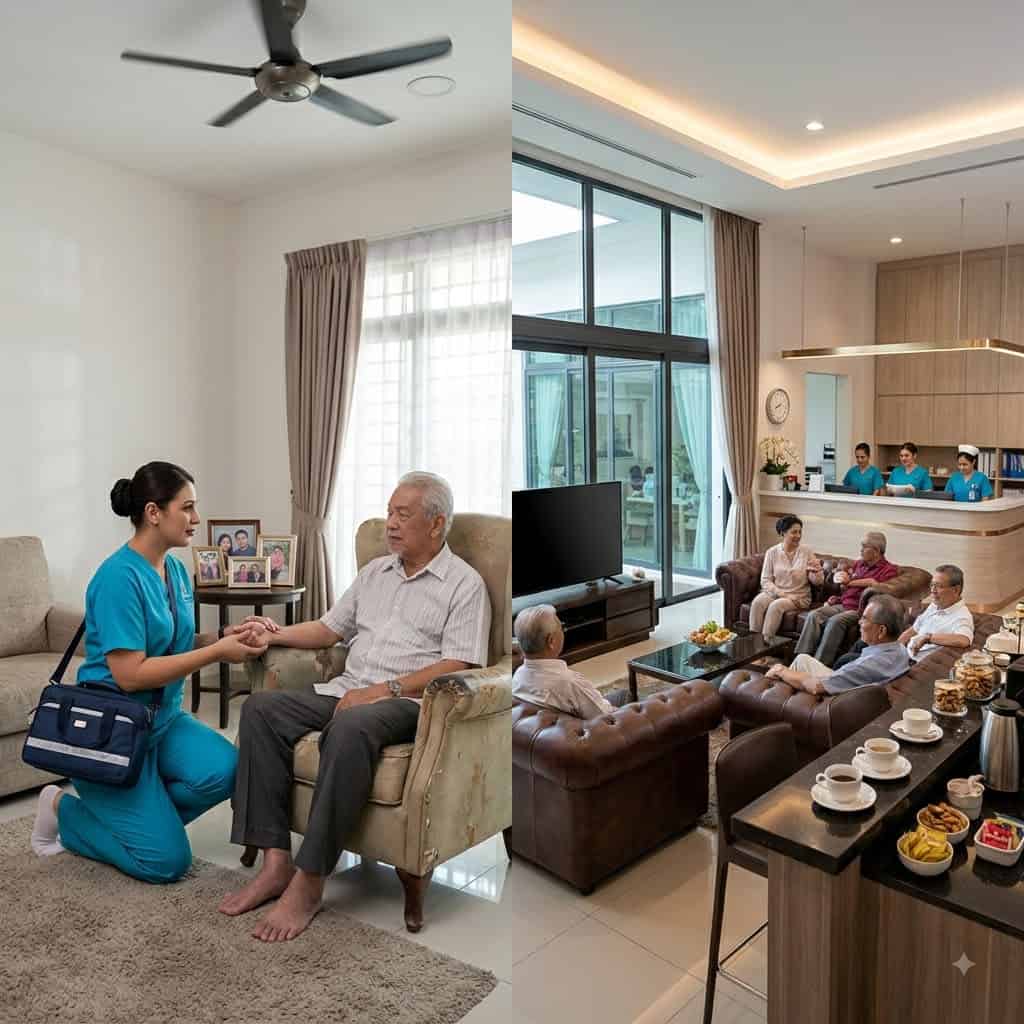
Our comparison of home care against residential care works through that decision, and nursing home in Taiping provides the continuous cover a visit schedule cannot. A daytime doctor visit is RM 150 to RM 220 and a nurse visit RM 120 to RM 180, with medication and consumables at cost; where visits become near-daily it is worth comparing the monthly total against residential care.
Frequently Asked Questions
Helpful answers to common questions about Home Palliative Care.
No. Palliative care treats symptoms — pain, breathlessness, nausea, agitation — and runs alongside active treatment where active treatment is still happening. It is most effective when started early rather than reserved for the final weeks.
Addiction is psychological dependence with use unrelated to pain, and it is not the pattern seen in patients taking opioids titrated to cancer pain. Physical tolerance and dependence are different, expected, and managed clinically. Fear of addiction is one of the main reasons pain goes under-treated.
No. There is no fixed ceiling dose in palliative practice — doses are increased as the illness progresses. Delaying pain relief to preserve its effect has no pharmacological basis and causes avoidable suffering in the meantime.
No. It is a route of delivery used when swallowing becomes unreliable or vomiting prevents absorption. Patients on syringe drivers can be alert and conversational, and some return to oral medication when swallowing improves.
Through positioning, a fan directed at the face, low-dose opioids, and treatment of the anxiety that breathlessness generates — the sensation and the fear amplify each other. Oxygen helps when oxygen levels are genuinely low but is often less useful than families expect.
It is routinely provided at home across Taiping and the surrounding district through scheduled doctor and nurse visits, with medication supplied and adjusted between visits. Most patients prefer home, and most symptoms can be controlled there.
Practical teaching, symptom guidance, and arranged relief — night nursing cover or a short respite stay. This matters clinically: a carer who collapses forces the emergency admission the family was trying to avoid.
A daytime doctor visit is RM 150 to RM 220 and a registered nurse visit RM 120 to RM 180, with medication, syringe driver consumables and dressings billed at cost. Visit frequency is set by symptom control needs, and where visits approach daily it is worth comparing the monthly total against residential care.
Popular Related Insights
Explore key guides and healthcare insights for elderly care in Taiping.


Ready to Explore Elderly Care Options in Taiping?
Book a free virtual tour, schedule a doctor consultation, or speak directly to our medical team today.
💬 WhatsApp Us NowPart of the ServicePro.my Healthcare Hub Network. All rights reserved.
Disclaimer: Some images used on this page are representational illustrations of clinical procedures and senior accommodations. Actual layout and equipment may vary.
Common Questions About Home Palliative Care
Helpful answers from our healthcare team on this subject.