Post-Renovation Cleaning in Malaysia: The 8 Surfaces Most Homeowners Miss
After a renovation, silica dust, VOC residue, and construction debris hide in 8 critical spots — false ceiling tracks, AC vents, cabinet interiors, window grooves, grout lines, switch plates, under built-in furniture, and exhaust fan grilles. Missing them degrades your indoor air quality for months.
Book a part-time maid for post-renovation cleaning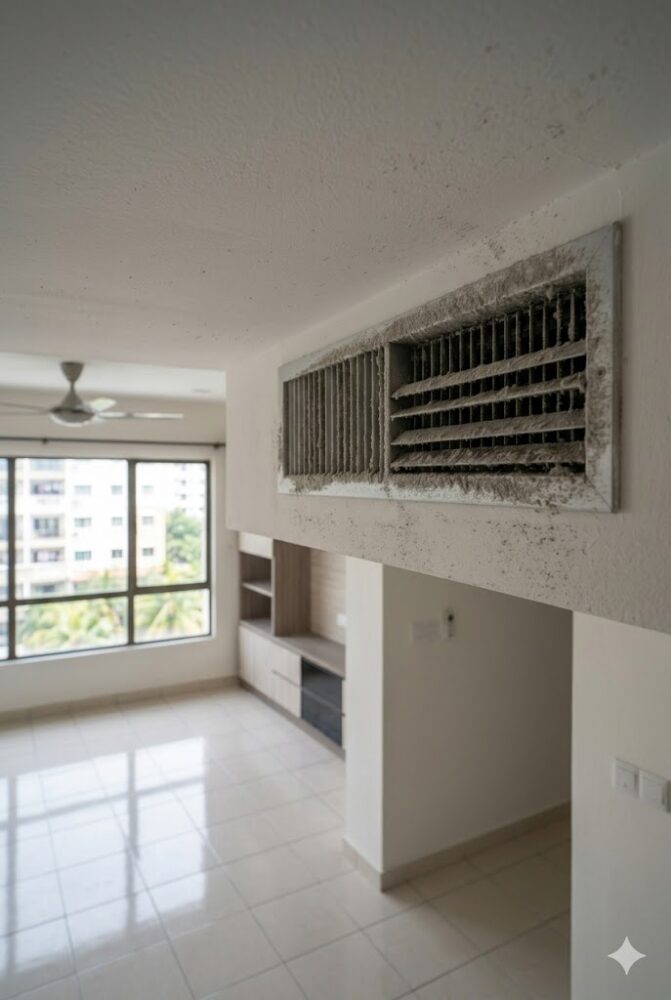
Why Post-Renovation Cleaning in Malaysia Is More Demanding Than in Other Countries
Post-renovation cleaning in Malaysia is significantly harder than in temperate climates because the country’s year-round humidity (averaging 80–90% RH) causes fine construction dust to bond with moisture and adhere to surfaces like a paste, rather than sitting loosely.
- Silica dust from cement cutting, tile hacking, and plaster work is the primary hazard. It is classified as a Group 1 carcinogen by the International Agency for Research on Cancer (IARC) and lodges in vents, ceiling tracks, and soft furnishings.
- VOC off-gassing from new paints, varnishes, and laminate flooring continues for 6–12 weeks after completion, coating smooth surfaces with a thin, sticky film that traps subsequent dust.
- Tropical mould risk is elevated post-renovation. Any moisture trapped inside wall cavities or under new flooring during work creates an immediate mould incubation environment — especially critical in Klang Valley, Penang, and Johor Bahru where humidity rarely drops below 70% even in dry months.
- Malaysian condo and terrace house builds frequently use spray-applied ceiling texture, which has a highly porous surface that traps fine particulate for far longer than a smooth plaster ceiling.
The result: A standard mop-and-wipe clean is insufficient. Professional-grade post-renovation cleaning in Malaysia requires HEPA-filtered vacuuming, wet-extraction on soft surfaces, and targeted chemical treatment on grout and metal fixtures.
The 8 Surfaces Malaysian Homeowners Miss After Renovation (And Why They Matter)
These are ranked in order of health risk and frequency of oversight, based on operational data from vetted cleaning professionals across the Klang Valley.
False Ceiling Tracks and Cornices
False ceiling systems (plaster or PVC cornice) are standard in Malaysian condos and new-build terrace houses. During renovation, fine gypsum and cement dust settles inside the recessed channel between the cornice and the structural ceiling — a space no standard vacuum attachment can reach without a crevice tool.
Why it matters: This channel is directly above the living space airflow. Each time the air-conditioning system cycles, it draws air across this debris field and redistributes fine particles into the breathing zone.
What to use: A narrow crevice nozzle on a HEPA vacuum, followed by a damp microfibre cloth. Do not use compressed air — this re-aerosolises the silica.
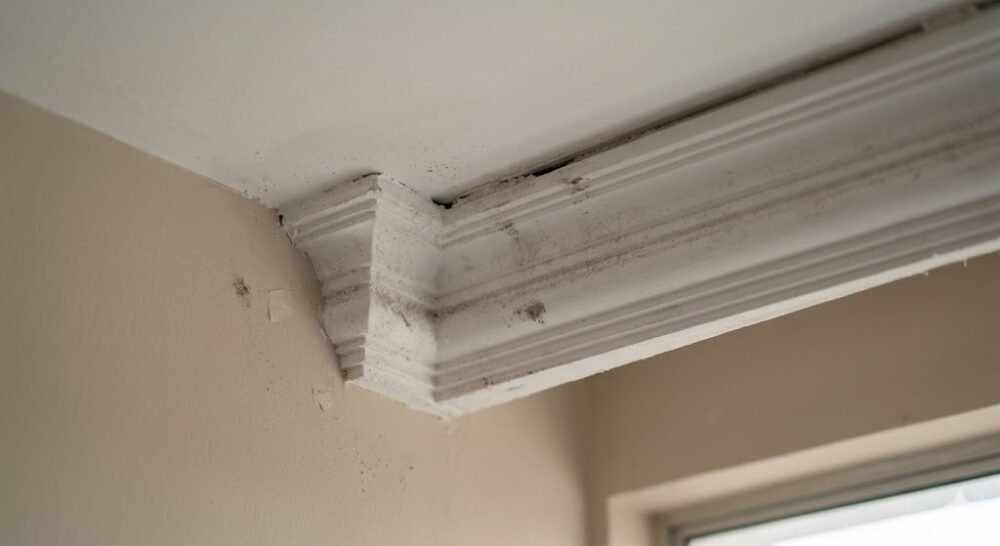 False ceiling cornice track filled with gypsum and cement dust — a common miss in Malaysian post-renovation cleaning.
Air-Conditioning Vents and Fan Coil Units (FCU)
Air-conditioning is non-negotiable in Malaysia. During renovation, contractor teams rarely seal the FCU — meaning the blower, evaporator coil, and drainage tray are fully exposed to construction dust throughout the project timeline.
A single renovation cycle can deposit enough particulate inside an FCU to reduce its efficiency by 15–25% and become a continuous source of airborne silica and biological contaminants (once humidity activates mould growth on the coil).
Post-renovation AC cleaning is a distinct, specialist service — not a standard split-unit wash. It requires full disassembly, coil chemical wash, and drainage tray sanitisation. For a thorough resolution, homeowners should schedule a professional air-conditioning deep cleaning service after renovation work is complete, before the unit is run continuously.
Pro Tip (Malaysia-specific): If your renovation took place during the Northeast Monsoon season (November–February), assume mould contamination of the FCU is likely. Request a mould count test before or during the cleaning.
Inside New Kitchen Cabinet Interiors
New kitchen cabinets — whether custom-built in Malaysia by local carpentry contractors or from flat-pack suppliers — arrive and are installed in the middle of a dusty construction environment. The interior shelving, hinge cavities, and panel seams all accumulate fine sawdust and laminate particulate from on-site cutting, VOC residue from the melamine or lacquer finish (which is tacky and attracts dust), and silicone sealant smears at the base and back panel joints.
The cleaning protocol: Wipe all interior surfaces with a diluted neutral detergent, dry thoroughly, then allow 24–48 hours with cabinet doors open before storing food or cookware. This also allows residual VOCs to off-gas safely.
Window Frame Grooves and Sliding Track Channels
Aluminium sliding windows (standard in Malaysian apartments and terrace houses) have multi-channel tracks at the base and top. During renovation, these fill with a dense mixture of cement slurry from floor screed work, paint drips often left uncleaned by contractors, and metal filings from grille installation or window hardware fitting.
Once dried, this material is extremely difficult to remove and promotes rust formation on the aluminium track, leading to stiff or non-functional window operation within 6–12 months.
What to use: A stiff-bristle detailing brush with a diluted acidic cleaner (citric acid solution is safer than muriatic acid for DIY use). Rinse thoroughly and dry.
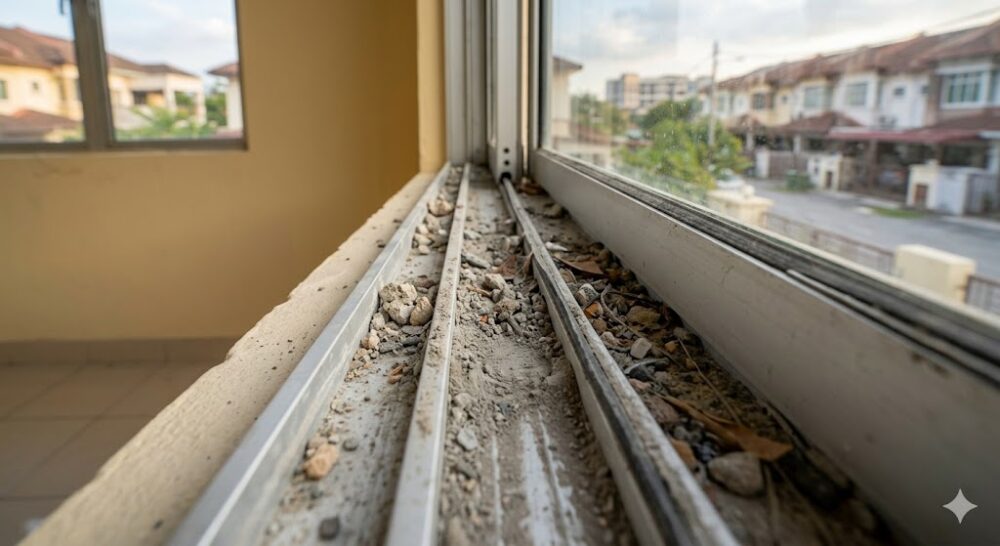 Clogged aluminium sliding window track after renovation — cement slurry, paint drips, and metal filings combine to jam the mechanism.
Tile Grout Lines (Especially on New Porcelain or Homogeneous Tile)
This is one of the most common post-renovation complaints in Malaysia. Contractors routinely leave grout haze — a thin film of dried grout across the tile surface and within the grout lines — because final polishing was rushed or skipped before handover.
On light-coloured tiles (popular in modern Malaysian interiors), grout haze creates a persistent milky, dull appearance that cannot be removed by standard mopping. Infected grout lines — where construction water has penetrated the grout before it fully cured — will show early signs of black mould within 4–8 weeks in Malaysia’s humidity.
Correct treatment: A dedicated grout haze remover (phosphoric acid-based) applied with a stiff nylon brush, followed by grout sealing to prevent future moisture ingress.
Electrical Switch Plates and Socket Face Plates
Every light switch, power socket, and data point has a face plate that is removed during plastering and painting, then re-fitted afterward. The cavity behind the face plate — between the plate and the plaster wall — collects fine dust that is never addressed.
This is a low health-risk item but a high VOC accumulation zone, as the enclosed cavity traps off-gassing from new paint.
The fix: Remove each face plate, wipe the cavity, and replace. Takes approximately 5 minutes per plate. Use a dry microfibre cloth only — moisture near electrical terminals is a hazard. If in doubt, isolate the circuit at the DB box first.
Under and Behind Built-In Furniture Bases
Malaysian renovation contracts almost always include built-in wardrobes, TV cabinets, and kitchen cabinets. The floor area under and directly behind these units is cleaned once by the contractor before installation (sometimes), and never accessible again after the unit is fixed to the wall.
This creates a sealed chamber of construction debris — silica dust, sawdust, screws, wire offcuts — that sits directly on your flooring, often against skirting with gaps that allow fine particulate to circulate into the room air.
The window for action is narrow: This is the one surface you can only properly clean before the units are permanently fixed. If your contractor is installing built-ins, request a scheduled cleaning pass of the floor area immediately before final fixing.
Bathroom Exhaust Fan Grilles and Ducts
Bathroom exhaust fans draw air from the wettest room in the house and expel it to the external wall or roof cavity. During renovation, grilles are rarely sealed so they fill with plaster and paint dust, the fan blade and motor housing accumulates the same debris, and if tile grouting or waterproofing work was done in the bathroom, VOC and adhesive vapour concentrations inside the duct will be high.
A blocked or dirty exhaust fan post-renovation dramatically reduces bathroom ventilation efficiency — which in Malaysia’s humidity accelerates mirror fogging, towel mould, and ceiling staining above the shower area.
Cleaning protocol: Remove the grille, wash with detergent, dry fully before re-fitting. Clean the fan blade with a damp cloth (power isolated). Check the duct exit point on the external wall is clear of debris.
Should You DIY Post-Renovation Cleaning or Hire a Professional in Malaysia?
You should hire a professional for post-renovation cleaning if any of the following apply:
Hire a Professional When…
- The renovation involved hacking (tile or wall demolition) — silica dust requires HEPA-rated equipment to capture safely. A domestic vacuum will recirculate it.
- The property is a condo or high-rise — restricted ventilation and shared air-handling systems mean thorough internal cleaning is essential before occupancy.
- Soft furnishings were present during renovation — curtains, carpets, and sofas will have absorbed VOCs and embedded silica requiring professional extraction.
- You have children, elderly, or occupants with respiratory conditions — MOH Malaysia has noted that fine particulate from construction is a significant indoor air quality hazard.
DIY Is Reasonable When…
- Renovation scope was minor — repainting only with no hacking or structural work performed.
- No soft furnishings were present during the renovation period.
- You own HEPA-rated equipment and follow the staged cleaning protocol correctly.
- No children or vulnerable occupants will be moving in immediately after cleaning.
Keep in mind that post-renovation cleaning is just the baseline. Once you move in, maintaining indoor air quality requires regular upkeep. If you are moving into a high-rise, read our guide on the weekly cleaning routines required for Malaysian condos to prevent construction dust from recirculating.
To book a vetted, trained post-renovation cleaning team that covers all 8 of these critical surfaces, visit the ServicePro.my Post-Renovation Cleaning service page and get an instant quote from verified professionals in your area.
How Long After Renovation Should You Wait Before Deep Cleaning?
You should begin post-renovation deep cleaning no earlier than 72 hours after all contractor work is complete. However, the full cleaning process should be staged:
| Stage | Timing | Task |
|---|---|---|
| Stage 1 | Day 1–3 post-handover | Ventilate fully. Open all windows and run exhaust fans continuously. Do not clean yet — let settleable dust settle. |
| Stage 2 | Day 3–5 | HEPA vacuum all surfaces (walls, ceilings, floors). Do not mop yet. Mopping before vacuuming turns fine dust into a paste. |
| Stage 3 | Day 5–7 | Wet-wipe all hard surfaces. Mop floors with neutral pH cleaner. Clean window tracks, grout lines, and switch plates. |
| Stage 4 | Day 7–14 | Schedule specialist services: AC deep clean, grout sealing, upholstery cleaning if soft furnishings were present during reno. |
Malaysian-specific note: If renovation occurred during the dry season (June–August, Southwest Monsoon), dust loads are typically higher due to reduced ambient humidity, meaning more aggressive HEPA vacuuming passes are required before wet-wiping.
What Does Professional Post-Renovation Cleaning Cost in Malaysia?
Post-renovation cleaning in Malaysia is typically priced by square footage (psf) or by property size tier.
| Property Size | Estimated Cost (RM) | Scope |
|---|---|---|
| Studio / 1-bed condo (< 700 sqft) | RM 250 – RM 400 | Standard post-reno clean |
| 2–3 bed condo (700–1,200 sqft) | RM 400 – RM 700 | Standard post-reno clean |
| Terrace house (1,200–1,800 sqft) | RM 600 – RM 900 | Standard post-reno clean |
| Semi-D / Bungalow (> 1,800 sqft) | RM 900 – RM 1,500+ | Standard post-reno clean |
| AC deep cleaning (per unit) | RM 80 – RM 150 | Add-on specialist service |
| Grout cleaning and sealing (per sqft) | RM 1.50 – RM 3.00 | Add-on specialist service |
Pricing note: Rates above reflect Klang Valley market rates as of 2025. Rates in Penang, Johor Bahru, and other major cities are broadly comparable. Rates in East Malaysia (Sabah, Sarawak) may vary by 10–20%. Always request itemised quotations from verified service partners.
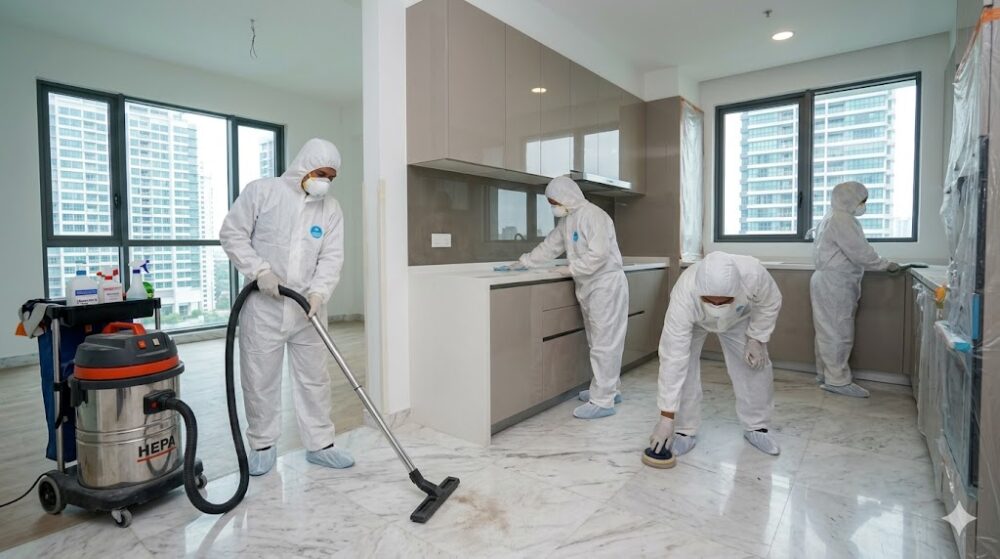 A vetted post-renovation cleaning team in PPE — HEPA equipment and specialist chemicals are essential for safe silica removal in Malaysian condos.
Frequently Asked Questions About Post-Renovation Cleaning in Malaysia
You should wait a minimum of 7–14 days after renovation completion and after full post-renovation cleaning before moving in. Malaysia’s high humidity means VOC concentrations from new paint and laminates remain elevated for longer than in cooler climates. Run all fans and air-conditioning with open windows for the first week to accelerate off-gassing.
Yes, post-renovation cleaning is a distinct, higher-intensity service. It addresses silica dust, grout haze, VOC residue, and construction debris that regular cleaning does not target. Standard cleaning companies without specific post-reno experience and HEPA equipment are not equipped to perform it safely or effectively.
Most post-renovation cleaning packages in Malaysia do not include air-conditioning deep cleaning as a standard item — it is almost always quoted as a separate add-on. Always ask your service provider explicitly, and request that the FCU be fully cleaned before the unit is run continuously in a freshly renovated space.
The most common cause is grout haze — a film of dried grout left on the tile surface by the tiler — combined with construction dust that has settled into the uncured grout lines. This requires a phosphoric acid-based grout haze remover, not regular mopping. In Malaysia’s humidity, mould can begin colonising uncured grout within 2–4 weeks if the bathroom has not been properly sealed and dried.
Look for companies that explicitly list HEPA vacuuming as part of their process, carry public liability insurance, and have verifiable reviews from condo and landed property clients in Klang Valley or your specific city. Avoid contractors who quote unusually low prices (below RM 200 for a standard condo) — these typically use domestic vacuums and skip specialist surfaces. ServicePro.my lists vetted partners with verified credentials and transparent pricing.
Yes. A single renovation cycle can introduce enough fine particulate into an unprotected FCU to reduce its cooling efficiency by up to 25% and significantly increase its energy consumption. Post-renovation AC cleaning is not a luxury — it is a maintenance necessity, and one that will extend the lifespan of your unit.
Post-renovation cleaning specifically addresses the residues left by construction work (silica, grout haze, VOC film, and building material debris). Deep cleaning refers to a thorough cleaning of an occupied property (accumulated domestic dust, grease, limescale, biological matter). They use different chemistry, different equipment protocols, and different skill sets. Some companies offer both; always confirm which service you are booking.
Post-renovation cleaning will reduce the VOC load on surfaces (which re-emits the smell), but it cannot fully eliminate the smell on its own. The primary solution is aggressive ventilation — running fans and air-conditioning with open windows continuously for 7–14 days. For severely impacted units, activated carbon air purifiers and VOC-absorbing plants (such as Boston fern or peace lily) can assist in the first 4 weeks.
📅 Book Your Post-Renovation Cleaning in the Klang Valley
Whether it’s a condo, terrace house, or semi-D, our vetted post-renovation cleaning partners cover all 8 missed surfaces with HEPA equipment and specialist chemicals — so your home is truly clean before move-in. Tap your location to connect instantly.
The information in this article is intended for general educational purposes and does not constitute professional health or safety advice. ServicePro.my connects Malaysians with vetted, verified hygiene and home service professionals across the Klang Valley and beyond.
Hygiene Questions. 0
Questions from homeowners within and beyond Klang Valley, answered by our hygiene specialists.
─── MORE HYGIENE INSIGHTS
Keep Reading
Continue building your knowledge on maintaining a hygienically clean home in Malaysia’s tropical climate.