Post-Surgical Orthopedic Rehabilitation: What Klang Valley Patients (and Their Families) Should Expect
Recovering from orthopedic surgery is a two-part process. The surgery corrects the structural problem. Physiotherapy is what restores your life. This guide explains exactly what to expect — week by week, stage by stage.
Consult a Verified Sungai Buloh Physiotherapist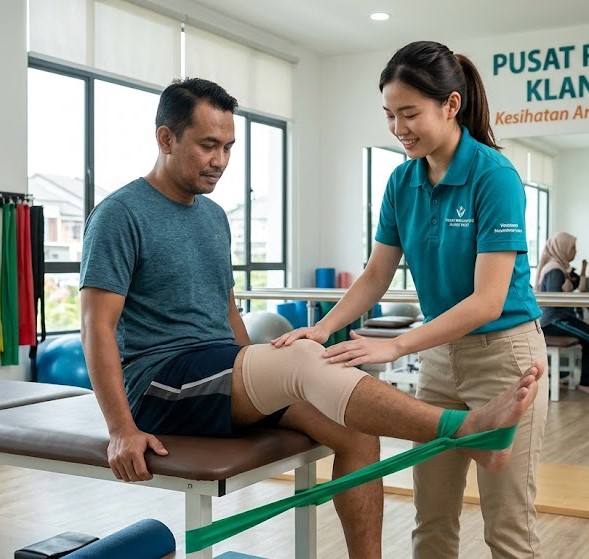
For families in the Klang Valley managing a parent, spouse, or child through post-surgical recovery, the rehabilitation phase is often the most misunderstood, most emotionally demanding, and most clinically consequential part of the entire journey. This guide explains exactly what to expect — week by week, stage by stage — and why skipping or delaying physiotherapy is the single most common reason Malaysian patients experience poor long-term surgical outcomes.
If you are specifically preparing for knee surgery, you may also want to review our complete TKR (Total Knee Replacement) rehab roadmap to understand condition-specific timelines before your procedure.
What Is Post-Surgical Orthopedic Rehabilitation in Malaysia?
Post-surgical orthopedic rehabilitation is a structured, clinician-supervised program of therapeutic exercises, manual therapy, and functional training designed to restore movement, strength, and independence after bone or joint surgery.
In Malaysia, this form of rehabilitation is delivered primarily by licensed Physiotherapists registered under the Allied Health Professions Act 2016 and regulated by the Allied Health Professions Council (AHPC). Orthopedic rehab is distinct from general fitness recovery — it is a clinical intervention, prescribed specifically to the type of surgery performed, the patient’s age, comorbidities, and recovery goals.
What Types of Orthopedic Surgeries Require Structured Rehab?
Total Knee Replacement (TKR) — among the most performed at HKL, Ampang Hospital, PPUM
Total Hip Replacement (THR)
ACL / PCL Reconstruction — increasingly common in younger, active Malaysians
Rotator Cuff Repair (shoulder surgery)
Spinal Fusion or Laminectomy
Fracture fixation (ORIF — Open Reduction Internal Fixation)
Ligament and tendon repair
Clinical Note: The Malaysian Orthopaedic Association (MOA) and the Ministry of Health Malaysia (MOH) clinical practice guidelines both identify early physiotherapy initiation as a Grade A recommendation in post-surgical care protocols.
Why Is Physiotherapy So Highly Recommended After Orthopedic Surgery?
Physiotherapy is highly recommended after orthopedic surgery because without guided neuromuscular re-education and progressive loading, surgical repairs fail to integrate properly — leading to stiffness, chronic pain, muscle atrophy, and re-injury risk.
This is not marketing language. This is clinical consensus. Here is a precise breakdown of what physiotherapy does that passive rest simply cannot:
It Prevents Joint Stiffness (Arthrofibrosis)
After knee or hip replacement surgery, scar tissue forms rapidly in the joint capsule. Without early, controlled mobilization, this scar tissue hardens — a condition called arthrofibrosis. Once established, arthrofibrosis often requires a second surgical procedure (manipulation under anaesthesia) to correct. Physiotherapy starts gentle range-of-motion work within 24–48 hours post-surgery in most contemporary protocols.
It Rebuilds Neuromuscular Control
Surgery disrupts the proprioceptive nerve pathways that tell your brain where your limb is in space. This is why post-surgical patients frequently feel “unstable” even after the structural repair is complete. Physiotherapists use targeted balance, gait training, and perturbation exercises to re-establish motor control — something no amount of passive rest can achieve.
It Manages Post-Surgical Swelling (Oedema)
Swelling is normal after orthopedic surgery, but unmanaged oedema delays tissue healing and increases pain. Physiotherapy employs manual lymphatic drainage, compression therapy, elevation and cryotherapy protocols, and electrical modalities (TENS, NMES) to reduce inflammation.
It Prevents Deep Vein Thrombosis (DVT)
This is particularly critical in Malaysia’s climate. Heat and humidity can exacerbate circulatory sluggishness in post-surgical patients. Early physiotherapy-guided ankle pumps, leg exercises, and ambulation training significantly reduce DVT risk — a potentially fatal complication of lower limb surgery.
It Restores Functional Independence
The ultimate clinical goal of orthopedic surgery is the patient’s ability to climb stairs in a terrace house, walk to the LRT, return to work, perform ADLs (Activities of Daily Living) including prayer positions for Muslim patients, and return to recreational activities like badminton, cycling, or hiking at Bukit Broga. Only structured physiotherapy produces measurable, documented functional recovery outcomes.
How Are Klang Valley Children and Teenagers Managing Post-Surgical Orthopedic Rehab?
Younger patients in the Klang Valley — particularly adolescents recovering from sports-related orthopedic surgeries such as ACL tears — face a unique set of rehabilitation challenges that differ significantly from adult patients.
Malaysia’s school sports culture (MSSM competitions, SUKMA development pathways, futsal leagues) and the rise of youth athletic programs have made ACL reconstruction in teenagers increasingly common. For parents managing a child’s rehab, here is what is clinically different:
Growth Plate Considerations
Adolescent patients whose growth plates (physes) have not yet closed require modified surgical techniques and modified rehabilitation protocols. A physiotherapist experienced in paediatric and adolescent orthopedic rehab will adjust loading timelines, exercise selection, and return-to-sport criteria accordingly.
Psychological Readiness vs. Physical Readiness
Teenagers frequently feel physically ready to return to sport before their neuromuscular system is clinically ready. This is the most common cause of ACL re-rupture in young athletes. A qualified physiotherapist uses objective functional testing (hop tests, strength symmetry indices) — not the patient’s subjective confidence — to determine return-to-sport clearance.
School Attendance and Compliance
Managing physiotherapy sessions (typically 2–3 sessions per week for 3–6 months) around school schedules is a practical challenge. Choose a rehab centre with flexible AM/PM appointment slots, request a formal MC for school PE exemption periods, and ensure the school is formally notified of weight-bearing restrictions, especially for students using crutches.
Parental Involvement Is Clinically Documented
Research consistently shows that adolescent patients with active parental involvement in home exercise program (HEP) compliance achieve significantly better outcomes. Parents should attend at least the first two physiotherapy sessions to understand the HEP, precautions, and red flags.
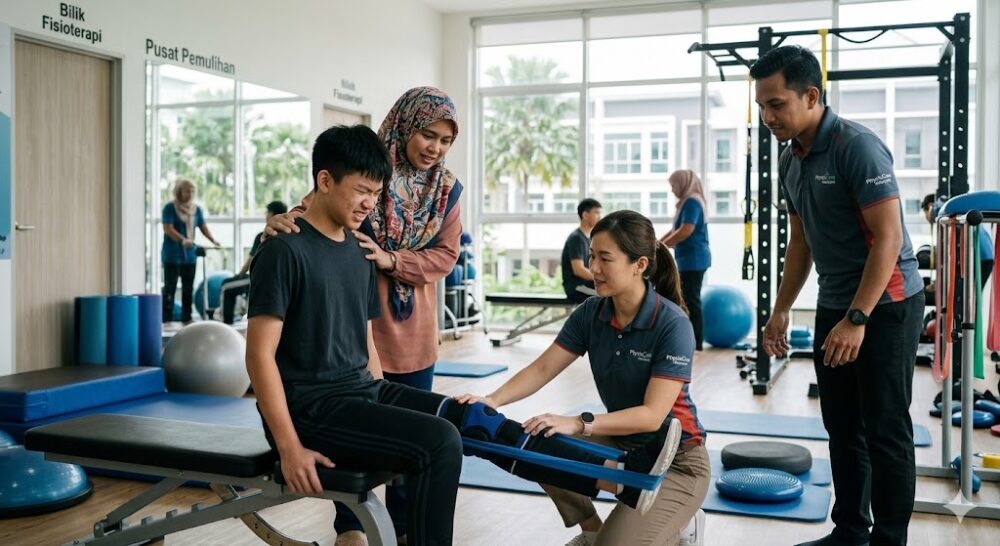 Parental involvement in adolescent ACL rehabilitation is clinically documented to improve outcomes — attend the first two sessions with your child.
What to Expect: A Week-by-Week Rehabilitation Timeline
The standard post-surgical orthopedic rehabilitation timeline spans 12 to 24 weeks, divided into distinct phases — each with specific clinical milestones your physiotherapist will assess before progression.
Note: The timeline below reflects a Total Knee Replacement (TKR) protocol, one of the most common post-surgical rehab pathways in Malaysia. ACL, hip, and shoulder protocols differ — your physiotherapist will customize accordingly.
Acute Phase — Hospital to Home
- Goals: Pain and oedema management, prevent DVT, initiate passive range of motion
- Key exercises: Ankle pumps, quad sets, heel slides, supported standing
- Weight-bearing status: Partial weight-bearing with assistive device (walker or crutches)
- Expected ROM target: 0–60° knee flexion by Day 7
Early Rehabilitation — Building Foundation
- Goals: Restore full ROM, initiate strengthening, normalize gait pattern
- Key exercises: Short arc quads, terminal knee extensions, stationary cycling, step-ups
- Weight-bearing status: Progressive to full weight-bearing (as tolerated)
- Expected ROM target: 0–110° by Week 6
- Session frequency: 2–3 sessions per week at rehab centre
Progressive Strengthening — Functional Training
- Goals: Strength symmetry (target: 70–80% of unaffected limb), improve balance and proprioception
- Key exercises: Leg press, closed kinetic chain exercises, balance board training, stair negotiation
- Weight-bearing status: Full weight-bearing without assistive device (most patients)
- Functional milestone: Independent stair climbing, 10-minute continuous walking
Return to Function — Activity-Specific Training
- Goals: Full ADL independence, return to recreational activity, discharge planning
- Key exercises: Sport-specific or occupation-specific functional drills, advanced proprioception
- Final assessment: Functional movement screen, patient-reported outcome measures (KOOS, WOMAC)
- Discharge criteria: Documented strength symmetry ≥85%, pain ≤2/10 on VAS, full functional independence
How Much Does Physiotherapy Cost in Malaysia After Orthopedic Surgery?
Post-surgical physiotherapy session fees in Malaysia typically range from RM 80 to RM 250 per session at private rehabilitation centres, depending on location, session duration, and modalities used.
Here is a practical cost breakdown for Klang Valley patients:
| Setting | Estimated Cost Per Session | Notes |
|---|---|---|
| MOH Government Hospital (outpatient) | RM 5 – RM 15 | Referral required; long waiting times |
| University Hospital (PPUM, UiTM) | RM 15 – RM 50 | Subsidized; specialist oversight |
| Private Rehab Centre (Klang Valley) | RM 80 – RM 180 | Flexible hours; shorter wait |
| Premium Sports Rehab Clinic (KL) | RM 150 – RM 250 | Sports medicine focus |
Does Malaysian Insurance Cover Post-Surgical Physiotherapy?
Panel insurance coverage varies significantly. Major insurers including AIA, Great Eastern, and Prudential offer physiotherapy riders — check your policy’s outpatient or physiotherapy benefit limit.
Most policies cover post-surgical physiotherapy if initiated within 90 days of the surgical procedure and with a referring surgeon’s letter.
EPF medical withdrawal (Account 2) can be utilized for physiotherapy treatment at registered healthcare providers.
Always request an official receipt and itemized treatment invoice for insurance claims.
How to Choose the Right Orthopedic Rehabilitation Centre in Klang Valley
The right orthopedic rehabilitation centre should have AHPC-registered physiotherapists, post-surgical rehabilitation experience, and the clinical infrastructure to deliver modality-based treatment — not just exercise coaching.
AHPC-registered physiotherapists — verify registration at ahpc.moh.gov.my
Dedicated orthopedic or musculoskeletal physiotherapy specialty
Access to clinical modalities: ultrasound therapy, shortwave diathermy, TENS, hydrotherapy (where available)
Collaboration with your operating surgeon — the best centres send progress reports to your orthopedic surgeon
Documented outcome measurement — they should track your ROM, strength, and pain scores at every visit
Home Exercise Program (HEP) provision — structured printed or digital HEP between sessions
Location accessibility — proximity to LRT/MRT stations or adequate parking (critical if you are on crutches)
For patients in the greater Klang Valley area, you can easily schedule a clinical assessment at our verified post-surgical rehabilitation clinic in Sungai Buloh — all listed partners are AHPC-compliant and experienced in rigorous post-surgical protocols.
Frequently Asked Questions About Post-Surgical Orthopedic Rehabilitation in Malaysia
Physiotherapy should begin within 24 to 72 hours after most orthopedic surgeries, while you are still in the hospital. Your surgeon or the hospital’s inpatient physiotherapy team will initiate the acute phase. Outpatient physiotherapy at a rehab centre typically begins within the first 1–2 weeks of discharge.
Some discomfort during physiotherapy after knee replacement is normal and expected — particularly when working on range of motion in the first 2–3 weeks. However, physiotherapists distinguish between therapeutic discomfort (a manageable stretch or ache) and pain that signals harm. Communicate your pain level clearly using a 0–10 scale. Sessions should never be unbearably painful.
Yes, most students can return to school within 1–2 weeks post-ACL surgery, with a formal MC and PE exemption from their physiotherapist or surgeon. Weight-bearing restrictions and crutch use will need to be communicated formally to the school. Full return to school sport typically takes 9–12 months from surgery date, subject to functional testing clearance.
Most post-surgical orthopedic rehabilitation programs require between 24 and 48 physiotherapy sessions over 3 to 6 months. Session frequency tapers from 3x per week in the acute phase to 1–2x per week in the functional training phase. Your physiotherapist will determine exact session count based on your progress milestones.
Home-based physiotherapy is appropriate for the home exercise program (HEP) component, but is not a substitute for supervised in-clinic physiotherapy, particularly in the first 12 weeks. Some private physiotherapy providers in the Klang Valley offer home visit services for patients with mobility constraints. However, clinical-grade equipment (parallel bars, isokinetic machines, electrotherapy units) can only be accessed at a rehabilitation centre.
After orthopedic surgery, only a licensed AHPC-registered physiotherapist should manage your rehabilitation — traditional bonesetters and sinseh are not clinically trained in post-surgical protocols and may apply manipulations contraindicated for fresh surgical repairs. This is particularly important in the first 6–12 weeks when implants, grafts, and repairs are in active healing phases.
Skipping physiotherapy after orthopedic surgery significantly increases the risk of permanent joint stiffness, chronic pain, muscle weakness, functional disability, and surgical failure requiring revision surgery. Multiple studies published in orthopedic literature confirm that adherence to physiotherapy is the single strongest predictor of functional outcome — more so than surgical technique alone.
Yes. MOH Malaysia’s Clinical Practice Guidelines for several orthopedic conditions, including osteoarthritis of the knee and hip, explicitly recommend structured physiotherapy as a core component of both surgical and non-surgical management pathways. The CPG for Management of Osteoarthritis (4th Edition) is publicly accessible via the MOH Malaysia CPG portal.
📅 Book Your Post-Surgical Physiotherapy Assessment in the Klang Valley
Whether you are recovering from a knee replacement, ACL reconstruction, hip surgery, or spinal procedure, the right rehabilitation from day one determines your long-term outcome. Our vetted physiotherapy partners across Sungai Buloh and the Klang Valley are AHPC-compliant and post-surgical rehabilitation specialists.
📍 Local Note:
This article is produced by the ServicePro.my Healthcare Editorial Team for informational purposes only. It does not constitute medical advice. Always consult a licensed healthcare professional — including a registered physiotherapist, orthopaedic surgeon, or GP — for diagnosis and individualised treatment planning.
Healthcare Questions. 0
Questions from our followers and readers within and beyond Klang Valley, answered by our healthcare specialists.
─── MORE HEALTHCARE INSIGHTS
Keep Reading
Continue building your knowledge on maintaining a healthy community in Malaysia.