The Impact of Malaysia’s Humid Weather on Mattress Mould (And How to Prevent It)
Malaysia’s year-round humidity between 70–90% creates perfect conditions for mould and dust mite proliferation inside your mattress — and most homeowners don’t know until the damage is already deep.
Book a Deep Clean Now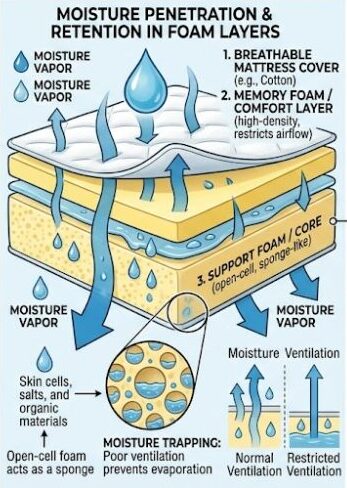
What Does Malaysia’s Humidity Actually Do to Your Mattress?
Malaysia’s tropical climate — with average relative humidity consistently sitting between 70% and 90% — creates near-perfect conditions for mould and dust mite proliferation inside your mattress. Unlike temperate countries where seasonal dryness naturally interrupts microbial growth cycles, Malaysia offers no such relief. The warmth and moisture persist year-round. This is also a primary factor when considering the differences between dust mites and bed bugs in Malaysia.
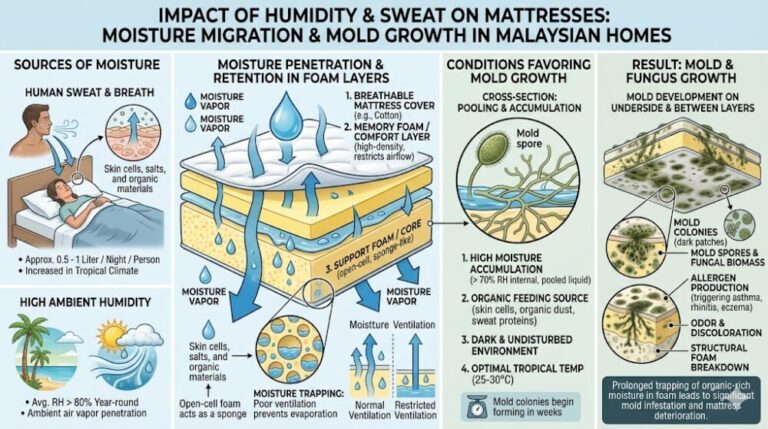
When you sleep, your body releases approximately 200ml of perspiration per night. In a humid environment, this moisture cannot evaporate efficiently. Instead, it is absorbed deep into the mattress core — the foam, spring cavity, or latex layer — where it remains trapped, creating a warm, dark, and damp microhabitat ideal for:
- Mould spores (Cladosporium, Aspergillus, and Stachybotrys species are most common indoors in Malaysia)
- House dust mites (Dermatophagoides pteronyssinus), which thrive at humidity above 65%
- Bacteria from dead skin cells and sweat residue
Key Fact: A single mattress can harbour up to 10 million dust mites under typical Malaysian household conditions.
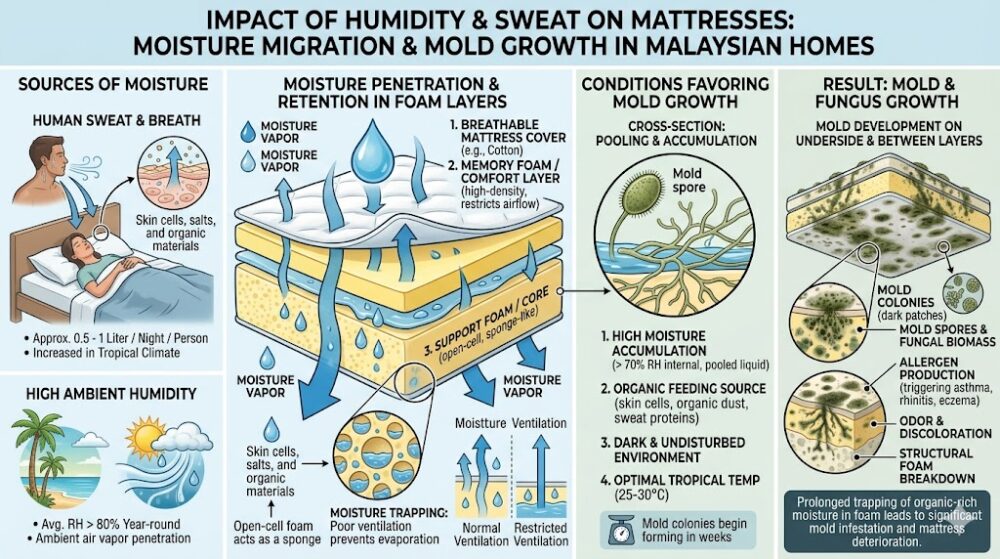 Cross-section showing how perspiration and ambient humidity penetrate mattress layers in Malaysia’s year-round tropical climate.
How to Tell If Your Mattress Has Mould: Early Warning Signs in Malaysia
Mould in a Malaysian mattress is frequently not visible on the surface. By the time surface staining appears, the internal contamination is already extensive. Identify the problem early by looking for these indicators:
- A persistent musty or “damp cloth” odour that does not clear after airing the room
- A smell that intensifies after rain or on high-humidity days (common during the Southwest Monsoon, May–September, and Northeast Monsoon, November–March)
- Yellow or brown staining on the mattress fabric, particularly around sides or seams
- Dark grey or greenish speckled patches — visible mould colony growth
- Fabric pilling or degradation in areas of recurring moisture
- Waking up with unexplained sneezing, runny nose, or itchy eyes
- Aggravated asthma or rhinitis that improves when away from home
- Skin rashes or eczema flare-ups with no clear dietary cause
Malaysian Context: Asthma affects approximately 12–14% of Malaysian children, and indoor allergens — primarily dust mites and mould — are the leading trigger according to the Malaysian Society of Allergy and Immunology (MSAI). If your child has a persistent cough or wheeze, the mattress should be considered a primary suspect.
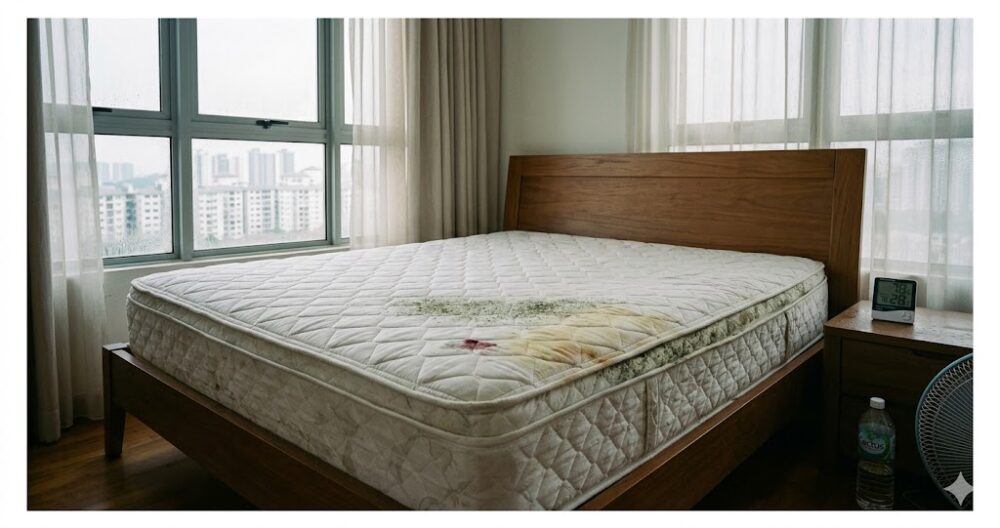 Early mould staining on mattress fabric — by this stage, internal colony growth has typically been underway for weeks.
Which Malaysian Homes Are at the Highest Risk?
Not all properties carry the same mould risk. Certain building types and habits accelerate mattress contamination significantly.
High-Risk Living Situations
| Risk Factor | Why It Matters |
|---|---|
| Low-floor condominiums (below Level 5) | Poor air circulation and proximity to ground moisture; common in older Klang Valley and Penang high-rises |
| Terrace houses with poor cross-ventilation | Standard in older housing estates (e.g., Petaling Jaya SS2, Cheras, Ampang); heat and moisture accumulate in bedrooms |
| Homes without air-conditioning | Daytime temperatures of 32–35°C combined with high RH create constant mould-conducive conditions |
| Mattresses placed directly on the floor | Zero airflow beneath the mattress; moisture has nowhere to escape |
| Rooms facing north or in shaded positions | Reduced natural sunlight means less natural UV sterilisation and slower surface drying |
Habits That Make It Worse
How to Prevent Mattress Mould in Malaysia’s Climate: A Practical Protocol
Preventing mould in a Malaysian home requires active management, not passive neglect. The following protocol is graded by effort level.
Daily Habits (5 Minutes or Less)
- Leave your bed unmade for 30 minutes after waking. This allows body heat and moisture to dissipate before sheets trap it.
- Open bedroom windows or run a fan for at least 30 minutes each morning to flush humid air out.
- Rotate sleeping positions to avoid concentrating body moisture in one mattress zone.
Weekly Maintenance
- Strip and air your bedsheet weekly. Wash at 60°C or above — the temperature required to kill dust mite eggs.
- Vacuum the mattress surface using a vacuum with a HEPA filter.
- Wipe mattress sides and seams with white vinegar solution (1:1 with water) — a mild antifungal effective against early-stage mould.
Monthly & Seasonal Actions
- Flip or rotate your mattress every 1–3 months to prevent uneven moisture accumulation.
- Sun your mattress on a dry day (before 10am or after 4pm) — UV light kills surface mould spores.
- Run a dehumidifier targeting indoor RH of 50–55% — the single most effective passive preventive measure.
- Inspect the mattress underside and bed base for mould, particularly after monsoon months.
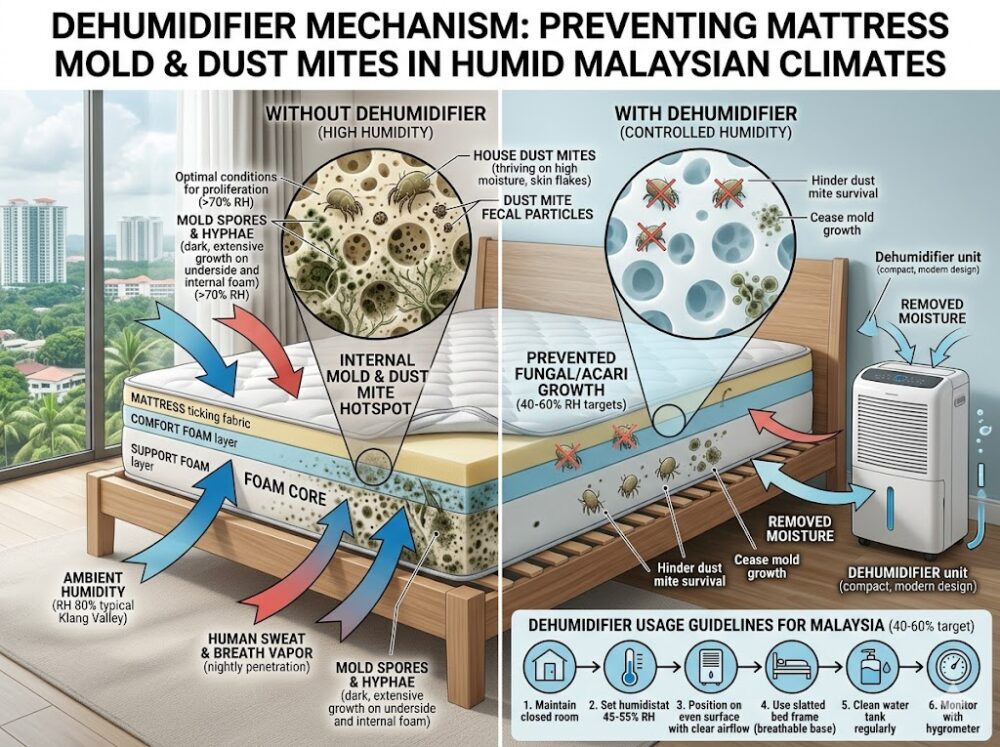 A dehumidifier set to 50–55% RH is the single most effective passive measure for mattress mould prevention in Malaysian bedrooms.
When DIY Is Not Enough: What a Professional Mattress Cleaning Service Does Differently
Surface cleaning — vacuuming, sunning, or wiping — addresses only the top 5–10mm of your mattress. Mould and dust mite colonies that have established themselves in the core layers (50–150mm deep) are inaccessible to household methods.
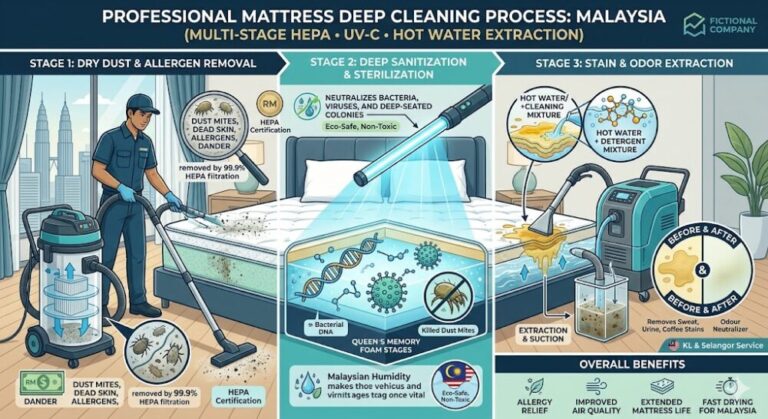
A professional deep cleaning uses hot water extraction (HWE) — the same methodology used in certified hospital linen disinfection — to:
Deep Injection
Hot water and antimicrobial solution are injected under high pressure into mattress layers, breaking up mould mycelium at depth
Industrial Extraction
Dissolved contaminants and 95%+ of moisture are extracted simultaneously using industrial-grade suction equipment
Residual Treatment
Antimicrobial treatment applied to delay re-contamination by 3–6 months after the service
Recommendation: For households with children, elderly members, or anyone diagnosed with asthma or rhinitis in Malaysia, professional cleaning at least once every 6–12 months is the evidence-based standard. Book a Professional Mattress Deep Cleaning Service through Service Pro’s verified partner network — available across Klang Valley, Selangor, Kuala Lumpur, Penang, and Johor Bahru.
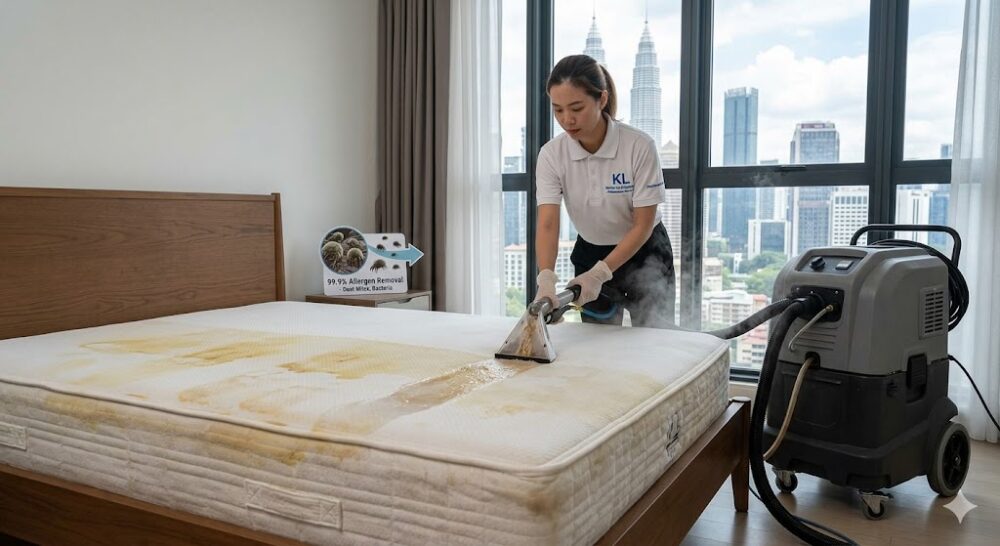 A certified technician performing hot water extraction on a mattress — the only method that reaches deep-layer mould colonies.
How Often Should You Replace a Mould-Affected Mattress in Malaysia?
Not every mould-affected mattress needs immediate replacement. The decision depends on the severity and depth of contamination.
Replace Immediately If:
- Visible mould covers more than 30% of the mattress surface or sides
- The mattress has a persistent musty smell that survives professional cleaning
- The mattress is more than 8–10 years old and showing structural degradation alongside mould
- A household member has a confirmed mould allergy or severe asthma that does not improve after cleaning
Professional Cleaning May Be Sufficient If:
- Mould is confined to surface staining with no internal odour
- The mattress is less than 5 years old with intact structural integrity
- Contamination is detected early before colony penetration into foam layers
Cost Context (Malaysia): A quality replacement mattress in Malaysia typically costs between RM800–RM3,500, depending on size and brand. A professional mattress cleaning service, by comparison, is typically priced between RM80–RM180 per mattress — representing a significantly more economical first intervention.
Frequently Asked Questions About Mattress Mould in Malaysia
Under Malaysian humidity conditions (RH 75%+), mould spores can begin colonising a damp mattress within 24–48 hours. Visible surface growth typically appears within 1–2 weeks of sustained moisture exposure, but internal colony growth may be underway weeks before you see or smell anything.
Yes, particularly for vulnerable groups. Mould spores released into bedroom air are directly inhaled during sleep and are a proven trigger for allergic rhinitis, asthma, and respiratory infections. Children under 12, the elderly, and individuals with existing respiratory conditions face the highest risk. Malaysia’s MOH cites indoor mould as a significant contributor to the country’s high asthma burden.
No. Bleach is not recommended for mattress mould treatment. It damages foam and fabric, leaves a harmful chemical residue, and does not penetrate deep enough to address internal mould colonies. White vinegar (for surface application) or professional antimicrobial treatments are the appropriate interventions.
Professional mattress cleaning in Malaysia is typically priced between RM80–RM150 for a single mattress (single/queen) and RM130–RM180 for a king-size mattress, depending on the service provider, location (KL/PJ tends to be slightly higher), and the condition of the mattress. Some providers offer package discounts for whole-home cleaning.
Air conditioning helps by reducing indoor humidity and temperature, both of which inhibit mould growth. However, AC alone is not sufficient if the mattress is already colonised, or if the AC unit itself has mould in its filters (a common issue in Malaysia). Combine AC use with regular mattress maintenance and a dehumidifier set to 50–55% RH for optimal results.
The most reliable approach is a skin prick test or specific IgE blood test ordered by an allergist or respiratory paediatrician (available at most Malaysian government hospitals under KKM and at private clinics). Practically, if your child’s symptoms consistently improve during school holidays spent elsewhere (e.g., kampung, hotel), the home environment — and particularly the mattress — is strongly implicated.
Latex mattresses (natural latex in particular) have inherent antimicrobial properties and resist mould and dust mite colonisation better than memory foam or spring mattresses. For any mattress type, the critical factor is pairing it with a waterproof breathable protector and maintaining regular professional cleaning, rather than relying solely on mattress material.
The evidence-based recommendation for Malaysian households is every 6 months for homes with children, pets, allergy sufferers, or older buildings with poor ventilation — and a minimum of once per year for all other households. This frequency accounts for Malaysia’s non-stop humid climate, which does not offer the seasonal reprieve that allows longer intervals in temperate countries.
📅 Book Your Mattress Deep Cleaning in the Klang Valley
Whether your mattress shows early warning signs or has not been professionally cleaned in over a year, our verified hygiene specialists are ready. Accurate assessment and hospital-grade treatment from the very first session.
Tap your location to open WhatsApp — no forms, no waiting.
Hygiene Questions. 0
Questions from homeowners within and beyond Klang Valley, answered by our hygiene specialists.
─── MORE HYGIENE INSIGHTS
Keep Reading
Continue building your knowledge on maintaining a hygienically clean home in Malaysia’s tropical climate.