Frozen Shoulder Treatment in Malaysia: Causes, Stages, and When to See a Physiotherapist
Frozen shoulder — clinically termed adhesive capsulitis — is one of the most debilitating musculoskeletal conditions affecting Malaysian adults. Left unmanaged, it can immobilise the joint for up to two to three years.
ServicePro.my Healthcare Insights • Physiotherapy & Rehab • 12 Min Read
Book Clinical Shoulder Assessment in Sungai Buloh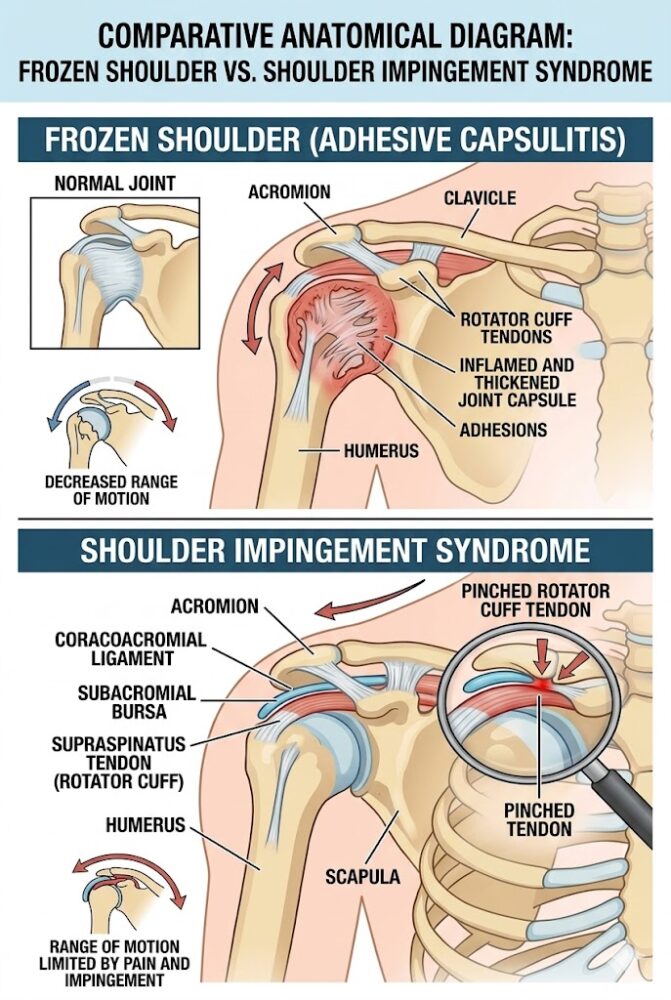
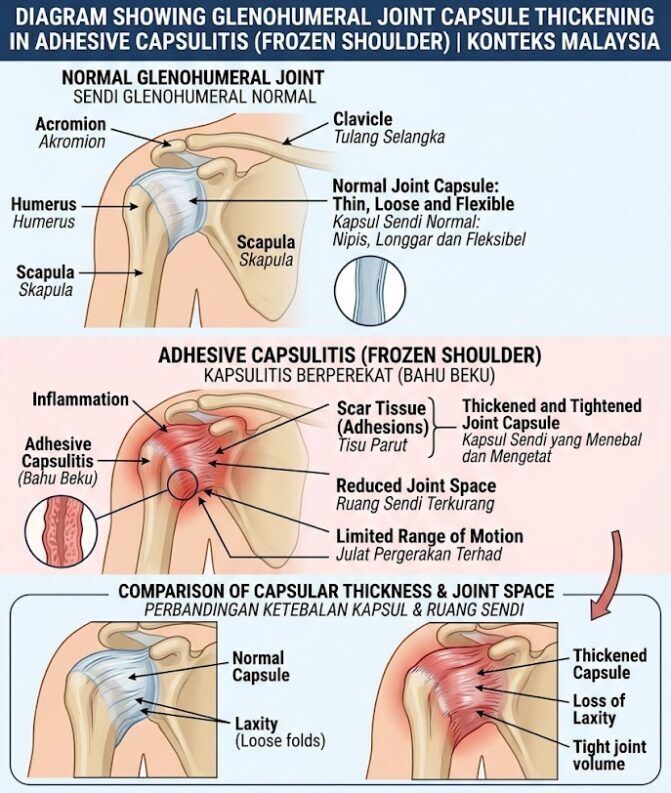
Frozen shoulder (adhesive capsulitis) is a pathological thickening and contracture of the glenohumeral joint capsule, resulting in progressive pain and global range-of-motion loss that follows a predictable three-stage cycle. In Malaysia, it is disproportionately prevalent for several reasons tied to both lifestyle and systemic health patterns.
What Is Frozen Shoulder and Why Is It Common in Malaysia?
High-risk populations in the Malaysian context:
Type 2 Diabetics
Malaysia has one of Southeast Asia’s highest diabetes prevalence rates (~18.3% of adults, per NHMS 2019). Diabetics are 2–4× more likely to develop adhesive capsulitis, a major risk factor highlighted by the Ministry of Health Malaysia (MyHealth) clinical guidelines.
Post-Surgical Immobilisation
Patients recovering from mastectomy, cardiac bypass, or rotator cuff repair who avoid shoulder movement develop capsular adhesions rapidly.
Klang Valley Office Workers
Prolonged forward-head posture and static shoulder loading from laptop and desktop work accelerates peri-capsular inflammation.
Thyroid Disorder Patients
Hypothyroidism is independently associated with frozen shoulder development, and Malaysia’s high iodine-deficiency burden in certain interior regions contributes.
Post-COVID Sequelae
Clinical observations from rehabilitation centres in Kuala Lumpur, Petaling Jaya, and Subang Jaya have noted a post-pandemic uptick in frozen shoulder presentations, potentially linked to prolonged bedrest and inflammatory cytokine cascades.
What Are the Three Stages of Frozen Shoulder?
Frozen shoulder progresses through three distinct clinical stages — freezing, frozen, and thawing — each requiring a different physiotherapy strategy. Understanding which stage you are in is the first step toward a targeted treatment plan.
Freezing Phase (Painful Stage)
Duration: 2 to 9 Months- Primary symptom: Diffuse, aching shoulder pain that worsens at night and disrupts sleep
- ROM loss: Gradual, predominantly external rotation
- Pathology: Active synovitis; the joint capsule is inflamed but not yet fibrosed
- Malaysian patient concern: Pain is frequently misattributed to rotator cuff strain or “sakit bahu biasa,” delaying proper diagnosis
- Treatment priority: Pain modulation, anti-inflammatory modalities, and gentle active-assisted range-of-motion (AAROM)
Frozen Phase (Stiffness Stage)
Duration: 4 to 12 Months- Primary symptom: Pain stabilises but severe stiffness dominates; loss of ≥50% of passive range in all planes
- Pathology: Dense fibrous adhesions obliterate the inferior capsular recess (the axillary pouch); synovial fluid volume is markedly reduced
- Activity impact: Difficulty reaching overhead, behind the back (fastening a bra strap, tucking in a shirt), or across the body
- Treatment priority: Intensive manual therapy, joint mobilisation (Maitland Grades III–IV), and stretching protocols
Thawing Phase (Recovery Stage)
Duration: 5 to 26 Months- Primary symptom: Gradual, spontaneous return of range of motion; pain substantially reduced
- Pathology: Fibrous capsule begins to remodel; adhesions loosen
- Treatment priority: Progressive strengthening, neuromuscular re-education, and functional restoration of full glenohumeral-scapulothoracic rhythm
| Stage | Duration | Pain Level | Stiffness Level | Primary Goal |
|---|---|---|---|---|
| Freezing | 2–9 months | Severe (7–9/10) | Mild–Moderate | Pain reduction |
| Frozen | 4–12 months | Moderate (4–6/10) | Severe | Restore ROM |
| Thawing | 5–26 months | Mild (1–3/10) | Reducing | Strength & function |
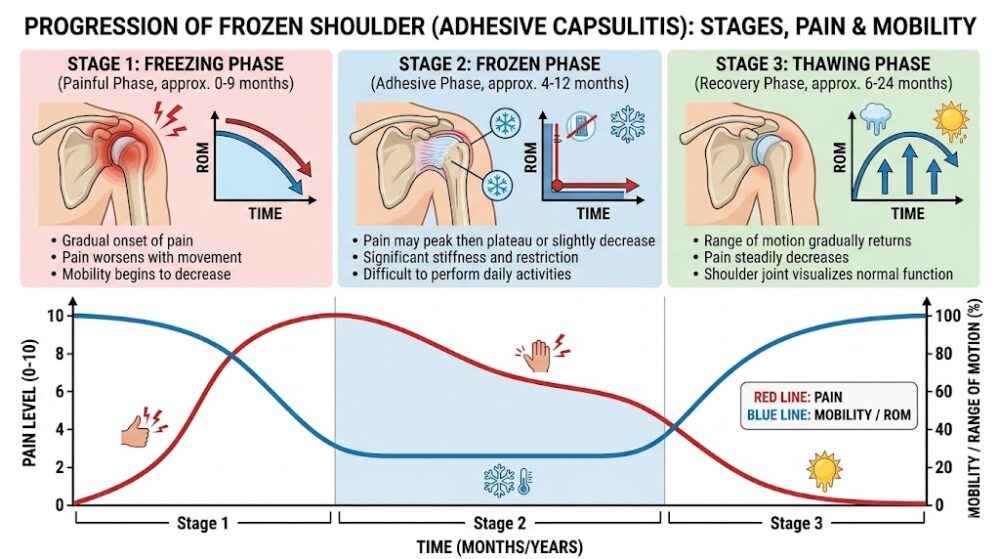 The three clinical stages of frozen shoulder — each requiring a distinct physiotherapy approach and realistic timeline expectation.
How Is Frozen Shoulder Diagnosed in Malaysia?
Frozen shoulder is a clinical diagnosis confirmed by physical examination, with imaging used to exclude competing pathology rather than confirm adhesive capsulitis directly.
Diagnostic criteria used in Malaysian clinical settings:
History
Insidious onset of shoulder pain ± preceding trauma, illness, or immobilisation period.
Active ROM Assessment
Global restriction across all planes — flexion, abduction, internal and external rotation — with external rotation most severely limited.
Passive ROM Assessment
Confirms restriction is articular (capsular), not purely muscular. The hallmark is a capsular end-feel — firm, non-yielding resistance at end range.
Special Tests
Empty Can and Hawkins-Kennedy tests are performed to rule out concurrent pathology, helping you distinguish whether your sakit bahu is a frozen shoulder or shoulder impingement.
Imaging (Supportive)
X-ray rules out osteoarthritis; Ultrasound can visualise inferior capsular thickening; MRI is the gold standard, available at University Malaya Medical Centre, Hospital KL, and Sunway Medical Centre.
In public hospitals: Referrals for physiotherapy are typically initiated by orthopaedic or general practitioners under the Ministry of Health (MOH) outpatient pathway. Wait times can range from 4 to 12 weeks, during which time the condition may progress from Stage 1 to Stage 2.
For faster access: Private physiotherapy rehabilitation centres — including the ServicePro.my-listed clinic in Sungai Buloh — offer direct-access assessments without requiring a GP referral, meaning you can begin evidence-based treatment within days, not months.
What Are the Physiotherapy Treatment Options for Frozen Shoulder in Malaysia?
Evidence-based physiotherapy remains the primary and most effective long-term treatment for frozen shoulder across all three stages. The goal is threefold: reduce pain, restore glenohumeral range of motion, and re-establish normal scapulohumeral rhythm.
Manual Therapy and Joint Mobilisation
Maitland Grade III and IV joint mobilisations are applied to the glenohumeral joint to mechanically stretch the contracted capsule and break down fibrous adhesions. Techniques include:
- Inferior glide mobilisations — targeting the obliterated axillary pouch, the primary site of capsular fibrosis
- Posterior capsule stretching — addressing the posterior shoulder tightness that accompanies capsular contracture
- Scapular mobilisation — correcting compensatory scapular elevation that develops as patients guard the painful shoulder
Therapeutic Ultrasound and Electrotherapy
- Therapeutic ultrasound (1–3 MHz): Delivers deep thermal and non-thermal effects to increase collagen extensibility and promote capsular remodelling; commonly used in Malaysian private physiotherapy clinics as a pre-mobilisation modality
- Transcutaneous Electrical Nerve Stimulation (TENS): Used primarily in the Stage 1 (Freezing) phase for pain gate modulation
- Interferential Therapy (IFT): Targets deeper peri-capsular tissue for analgesia; widely available across Selangor and KL rehab centres
- Low-Level Laser Therapy (LLLT): Emerging evidence supports its use in reducing synovitis in early-stage adhesive capsulitis; available at select Petaling Jaya and Mont Kiara physiotherapy clinics
Therapeutic Exercise Protocols
Structured exercise is non-negotiable for recovery and must be correctly staged to avoid exacerbating inflammation in the Freezing phase:
Gentle AAROM Exercises
- Pendulum (Codman’s) exercises — gravity-assisted distraction
- Supine passive external rotation with a cane
- Wall walking (finger ladder) — flexion only, within pain tolerance
Capsular Stretching Protocols
- Sleeper stretch — posterior capsule elongation
- Cross-body adduction stretch
- Behind-the-back internal rotation towel stretch
- Passive overhead stretching with physiotherapist-guided overpressure
Progressive Strengthening
- Rotator cuff strengthening: Theraband external/internal rotation
- Scapular stabiliser strengthening: Serratus anterior, lower trapezius
- Closed-chain weight-bearing exercises for glenohumeral proprioception
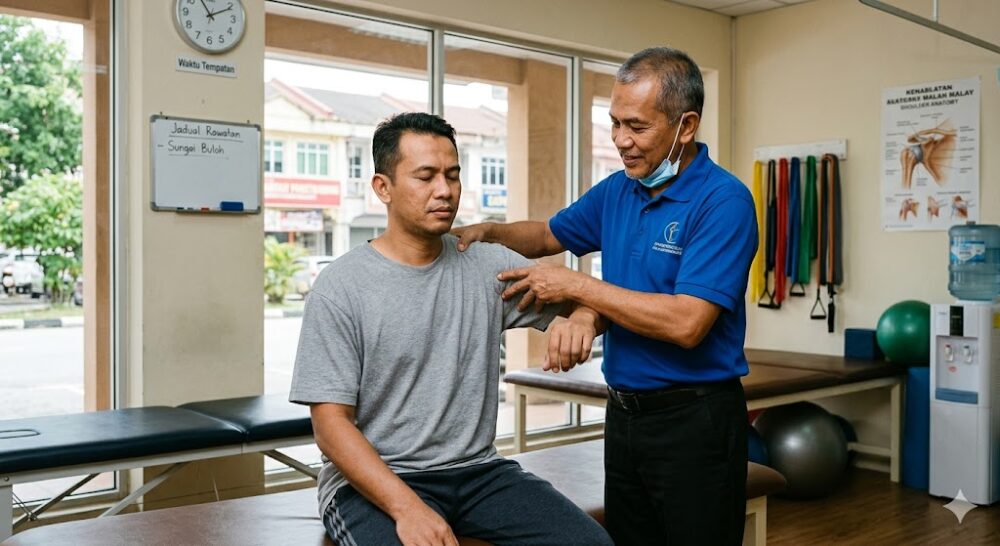 Maitland joint mobilisation is a cornerstone of frozen shoulder physiotherapy — performed by registered physiotherapists at clinics across the Klang Valley.
Advanced Interventional Options
Hydrodilatation (Arthrographic Distension)
For Stage 2 patients unresponsive after 3–6 months of physiotherapy. A large volume of saline, corticosteroid, and local anaesthetic is injected into the glenohumeral joint to physically distend the contracted capsule. Available at Pantai Hospital, Sunway Medical Centre, and KPJ Specialist Hospitals. Best outcomes when combined with immediate post-procedure physiotherapy within 24–48 hours.
Corticosteroid Injections
Most effective in the Freezing stage where active synovitis is driving pain. Administered by orthopaedic surgeons or sports medicine physicians. Suppresses the inflammatory cascade; effect is analgesic rather than curative. Diabetic patients should monitor blood glucose closely for 3–7 days post-injection.
Manipulation Under Anaesthesia (MUA)
For severely refractory Stage 2 cases. Involves forceful passive stretching under general or regional anaesthesia to mechanically lyse adhesions. Performed in tertiary hospital settings in Malaysia. Reserved for cases where 6+ months of conservative management has failed.
Arthroscopic Capsular Release
Surgical option of last resort — direct visualisation and incision of contracted capsular tissue. Indicated when all conservative measures have failed after 12+ months. Available at major private hospitals in KL and Johor Bahru. Typical total cost (private): RM 8,000 to RM 18,000 including anaesthesia, hospital stay, and post-operative physiotherapy.
How Long Does Frozen Shoulder Take to Recover With Physiotherapy in Malaysia?
With consistent, evidence-based physiotherapy, most frozen shoulder patients in Malaysia see meaningful improvement within 8 to 16 weeks of treatment, though full recovery can take 12 to 24 months depending on stage at presentation and individual comorbidities.
Key factors that influence recovery time in the Malaysian context:
| Factor | Effect on Recovery |
|---|---|
| Uncontrolled Type 2 Diabetes (HbA1c >8%) | Significantly prolonged recovery; capsular remodelling impaired by advanced glycation end-products |
| Stage at first treatment | Stage 1 presentation → faster resolution vs. Stage 2 at first contact |
| Compliance with home exercise programme | 20–30% faster ROM recovery in compliant patients |
| Frequency of physiotherapy sessions | 2–3× per week produces better outcomes than 1× per week |
| BMI >27.5 (Asian-adjusted overweight threshold) | Contributes to systemic inflammation; moderately associated with slower recovery |
| Co-existing rotator cuff pathology | Complicates prognosis; requires concurrent treatment |
Practical expectation-setting for Malaysian patients:
Pain during rest and sleep should begin to decrease
Measurable improvement in passive external rotation (the last ROM to return)
Most daily activities (reaching overhead, driving, dressing) should be possible
Near-complete functional restoration in most patients without comorbidities
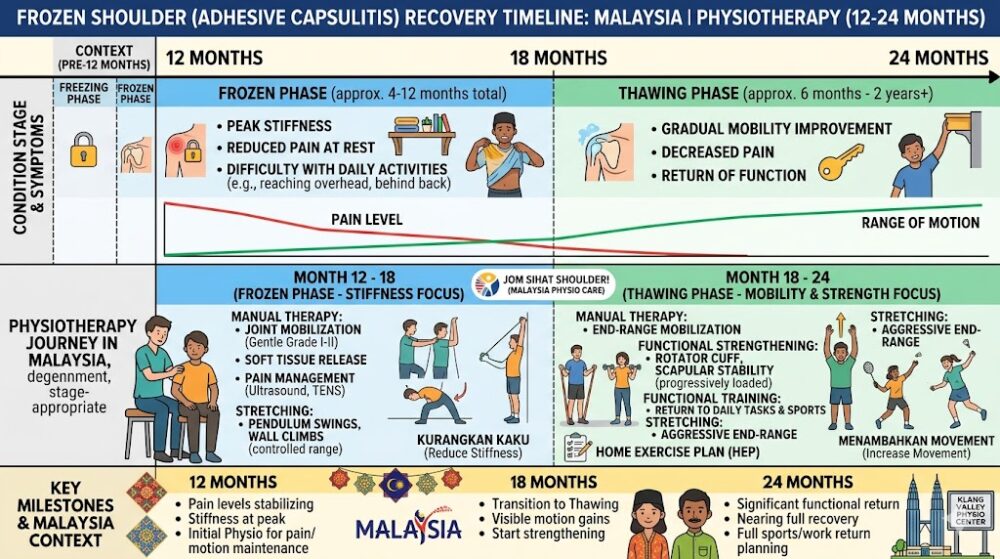 Recovery milestones for frozen shoulder physiotherapy in Malaysia — realistic timelines differ based on the stage at first treatment and individual comorbidities.
What Is the Cost of Frozen Shoulder Physiotherapy in Malaysia?
Physiotherapy for frozen shoulder in Malaysia ranges from RM 60 to RM 250 per session depending on the setting, modalities used, and geographic location.
Typical pricing tiers (2024–2025 benchmarks):
| Setting | Per Session Cost | Notes |
|---|---|---|
| Government Hospital (KKM) | RM 1–5 (subsidised) | Long wait times; limited session frequency |
| Community Health Clinic (Klinik Kesihatan) | RM 1–5 | Basic physiotherapy; restricted modalities |
| Private Standalone Physio Clinic | RM 80–RM 180 | Most common for Klang Valley working adults |
| Private Hospital Physiotherapy Department | RM 150–RM 250 | Includes specialist oversight; full modality access |
| Home Visit Physiotherapy | RM 180–RM 350 | Available in KL, Subang Jaya, Petaling Jaya |
Malaysian Insurance Coverage
- Most panel insurance plans (Great Eastern, AIA, Prudential, Allianz, Etiqa) do not include outpatient physiotherapy as a standard benefit without a specific rider
- SOCSO (Pertubuhan Keselamatan Sosial) covers physiotherapy for work-related injuries under the Employment Injury Scheme. Read More
- PERKESO Return to Work Programme includes physiotherapy for eligible claimants following workplace musculoskeletal injuries. Read More
- Patients should check their policy for “outpatient physiotherapy” or “specialist care” riders before assuming coverage
When Should You See a Physiotherapist for Shoulder Pain in Malaysia?
You should see a physiotherapist for shoulder pain if the restriction or pain has persisted for more than two to four weeks without improvement, particularly if night pain is disrupting sleep or if you are unable to perform routine overhead tasks.
Red Flag Signs Requiring Urgent Medical Review (Not Physiotherapy Alone)
Do not self-manage shoulder pain if any of the following are present:
- Sudden, severe shoulder pain with no prior history (possible rotator cuff rupture)
- Pain radiating to the jaw, arm, or chest (possible cardiac origin — seek Emergency Department immediately)
- Unexplained weight loss alongside shoulder pain (possible Pancoast tumour or metastatic disease)
- Fever, redness, and warmth over the joint (possible septic arthritis — medical emergency)
- History of shoulder dislocation with ongoing instability
For progressive, stiffening shoulder pain without these red flags: Begin physiotherapy assessment at a registered centre without delay. The earlier you begin treatment — ideally in the Freezing stage — the significantly better the prognosis.
Book Frozen Shoulder Physiotherapy at ServicePro.my’s Sungai Buloh Rehabilitation Centre
If you or a family member is experiencing progressive shoulder stiffness, sleep-disrupting night pain, or loss of overhead reach that has persisted beyond two weeks, do not wait for the condition to advance to Stage 2.
The centre offers:
Direct-Access Physiotherapy AssessmentsNo GP referral required
Full Modality AvailabilityManual therapy, therapeutic ultrasound, electrotherapy, and structured exercise prescription
Experienced, Registered PhysiotherapistsCompliant with the Physiotherapy Act 2021 (Malaysia) and Malaysian Physiotherapy Association (MPA) standards
Convenient Sungai Buloh LocationAccessible from Kepong, Kota Damansara, Rawang, and Kuala Lumpur via the LKSA highway and MRT Sungai Buloh–Kajang line
Frequently Asked Questions About Frozen Shoulder Treatment in Malaysia
No — frozen shoulder (adhesive capsulitis) and rotator cuff tears are entirely different conditions, though they share overlapping symptoms. Frozen shoulder causes global restriction of all shoulder movements due to capsular fibrosis, while rotator cuff tears typically produce specific weakness in particular movement planes (elevation, external rotation) with less profound stiffness. An MRI or ultrasound, combined with a clinical examination, is necessary to distinguish between the two. Both conditions can co-exist in the same shoulder.
Frozen shoulder may slowly self-resolve over 2–3 years in some patients, but spontaneous recovery often leaves residual stiffness and pain in up to 40% of cases. In the Malaysian context, where a large proportion of sufferers are diabetic — a population with severely impaired natural recovery — waiting for spontaneous resolution is not clinically advisable. Evidence consistently shows that early physiotherapy intervention shortens the total disease duration and produces better functional outcomes than watchful waiting.
Yes, significantly. Diabetic patients are 2–4 times more likely to develop adhesive capsulitis compared to non-diabetics, and their condition tends to be more severe, bilateral (affecting both shoulders), and slower to resolve. Given Malaysia’s high diabetes burden — the highest in ASEAN — diabetics presenting with shoulder pain should be proactively screened for early capsular contracture. Optimal blood glucose control (target HbA1c <7%) is an important adjunct to physiotherapy treatment.
Safe home exercises depend on your current stage. In the Freezing stage, limit activity to gentle Codman’s pendulum exercises (letting the arm hang freely and making small circles using trunk sway, not shoulder muscle activation) and supine passive external rotation using a cane or walking stick. Avoid painful end-range stretching during this stage as it exacerbates synovitis. In the Frozen stage, your physiotherapist will prescribe a structured home stretching programme including sleeper stretches and cross-body adduction. Never attempt to “push through” sharp pain in any stage.
Most Malaysian physiotherapy clinics recommend an initial course of 12 to 20 sessions over 6–10 weeks, assessed at the midpoint for progress. Patients in the Freezing stage may require fewer sessions focused on pain management, while Stage 2 patients typically need a longer course of intensive mobilisation. Your physiotherapist will re-evaluate ROM and pain scores at each session and adjust the frequency and modalities accordingly. Attempting to manage frozen shoulder with fewer than 2 sessions per week in the Frozen stage is associated with slower recovery.
Approximately 6–17% of frozen shoulder patients develop the condition in the contralateral (opposite) shoulder, typically within 5 years of the first episode. The risk is substantially higher in diabetic patients. Notably, the second shoulder episode is often less severe and shorter in duration, possibly due to residual immunity or the patient’s earlier recognition and treatment-seeking behaviour.
Shoulder impingement syndrome (subacromial impingement) refers to mechanical compression of the rotator cuff tendons and subacromial bursa beneath the acromion, producing a painful arc of abduction (typically between 60°–120°). Frozen shoulder involves the entire joint capsule and produces painful, globally restricted movement in all planes with no pain-free arc. Impingement is more common in younger, active individuals and overhead workers; frozen shoulder is more common in middle-aged adults, diabetics, and those following periods of shoulder immobilisation.
A competent GP can make a provisional clinical diagnosis of frozen shoulder based on history and physical examination. However, because shoulder pathology is complex and several conditions mimic frozen shoulder (including rotator cuff tears, glenohumeral osteoarthritis, and cervical radiculopathy), a referral to an orthopaedic surgeon, sports medicine physician, or a directly-accessible registered physiotherapist for a detailed assessment is recommended — particularly before commencing any injection-based treatment. Registered physiotherapists in Malaysia can also perform screening assessments and refer onward if red flags are identified.
Book Your Frozen Shoulder Physiotherapy Assessment in the Klang Valley
Whether you are in the Freezing, Frozen, or Thawing stage, the right clinical assessment changes everything. Our vetted physiotherapy partners across Sungai Buloh and the Klang Valley provide accurate staging and condition-specific rehabilitation from the very first session.
Tap your location to open WhatsApp — no forms, no waiting.
📍 Local Note:
This article is produced by the ServicePro.my Healthcare Editorial Team for informational purposes only. It does not constitute medical advice. Always consult a licensed healthcare professional — including a registered physiotherapist, orthopaedic surgeon, or GP — for diagnosis and individualised treatment planning.
Healthcare Questions. 0
Questions from our followers and readers within and beyond Klang Valley, answered by our healthcare specialists.
─── MORE HEALTHCARE INSIGHTS
Keep Reading
Continue building your knowledge on maintaining a healthy community in Malaysia.